Why Push Notifications Are So Addictive (and How to Take Back Control)

Ever felt that irresistible urge to check your phone the second a notification pops up? You’re not alone.
Understand

Dec 15, 2025

6 min

From the gentle ping of a message to that tiny red badge screaming for attention, push notifications are designed to hijack your focus—and your brain chemistry. But where did they come from? Why are they so addictive? And most importantly, how can we escape their grip without going off the grid?

Back to the Origins

A “push” notification (the kind that pops up on your phone even when the app isn’t open) is often associated with the smartphone era. But this channel actually originated with BlackBerry (RIP 🪦) back in the early 2000s.

Before that, if you wanted to check an email, your device had to send a request to the server to see if you had any new messages. It took time—you had to go fishing for the info.

Push notifications flipped that model: now, messages are delivered the moment an event happens on the server. In real time. BlackBerry did it via a little tab that appeared on the screen.
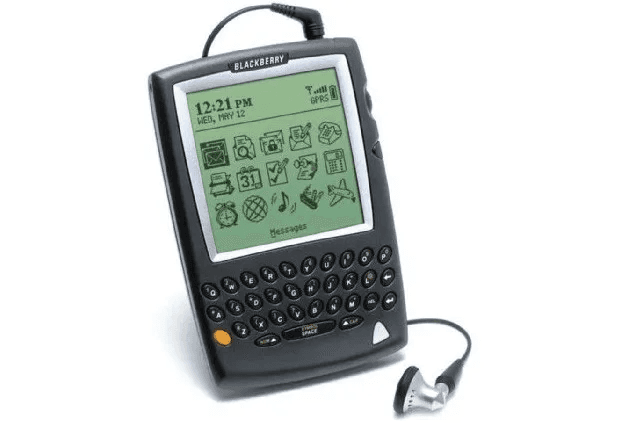
BlackBerry, 2003

However, push notifications really went mainstream with the launch of the Apple Push Notification Service in 2009. Thanks, Steve Jobs.

Google followed suit a year later and introduced rich notifications in 2013—complete with action buttons and images. Over time, push notifications have become the default way to interact with the digital world. They’ve become the cue that draws us into an app, prompts us to reply to a message, read an article, or play a game.

They’re everywhere.

Today, teenagers receive an average of 237 push notifications a day. In the most extreme cases, the number climbs as high as 5,000. Looking at the general population, a 2019 study showed we receive an average of 65 to 80 push notifications a day.
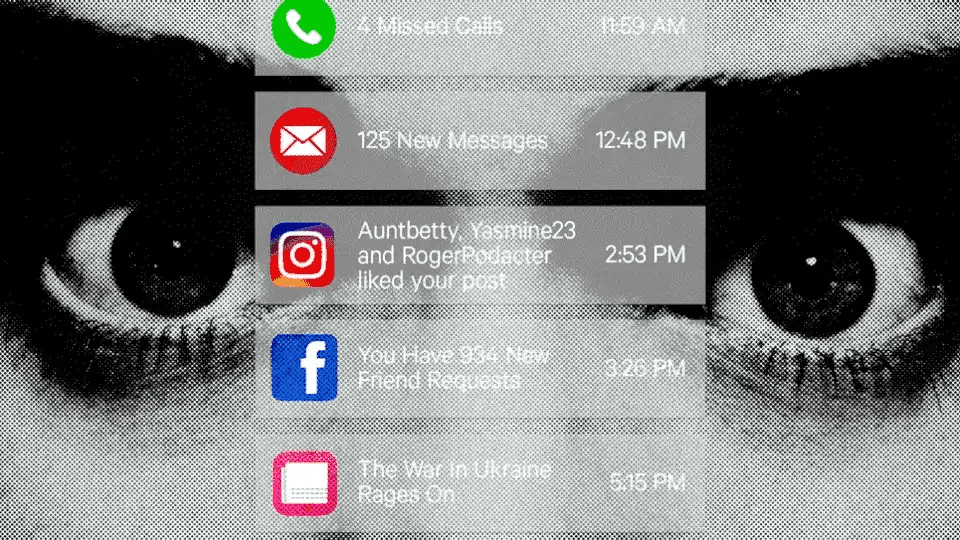
Source: The Atlantic

What’s pitched as a useful and efficient feature to keep us informed often turns out to be a Pavlovian interruption—something that triggers us, making us drop everything and react. Why are they so effective at grabbing our attention? Why is it so hard to resist them?

The Brain’s 911

Back in hunter-gatherer days, you had to be on high alert whenever an external stimulus appeared. Why? Because it was often a matter of life or death.

A sudden sound could mean a predator was nearby—or that there was food around. Our brains evolved in this context, treating all stimuli as top priority. Something urgent. Something you needed to act on immediately. The flaw is obvious: our brains haven’t changed. They’re still primitive. As I write this, I’m reminded of a quote from Edward O. Wilson I’ve already shared with you:

“The real problem of humanity is the following: we have Paleolithic emotions, medieval institutions, and godlike technology.”

Every notification is thus interpreted by the brain as urgent and important. Even when there’s no actual danger. We’re wired to go on high alert. A mental 911.

What actually happens?

When a notification arrives, the prefrontal cortexresponsible for reasoning and logic—takes a little break. And the part of the brain that handles emotion and primitive instincts—the limbic system—takes over. That’s why it’s so hard to resist. Notifications tap into deeply ingrained, hardwired behaviors. Even I—who know all of this—struggle to resist clicking on the red dot in the top right corner of LinkedIn when I see it.

The Need for Completion

When we get a notification, it’s hard to keep going with what we were doing. We want to see what it’s about. One major reason behind this feeling is our need for completion.

It’s known as the Zeigarnik Effect: unfinished tasks create tension in the brain until they’re resolved.

Bluma Zeigarnik – Wikipedia, The psychologist behind the discovery

Every notification adds a new item to our mental to-do list.

This makes it nearly impossible to stay fully focused: that notification continues to occupy mental space until it’s dealt with. We feel uneasy until then. The brain develops an obsession. A notifixation. A kind of mental “tension” holds space for that new task, keeping it accessible. We stay on edge.

To simplify: a residue of attention remains, making it physiologically harder to refocus 100% on what we were doing before.

From the gentle ping of a message to that tiny red badge screaming for attention, push notifications are designed to hijack your focus—and your brain chemistry. But where did they come from? Why are they so addictive? And most importantly, how can we escape their grip without going off the grid?

Back to the Origins

A “push” notification (the kind that pops up on your phone even when the app isn’t open) is often associated with the smartphone era. But this channel actually originated with BlackBerry (RIP 🪦) back in the early 2000s.

Before that, if you wanted to check an email, your device had to send a request to the server to see if you had any new messages. It took time—you had to go fishing for the info.

Push notifications flipped that model: now, messages are delivered the moment an event happens on the server. In real time. BlackBerry did it via a little tab that appeared on the screen.

BlackBerry, 2003

However, push notifications really went mainstream with the launch of the Apple Push Notification Service in 2009. Thanks, Steve Jobs.

Google followed suit a year later and introduced rich notifications in 2013—complete with action buttons and images. Over time, push notifications have become the default way to interact with the digital world. They’ve become the cue that draws us into an app, prompts us to reply to a message, read an article, or play a game.

They’re everywhere.

Today, teenagers receive an average of 237 push notifications a day. In the most extreme cases, the number climbs as high as 5,000. Looking at the general population, a 2019 study showed we receive an average of 65 to 80 push notifications a day.

Source: The Atlantic

What’s pitched as a useful and efficient feature to keep us informed often turns out to be a Pavlovian interruption—something that triggers us, making us drop everything and react. Why are they so effective at grabbing our attention? Why is it so hard to resist them?

The Brain’s 911

Back in hunter-gatherer days, you had to be on high alert whenever an external stimulus appeared. Why? Because it was often a matter of life or death.

A sudden sound could mean a predator was nearby—or that there was food around. Our brains evolved in this context, treating all stimuli as top priority. Something urgent. Something you needed to act on immediately. The flaw is obvious: our brains haven’t changed. They’re still primitive. As I write this, I’m reminded of a quote from Edward O. Wilson I’ve already shared with you:

“The real problem of humanity is the following: we have Paleolithic emotions, medieval institutions, and godlike technology.”

Every notification is thus interpreted by the brain as urgent and important. Even when there’s no actual danger. We’re wired to go on high alert. A mental 911.

What actually happens?

When a notification arrives, the prefrontal cortexresponsible for reasoning and logic—takes a little break. And the part of the brain that handles emotion and primitive instincts—the limbic system—takes over. That’s why it’s so hard to resist. Notifications tap into deeply ingrained, hardwired behaviors. Even I—who know all of this—struggle to resist clicking on the red dot in the top right corner of LinkedIn when I see it.

The Need for Completion

When we get a notification, it’s hard to keep going with what we were doing. We want to see what it’s about. One major reason behind this feeling is our need for completion.

It’s known as the Zeigarnik Effect: unfinished tasks create tension in the brain until they’re resolved.

Bluma Zeigarnik – Wikipedia, The psychologist behind the discovery

Every notification adds a new item to our mental to-do list.

This makes it nearly impossible to stay fully focused: that notification continues to occupy mental space until it’s dealt with. We feel uneasy until then. The brain develops an obsession. A notifixation. A kind of mental “tension” holds space for that new task, keeping it accessible. We stay on edge.

To simplify: a residue of attention remains, making it physiologically harder to refocus 100% on what we were doing before.

From the gentle ping of a message to that tiny red badge screaming for attention, push notifications are designed to hijack your focus—and your brain chemistry. But where did they come from? Why are they so addictive? And most importantly, how can we escape their grip without going off the grid?

Back to the Origins

A “push” notification (the kind that pops up on your phone even when the app isn’t open) is often associated with the smartphone era. But this channel actually originated with BlackBerry (RIP 🪦) back in the early 2000s.

Before that, if you wanted to check an email, your device had to send a request to the server to see if you had any new messages. It took time—you had to go fishing for the info.

Push notifications flipped that model: now, messages are delivered the moment an event happens on the server. In real time. BlackBerry did it via a little tab that appeared on the screen.

BlackBerry, 2003

However, push notifications really went mainstream with the launch of the Apple Push Notification Service in 2009. Thanks, Steve Jobs.

Google followed suit a year later and introduced rich notifications in 2013—complete with action buttons and images. Over time, push notifications have become the default way to interact with the digital world. They’ve become the cue that draws us into an app, prompts us to reply to a message, read an article, or play a game.

They’re everywhere.

Today, teenagers receive an average of 237 push notifications a day. In the most extreme cases, the number climbs as high as 5,000. Looking at the general population, a 2019 study showed we receive an average of 65 to 80 push notifications a day.

Source: The Atlantic

What’s pitched as a useful and efficient feature to keep us informed often turns out to be a Pavlovian interruption—something that triggers us, making us drop everything and react. Why are they so effective at grabbing our attention? Why is it so hard to resist them?

The Brain’s 911

Back in hunter-gatherer days, you had to be on high alert whenever an external stimulus appeared. Why? Because it was often a matter of life or death.

A sudden sound could mean a predator was nearby—or that there was food around. Our brains evolved in this context, treating all stimuli as top priority. Something urgent. Something you needed to act on immediately. The flaw is obvious: our brains haven’t changed. They’re still primitive. As I write this, I’m reminded of a quote from Edward O. Wilson I’ve already shared with you:

“The real problem of humanity is the following: we have Paleolithic emotions, medieval institutions, and godlike technology.”

Every notification is thus interpreted by the brain as urgent and important. Even when there’s no actual danger. We’re wired to go on high alert. A mental 911.

What actually happens?

When a notification arrives, the prefrontal cortexresponsible for reasoning and logic—takes a little break. And the part of the brain that handles emotion and primitive instincts—the limbic system—takes over. That’s why it’s so hard to resist. Notifications tap into deeply ingrained, hardwired behaviors. Even I—who know all of this—struggle to resist clicking on the red dot in the top right corner of LinkedIn when I see it.

The Need for Completion

When we get a notification, it’s hard to keep going with what we were doing. We want to see what it’s about. One major reason behind this feeling is our need for completion.

It’s known as the Zeigarnik Effect: unfinished tasks create tension in the brain until they’re resolved.

Bluma Zeigarnik – Wikipedia, The psychologist behind the discovery

Every notification adds a new item to our mental to-do list.

This makes it nearly impossible to stay fully focused: that notification continues to occupy mental space until it’s dealt with. We feel uneasy until then. The brain develops an obsession. A notifixation. A kind of mental “tension” holds space for that new task, keeping it accessible. We stay on edge.

To simplify: a residue of attention remains, making it physiologically harder to refocus 100% on what we were doing before.

Your phone, your rules. Block on command and own your time.

Your phone, your rules. Block on command and own your time.

Your phone, your rules. Block on command and own your time.

The Vicious Cycle of Distraction

What’s waiting behind that little red badge?

When we receive a notification, the brain releases a little hit of dopamine in anticipation. Just like a slot machine. It’s the uncertain possibility of something rewarding that drives us. This is called variable reinforcement.

Notifications have hijacked our brain’s reward system—the root of all compulsive behaviors.
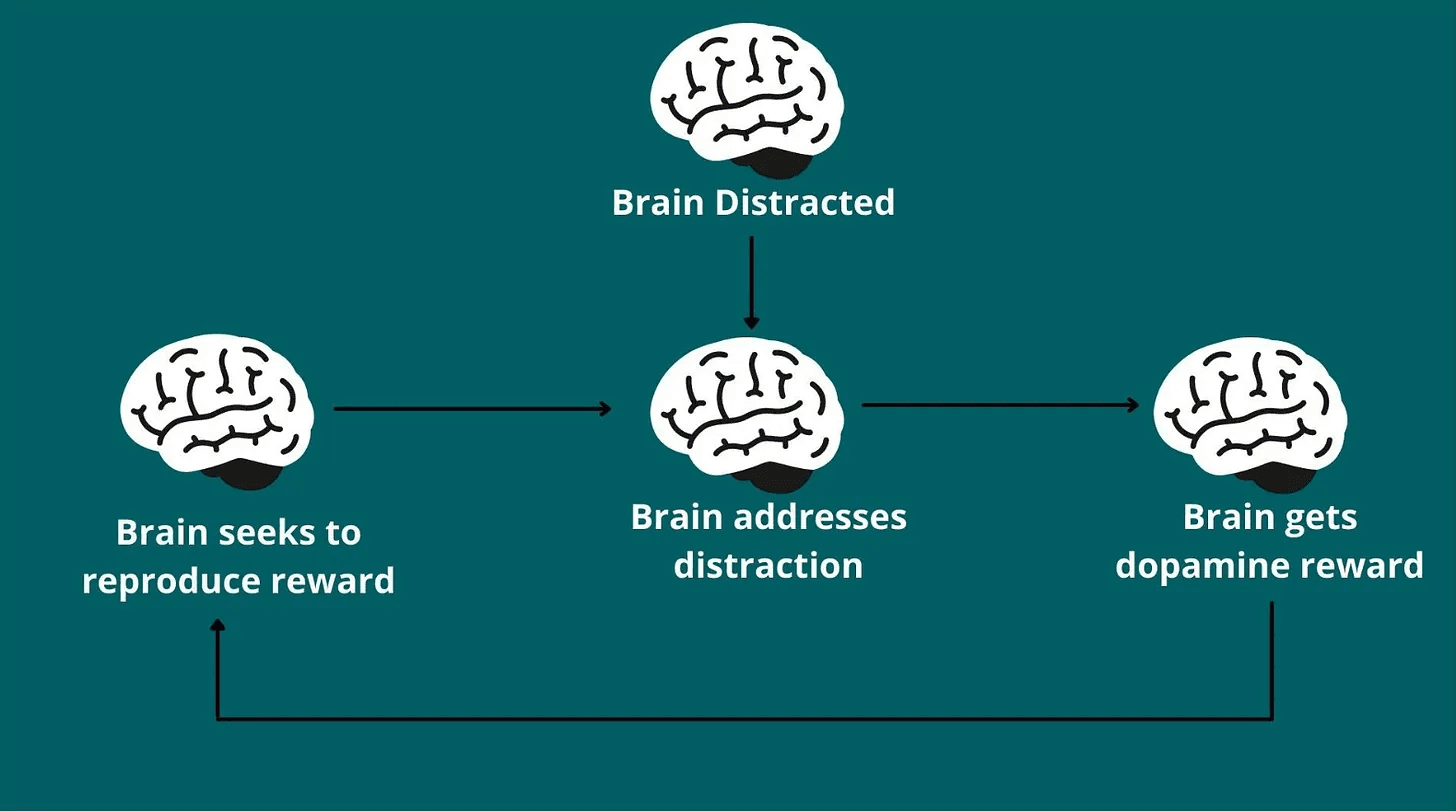
The problem? Our brains reward us for giving in to distraction.

Clearing a notification gives us the feeling of completing a task—even if it wasn’t meaningful. The brain enjoys that feeling and gives us another hit of dopamine as a reward. You know the drill. That dopamine hit motivates us to seek out the next distraction. And so on.

Eventually, it becomes a Pavlovian reflex. Like a dog that salivates when it hears a bell, we begin to anticipate the reward. In some cases, it’s even worse: once this habit is entrenched, waiting for a notification makes us constantly glance at our phone, just to make sure we haven’t missed anything. Classic FOMO. Sometimes, we even feel our phones vibrating when they aren’t—the infamous phantom vibrations.

The Cost of Interruption

Each day brings a flood of notifications, instant messages, and emails that break our focus and interrupt our work.

Microsoft has even referred to this overload as digital debta real burden. In 2023, 64% of employees reported struggling to find the time and energy to do quality work. When everything feels urgent, you spend your whole day just trying to stay afloat. In the workplace, there’s a constant (often unconscious) pressure to respond immediately to emails, Slack messages, or Teams alerts.

A study from OICN revealed:

  • 51.4% of employees respond to all emails within an hour

  • 70% interrupt their work whenever a notification appears

Not exactly productive, right?
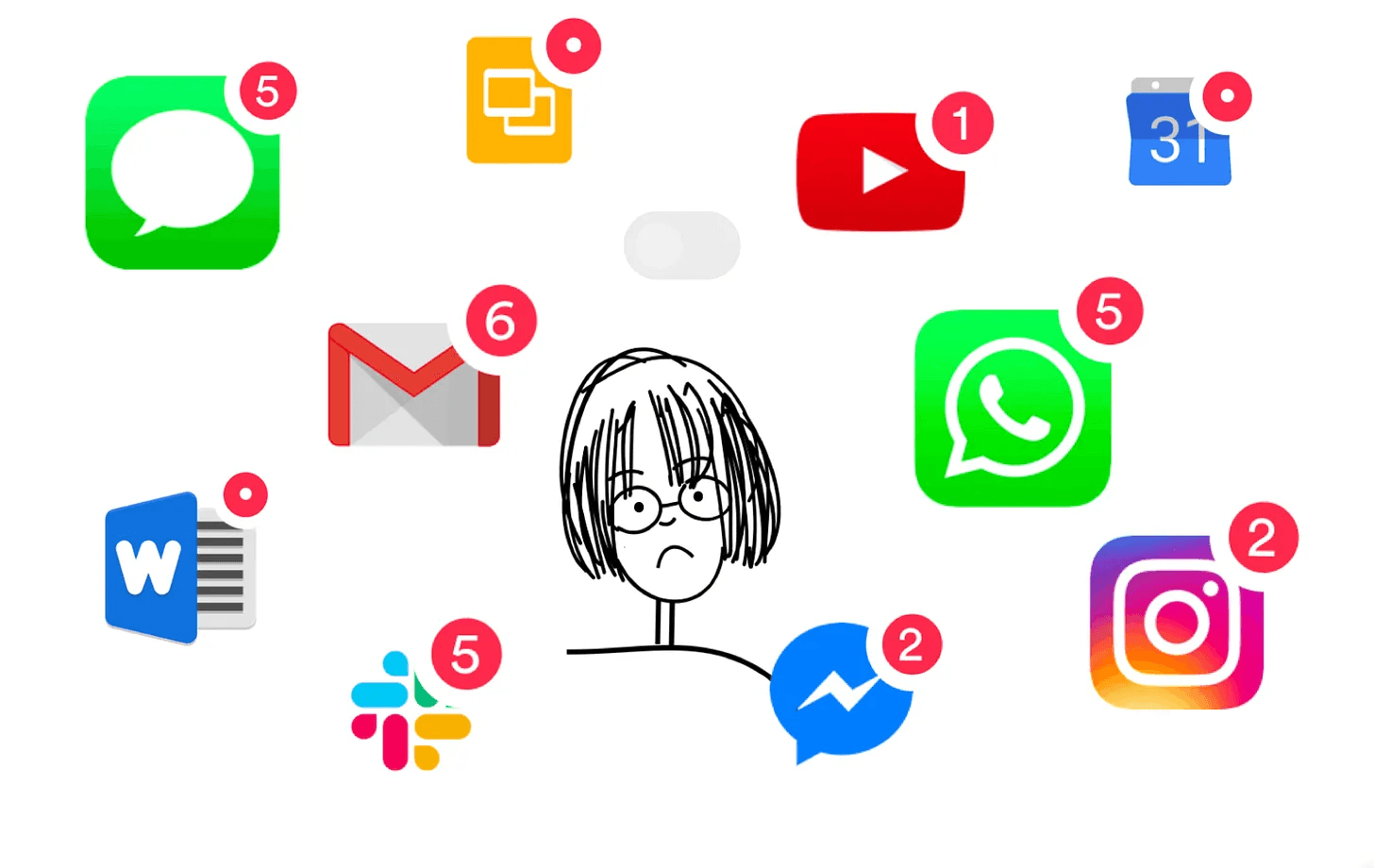
Gloria Mark talks about this in her book Attention Span. Based on years of research, she found that we get interrupted every 10.5 minutes at work.

And each time, there’s a price to pay. This is known as the switching cost: every time your focus breaks, your brain needs to “pay” in time and effort to get back on track. According to her research, this takes over 23 minutes each time. An eternity.

You can imagine the cumulative impact over a day—or a week. It’s a massive productivity drain. Distraction is a major and underestimated issue—both personally and collectively.
Another hormone comes into play when it comes to notifications: cortisol. It’s released in high doses to help us deal with danger, triggering a state of alertness.

Here, it’s released because the brain interprets every notification as urgent. The issue? Cortisol is the stress hormone. So every notification triggers a tiny, nearly invisible micro-stress: your heart rate increases, your breathing gets slightly more shallow. And the accumulation of these micro-stresses wears you down mentally throughout the day. This biological reaction was meant to protect us from real threats—not to alert us about who liked our latest Instagram story.

Creating Your Own Notification Policy

I’m always surprised when people tell me they have a problematic relationship with their phone—and then say that every single notification is still turned on.

It’s such a simple thing, but many of us never think to do it. Yet setting an intentional notification policy is one of the best ways to take back control. It cuts out a huge portion of unproductive interruptions. To regain the smartness of these features, it’s important to identify which notifications are actually useful to you.

And then turn off the non-essential ones.

Which ones are purely distractions? Which ones are just noise? Personally, I’ve told my phone to stay quiet most of the time.

Anatomy of a “shush”: no more notifications from LinkedIn or Gmail. And it feels amazing.

Only when you get some peace do you realize how damaging that constant stream of uncontrolled information really was—for both performance and mental health. Notifications are only one part of the problem, but they’re a major gateway to developing a problematic relationship with digital tools. Just one of many instruments crafted by the attention economy to make us lose control.

Block Apps, Block Notifications

Disabling them isn’t always enough to get rid of them — or you end up facing FOMO that keeps you from doing it. What if you miss a vital Slack notification from a coworker at 11 PM? Or Shein’s latest promo to refresh your wardrobe?

For this kind of problem, we’ve got a more radical solution: block those apps.

Let’s be honest: it’s very unlikely a coworker will share something truly urgent on Slack outside your working hours (they’ll probably call you — or at least, that’s what we hope for you). It’s also unlikely that a notification is really announcing the deal of the century… so why not block these apps and get rid of the pests?

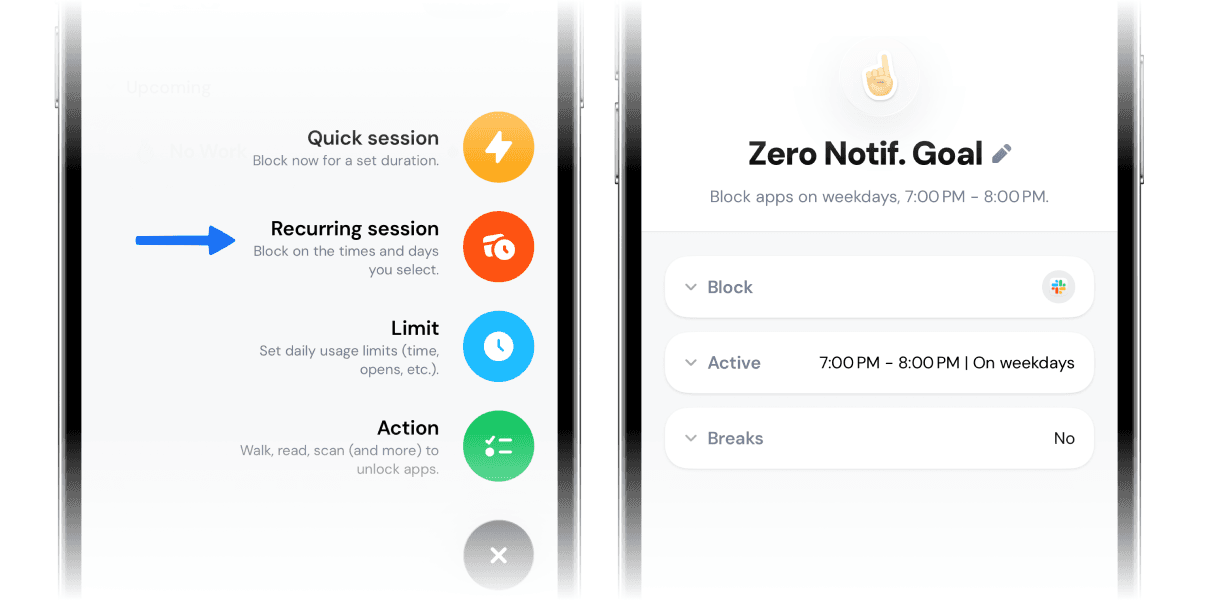
To do that, you can set up a Session in Jomo. It’s a blocking rule that cuts access to your apps during a time window you choose.

For example, for shopping apps with nonstop notifications: block them when you don’t want to be disturbed at work, or when you know you’re a bit tired, distracted, and more likely to spend. For Slack, email, and all the work stuff that won’t let go: set up a Session to block them once your workday is over.

Here’s how to do it in 3 steps (under 2 minutes, promise):

  1. Download Jomo from the App Store.

  2. Tap Rules > + > Recurring Session.

  3. Block: choose your apps. Active: choose the time window.

  4. Then just tap Schedule.

(Yes, that’s it… Yes, we know — it’s kind of amazing.)

And if the app helped you and you liked it, feel free to tell people about it and share your referral code (you give them 14 days of the Plus plan, and once you reach 25 referrals, you get Plus FREE FOR LIFE). And if you want to try the Plus plan for 14 days, use my code: FG2HA9

The Vicious Cycle of Distraction

What’s waiting behind that little red badge?

When we receive a notification, the brain releases a little hit of dopamine in anticipation. Just like a slot machine. It’s the uncertain possibility of something rewarding that drives us. This is called variable reinforcement.

Notifications have hijacked our brain’s reward system—the root of all compulsive behaviors.

The problem? Our brains reward us for giving in to distraction.

Clearing a notification gives us the feeling of completing a task—even if it wasn’t meaningful. The brain enjoys that feeling and gives us another hit of dopamine as a reward. You know the drill. That dopamine hit motivates us to seek out the next distraction. And so on.

Eventually, it becomes a Pavlovian reflex. Like a dog that salivates when it hears a bell, we begin to anticipate the reward. In some cases, it’s even worse: once this habit is entrenched, waiting for a notification makes us constantly glance at our phone, just to make sure we haven’t missed anything. Classic FOMO. Sometimes, we even feel our phones vibrating when they aren’t—the infamous phantom vibrations.

The Cost of Interruption

Each day brings a flood of notifications, instant messages, and emails that break our focus and interrupt our work.

Microsoft has even referred to this overload as digital debta real burden. In 2023, 64% of employees reported struggling to find the time and energy to do quality work. When everything feels urgent, you spend your whole day just trying to stay afloat. In the workplace, there’s a constant (often unconscious) pressure to respond immediately to emails, Slack messages, or Teams alerts.

A study from OICN revealed:

  • 51.4% of employees respond to all emails within an hour

  • 70% interrupt their work whenever a notification appears

Not exactly productive, right?

Gloria Mark talks about this in her book Attention Span. Based on years of research, she found that we get interrupted every 10.5 minutes at work.

And each time, there’s a price to pay. This is known as the switching cost: every time your focus breaks, your brain needs to “pay” in time and effort to get back on track. According to her research, this takes over 23 minutes each time. An eternity.

You can imagine the cumulative impact over a day—or a week. It’s a massive productivity drain. Distraction is a major and underestimated issue—both personally and collectively.

Another hormone comes into play when it comes to notifications: cortisol. It’s released in high doses to help us deal with danger, triggering a state of alertness.

Here, it’s released because the brain interprets every notification as urgent. The issue? Cortisol is the stress hormone. So every notification triggers a tiny, nearly invisible micro-stress: your heart rate increases, your breathing gets slightly more shallow. And the accumulation of these micro-stresses wears you down mentally throughout the day. This biological reaction was meant to protect us from real threats—not to alert us about who liked our latest Instagram story.

Creating Your Own Notification Policy

I’m always surprised when people tell me they have a problematic relationship with their phone—and then say that every single notification is still turned on.

It’s such a simple thing, but many of us never think to do it. Yet setting an intentional notification policy is one of the best ways to take back control. It cuts out a huge portion of unproductive interruptions. To regain the smartness of these features, it’s important to identify which notifications are actually useful to you.

And then turn off the non-essential ones.

Which ones are purely distractions? Which ones are just noise? Personally, I’ve told my phone to stay quiet most of the time.

Anatomy of a “shush”: no more notifications from LinkedIn or Gmail. And it feels amazing.

Only when you get some peace do you realize how damaging that constant stream of uncontrolled information really was—for both performance and mental health. Notifications are only one part of the problem, but they’re a major gateway to developing a problematic relationship with digital tools. Just one of many instruments crafted by the attention economy to make us lose control.

Block Apps, Block Notifications

Disabling them isn’t always enough to get rid of them — or you end up facing FOMO that keeps you from doing it. What if you miss a vital Slack notification from a coworker at 11 PM? Or Shein’s latest promo to refresh your wardrobe?

For this kind of problem, we’ve got a more radical solution: block those apps.

Let’s be honest: it’s very unlikely a coworker will share something truly urgent on Slack outside your working hours (they’ll probably call you — or at least, that’s what we hope for you). It’s also unlikely that a notification is really announcing the deal of the century… so why not block these apps and get rid of the pests?

To do that, you can set up a Session in Jomo. It’s a blocking rule that cuts access to your apps during a time window you choose.

For example, for shopping apps with nonstop notifications: block them when you don’t want to be disturbed at work, or when you know you’re a bit tired, distracted, and more likely to spend. For Slack, email, and all the work stuff that won’t let go: set up a Session to block them once your workday is over.

Here’s how to do it in 3 steps (under 2 minutes, promise):

  1. Download Jomo from the App Store.

  2. Tap Rules > + > Recurring Session.

  3. Block: choose your apps. Active: choose the time window.

  4. Then just tap Schedule.

(Yes, that’s it… Yes, we know — it’s kind of amazing.)

And if the app helped you and you liked it, feel free to tell people about it and share your referral code (you give them 14 days of the Plus plan, and once you reach 25 referrals, you get Plus FREE FOR LIFE). And if you want to try the Plus plan for 14 days, use my code: FG2HA9

The Vicious Cycle of Distraction

What’s waiting behind that little red badge?

When we receive a notification, the brain releases a little hit of dopamine in anticipation. Just like a slot machine. It’s the uncertain possibility of something rewarding that drives us. This is called variable reinforcement.

Notifications have hijacked our brain’s reward system—the root of all compulsive behaviors.

The problem? Our brains reward us for giving in to distraction.

Clearing a notification gives us the feeling of completing a task—even if it wasn’t meaningful. The brain enjoys that feeling and gives us another hit of dopamine as a reward. You know the drill. That dopamine hit motivates us to seek out the next distraction. And so on.

Eventually, it becomes a Pavlovian reflex. Like a dog that salivates when it hears a bell, we begin to anticipate the reward. In some cases, it’s even worse: once this habit is entrenched, waiting for a notification makes us constantly glance at our phone, just to make sure we haven’t missed anything. Classic FOMO. Sometimes, we even feel our phones vibrating when they aren’t—the infamous phantom vibrations.

The Cost of Interruption

Each day brings a flood of notifications, instant messages, and emails that break our focus and interrupt our work.

Microsoft has even referred to this overload as digital debta real burden. In 2023, 64% of employees reported struggling to find the time and energy to do quality work. When everything feels urgent, you spend your whole day just trying to stay afloat. In the workplace, there’s a constant (often unconscious) pressure to respond immediately to emails, Slack messages, or Teams alerts.

A study from OICN revealed:

  • 51.4% of employees respond to all emails within an hour

  • 70% interrupt their work whenever a notification appears

Not exactly productive, right?

Gloria Mark talks about this in her book Attention Span. Based on years of research, she found that we get interrupted every 10.5 minutes at work.

And each time, there’s a price to pay. This is known as the switching cost: every time your focus breaks, your brain needs to “pay” in time and effort to get back on track. According to her research, this takes over 23 minutes each time. An eternity.

You can imagine the cumulative impact over a day—or a week. It’s a massive productivity drain. Distraction is a major and underestimated issue—both personally and collectively.

Another hormone comes into play when it comes to notifications: cortisol. It’s released in high doses to help us deal with danger, triggering a state of alertness.

Here, it’s released because the brain interprets every notification as urgent. The issue? Cortisol is the stress hormone. So every notification triggers a tiny, nearly invisible micro-stress: your heart rate increases, your breathing gets slightly more shallow. And the accumulation of these micro-stresses wears you down mentally throughout the day. This biological reaction was meant to protect us from real threats—not to alert us about who liked our latest Instagram story.

Creating Your Own Notification Policy

I’m always surprised when people tell me they have a problematic relationship with their phone—and then say that every single notification is still turned on.

It’s such a simple thing, but many of us never think to do it. Yet setting an intentional notification policy is one of the best ways to take back control. It cuts out a huge portion of unproductive interruptions. To regain the smartness of these features, it’s important to identify which notifications are actually useful to you.

And then turn off the non-essential ones.

Which ones are purely distractions? Which ones are just noise? Personally, I’ve told my phone to stay quiet most of the time.

Anatomy of a “shush”: no more notifications from LinkedIn or Gmail. And it feels amazing.

Only when you get some peace do you realize how damaging that constant stream of uncontrolled information really was—for both performance and mental health. Notifications are only one part of the problem, but they’re a major gateway to developing a problematic relationship with digital tools. Just one of many instruments crafted by the attention economy to make us lose control.

Block Apps, Block Notifications

Disabling them isn’t always enough to get rid of them — or you end up facing FOMO that keeps you from doing it. What if you miss a vital Slack notification from a coworker at 11 PM? Or Shein’s latest promo to refresh your wardrobe?

For this kind of problem, we’ve got a more radical solution: block those apps.

Let’s be honest: it’s very unlikely a coworker will share something truly urgent on Slack outside your working hours (they’ll probably call you — or at least, that’s what we hope for you). It’s also unlikely that a notification is really announcing the deal of the century… so why not block these apps and get rid of the pests?

To do that, you can set up a Session in Jomo. It’s a blocking rule that cuts access to your apps during a time window you choose.

For example, for shopping apps with nonstop notifications: block them when you don’t want to be disturbed at work, or when you know you’re a bit tired, distracted, and more likely to spend. For Slack, email, and all the work stuff that won’t let go: set up a Session to block them once your workday is over.

Here’s how to do it in 3 steps (under 2 minutes, promise):

  1. Download Jomo from the App Store.

  2. Tap Rules > + > Recurring Session.

  3. Block: choose your apps. Active: choose the time window.

  4. Then just tap Schedule.

(Yes, that’s it… Yes, we know — it’s kind of amazing.)

And if the app helped you and you liked it, feel free to tell people about it and share your referral code (you give them 14 days of the Plus plan, and once you reach 25 referrals, you get Plus FREE FOR LIFE). And if you want to try the Plus plan for 14 days, use my code: FG2HA9
Credits
This article is a revised version of Edition #33 of the Screenbreak newsletter created by Julien Rousset. With his permission, we're sharing this high-quality content with you today! So many thanks to Julien. 😌
Photographies by Unsplash, Dall-e, ScreenBreak and the Internet.
[1] Mark - Attention Span
[2] Messias - Les notifications, ça rend con, Korii, 2022.
[3] Lemarchand, Vilrobe - Pourquoi il faut résister à l'avalanche de notifications, Les Echos, 2020.
[4] TechDetox - How Phones Hack Our Brain: Anatomy of a Notification, 2024.
[5] Goode - A Brief History of Smartphone Notifications, Wired, 2019.
[6] Simmons - Your Brain and modern-day micro-stressors: Notifications, After Burner.
[7] Les notifications qui nous convoquent devant nos ecrans. Utilite, reflexe Ou dependance ?, CyberAddictologie.

The Joy Of Missing Out

Crafted in Europe

All rights reserved to Jomo SAS, 2025

The Joy Of Missing Out

Crafted in Europe

All rights reserved to Jomo SAS, 2025

The Joy Of Missing Out

Crafted in Europe

All rights reserved to Jomo SAS, 2025