What Is The 2026 Trend Friction-Maxxing on IA Tools?

Okay. Let’s be honest: since ChatGPT became widely available to everyone in early 2023, it has (very) quickly become the number one tool in many people’s lives.
Understand

Mar 9, 2026

6 min

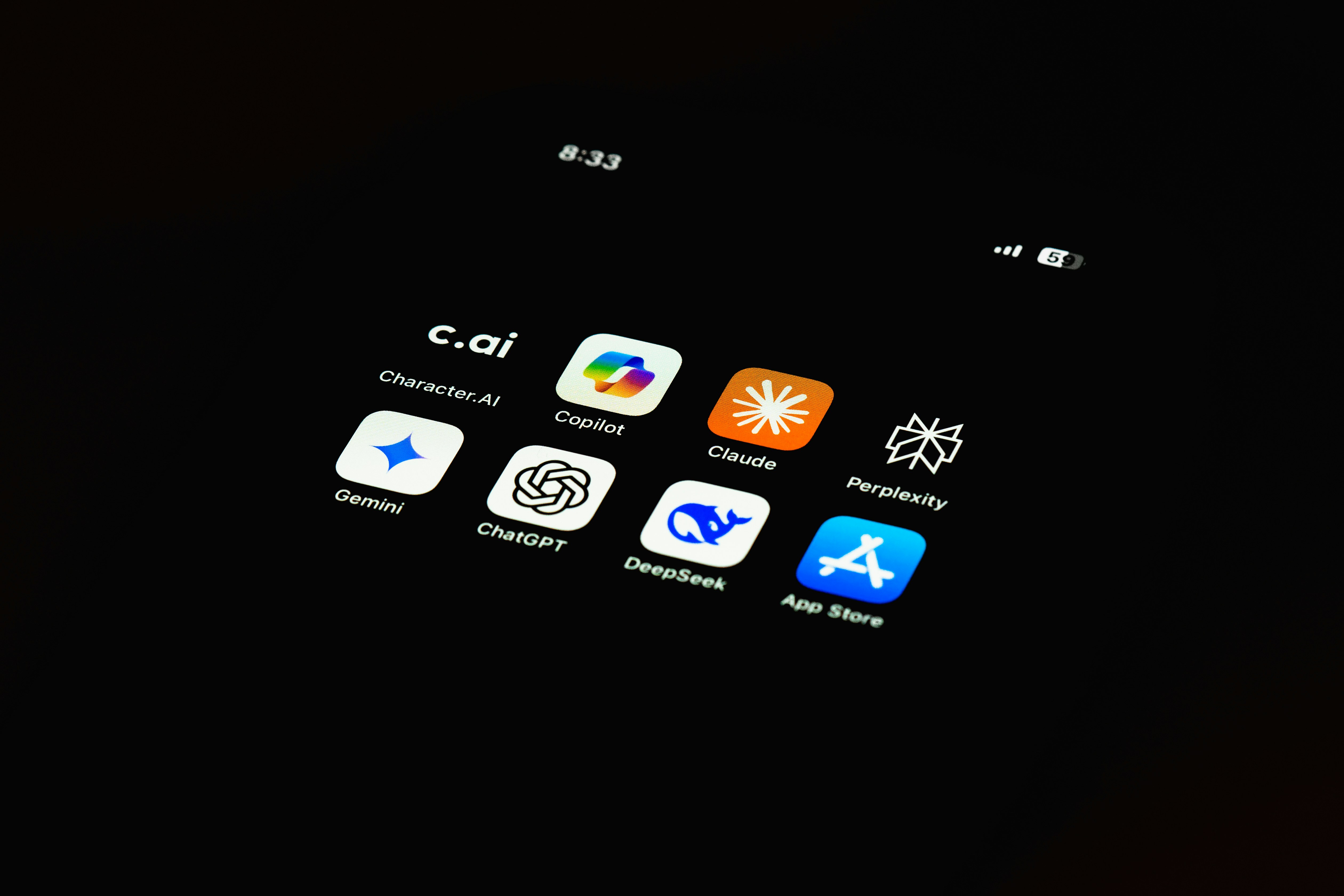
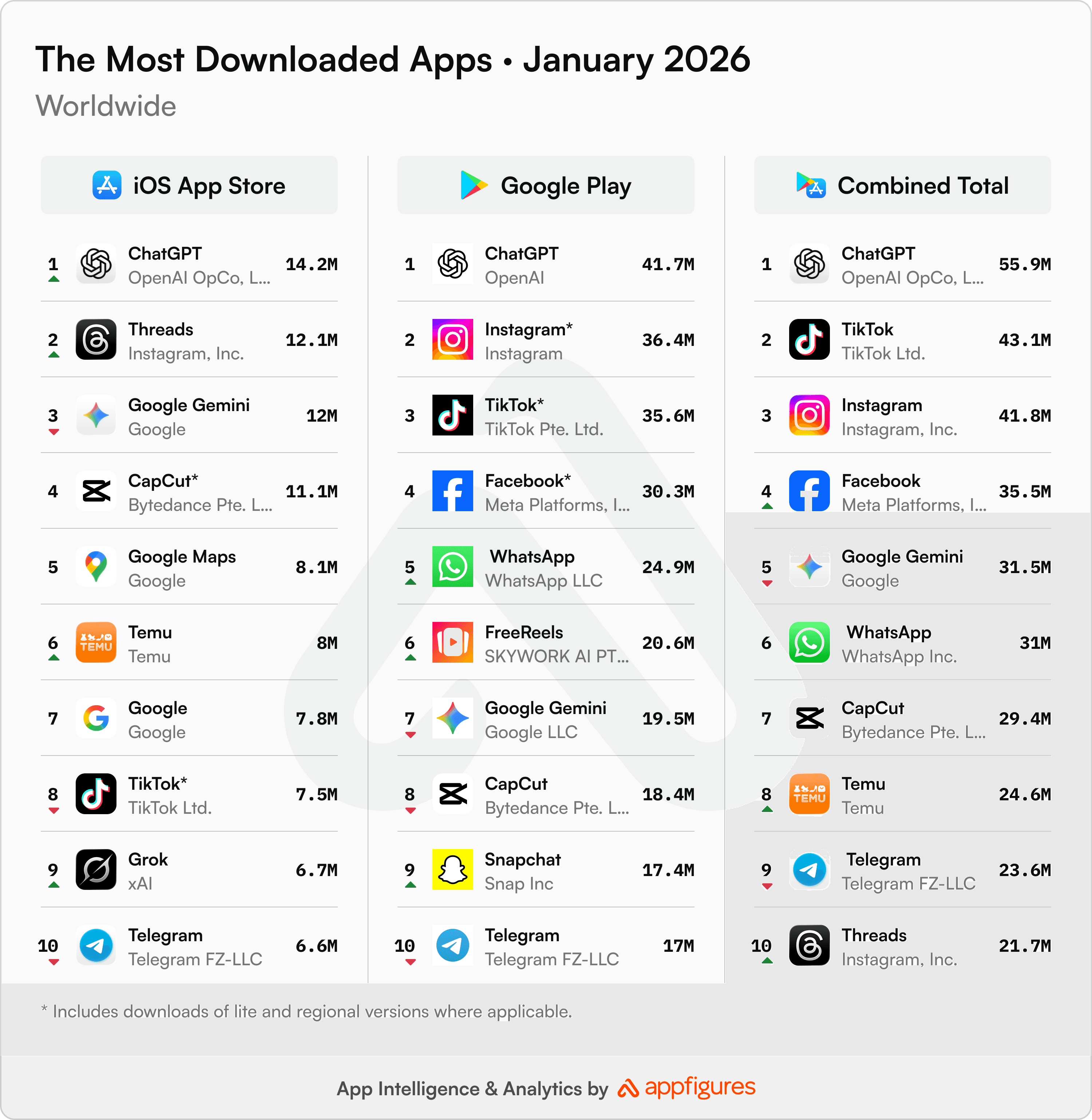
All you have to do is look at the most downloaded apps. In first place, you’ll often see the same names: Gemini, GPT, or Grok. And that’s been the case for quite a while now.
If these tools were initially used mostly for professional purposes—and were even the subject of ridicule from many skeptics—the jokes have quieted down a bit since then. Especially after seeing how quickly they started replacing certain jobs. Yeah.

The goal here isn’t to write an anti-AI article; that’s not our position. Instead, the idea is to question how we use these tools, the relationship we build with them, and the dependence that can develop around them. And in that sense, we came across a counter-trend to the “use AI for absolutely everything” mindset: friction-maxxing.

But before we begin, let me introduce myself. The little voice you’re reading is Laureline. I’m the designer and co-founder of the Jomo app. For the past 10 years, I’ve been working in UX and interface design. In 2022, we launched Jomo to finally bring a long-time project to life: a great app to help people stop mindlessly scrolling and take back control of their time. I wrote this article with my own two hands and my own little brain. So if you enjoyed it or found it useful, feel free to share it and let us know what you think!

Friction-Maxxing: What Is It?

As I mentioned earlier, today you use AI for almost everything. In general, the moment a task requires even a little thinking—or activating more than a couple of brain cells—you reach for ChatGPT. Even doing a proper Google search has started to feel tiring.

Friction-maxxing is the practice of intentionally introducing frictionextra steps, time, or effortwhen using AI tools so you don’t become overly passive or dependent.

This practice isn’t a punishment; quite the opposite. Its goal is to push you to use AI not to think for you, but to enhance your thinking. The idea is simple: you think first, write down your ideas, and only then use AI to improve them.

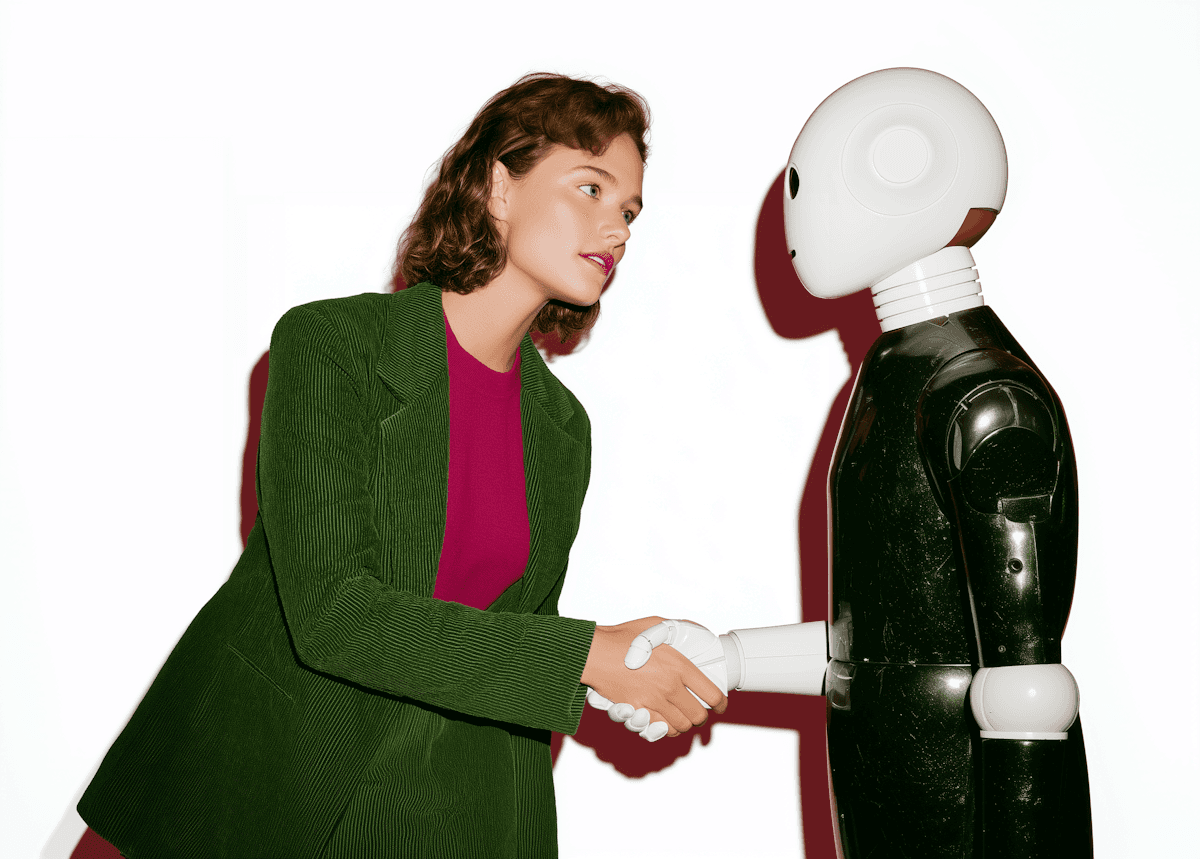
You don’t stop using these tools—you adopt a new philosophy of use: one where you become their ally, not their slave.
© Art by Gabs

The Origin of the Concept

The concept emerged from observing how people used AI between 2023 and 2025. People gradually shifted from a model of cognitive effort → result to prompt → result. Reflection, effort, and deep thinking started disappearing, replaced by the instant gratification of an immediate answer.

Yes, it’s “convenient.” But it also comes with real consequences—and a price to pay: less thinking, less creativity, and, above all, a growing cognitive dependence. And yes, even if you’re “only” delegating your dinner plans or your Google searches, you’re still making a deal with the devil. Because it always starts with a little… and eventually becomes a lot.

And in response to that, there’s friction-maxxing: a small barrier between you, AI, and intellectual laziness.

How Does It Work?

Friction-maxxing won’t make you delete your AI agents, don’t worry. But it will help you put them in the background—turning them into support tools rather than essentials.

That might sound a bit abstract, so let’s look at a few examples to make it clearer.

  • Concept 1: “Think first, prompt later.”

    The idea is to use your brain first and keep it working. So you write down your ideas, structure your thinking, and propose solutions before turning to AI. Then you ask your AI agent to help refine or improve what you’ve already done.

    “Generate a weekly menu for me.”

    “I’ve created my weekly menu. Can you check whether it covers all the necessary nutrients?”

    You end up with the same result. But this way, you’re not weakening your brain out of pure laziness. You’re simply asking AI to double-check your work.

  • Concept 2: Avoid “one-shot” prompts

    Many people use AI like a new kind of super-powered search engine. You ask a question → you get an answer. And that’s it. But you lose the surrounding context, the related information, and the curiosity that normally comes with exploring a topic. When you search the web, you inevitably discover other pieces of information that enrich your understanding. That’s part of the beauty of the internet. With AI, you often just get the answer. Avoiding one-shot prompts means prioritizing dialogue, iteration, and critique.


    “Give me the answer.”

    “What is missing in my reasoning? Challenge my idea. What would a critic say? What do experts think?”


    And most importantly, always verify the sources. An AI is not an absolute source of truth.

  • Concept 3: Stop automating everything

    More recently, I came across new “agents” that can literally manage your entire life—both personal and professional. One command and the thing does everything: it writes content, drafts your emails, generates code… everything. But here’s the problem: that won’t make you smarter. You automate, but you don’t master anything. You’re not developing skills—you’re simulating them.


    Tomorrow, if your AI is taken away, what are you actually worth? What are you really capable of doing? Do you truly understand what you’re doing?


    “Generate this or that for me.”

    “Can you check what I’ve done based on this principle…?”

So to sum it up: friction-maxxing means creating distance between yourself and AI tools. Think first. Don’t settle for a simple answer. And most importantly, stop automating everythinguse AI as support, not as a replacement.

Your phone, your rules. Block on command and own your time.

Your phone, your rules. Block on command and own your time.

Why Does It Matter?

Even though the technology is very recent (it only really reached the mainstream around 2023), we’re already seeing some worrying signs of excessive use. Purists will say, “It’s the same thing people said about smartphones… blah blah blah.But it’s not.

Loss of mental capacity

When AI is used for everything, there’s a real cognitive risk. If AI writes everything for you, you stop analyzing, you stop structuring your thoughts, you stop memorizing. Your brain becomes weaker. And the brain is like a muscle: the less you train it, the weaker it gets. Just imagine what conversations will sound like in 10 years…

And this isn’t something unique to AI. We’ve already seen it with other technologies:

  • GPS → massive loss of sense of direction

  • Calculators → decline in mental math skills

Loss of Identity

Yes, AI can produce “high-quality” content. But not original content. And that’s a huge issue. How do you find your place in society when you live only through a machine? In the end, who are you? You’re not the AI—but without it, are you even yourself anymore? Scary, right?

Because you might think that if you generate content with your GPT, you’re the only one who has it. Wrong. That content is often shared with many other people. AI has limits. Its outputs are often average, follow similar structures, and tend to move in the same direction. The result? We all start to “think” the same way and “write” the same way…

Let me give you an example. Recently, in France, at a university in Lyon, a professor asked students to write an essay on: “Define the main features of the medical approach to disability in Europe.” While reading the papers, the professor noticed that the structure of many of them was extremely similar—and not only that. In 50% of the papers written with AI, every student included a personal example about having a relative with a disability.

“Finally, they [the essays] were all illustrated with a personal example involving a grandmother or a grandfather… It was therefore obvious that these essays were not normal.” — Le Parisien

© Art by Rena

Learning Stops

We often think that learning only happens when you’re a child. But that’s not true. You learn throughout your entire life. And contrary to what many of us believe, it’s not the result that makes you learn — it’s the process of getting there. Everything that happens during the effort, during your thinking journey, is what forms real learning. The result is part of it, of course.

With AI, you focus 150% on the result. Which makes sense: there’s no thinking process involved. It’s just generation. And that contributes to the gradual disappearance of learning in humans.

Is It a Problem if I Don’t Practice Friction-Maxxing?

Yes and no. It really depends on how you use AI todayand how you plan to use it tomorrow.

No

Personally, yes, I use AI. Do I think that’s a problem? No, I don’t. I don’t rely on it for everything. I have two hands, ten fingers, and a brain—I can manage on my own. But in some situations, it has become convenient. Since I’m French, I don’t speak English like a native speaker. AI helps me spot my mistakes and improve my grammar. I could have everything translated for me—but I don’t want that. I also tend to be a bit verbose (meaning I sometimes stretch things out in writing), and I occasionally need help structuring my ideas into something clearer. So I use AI tools to help with that, but I still write my blog articles myself 🙂.

If you’re like me, that’s perfectly fine.

Yes

However, if you delegate everything and develop a real dependency on the tool, then yes, it becomes a problem. You’re locking yourself into a relationship that could have serious long-term consequences.

Imagine tomorrow that OpenAI shuts down its tools. What would happen in your life at that moment? Would you still be able to rely on yourself? Would you still be able to live your life normally?

Think about all the people who already use AI to replace human interactions: generating replies—or even sending them—to messages (both personal and professional), using it as a therapist, and so on…

But Why Does Nobody Seem To Care, While I Should?

Them…

First, there’s a kind of blindness effect. This technology is evolving so quickly that people rarely take five minutes to stop and ask themselves whether it’s actually a good thing. We’re constantly pulled toward the next new feature; there’s clearly a lot of FOMO involved.

On top of that, all this technology encourages hyper-consumption rather than moderate use. The interfaces remove friction, deliver everything instantly, and require almost no effort. And your brain loves that. To it, it’s like junk food or doomscrolling: endless dopamine hits. But what’s easiest to get isn’t always what’s best for you.

… vs. You

Think about your own value. About who you are. Your essence is made of YOUR ideas, YOUR understanding, YOUR judgment. If people trust YOU at work or in your personal life, it’s because YOU bring something unique that makes you interesting.

With AI, that uniqueness can disappear. You become interchangeable. You turn into a clone of another person hooked on AI. You stop being different.

Friction-maxxing isn’t some fringe trend. It’s a practice meant to protect your most important skill: your ability to think.

How Can You Do It, Concretely?

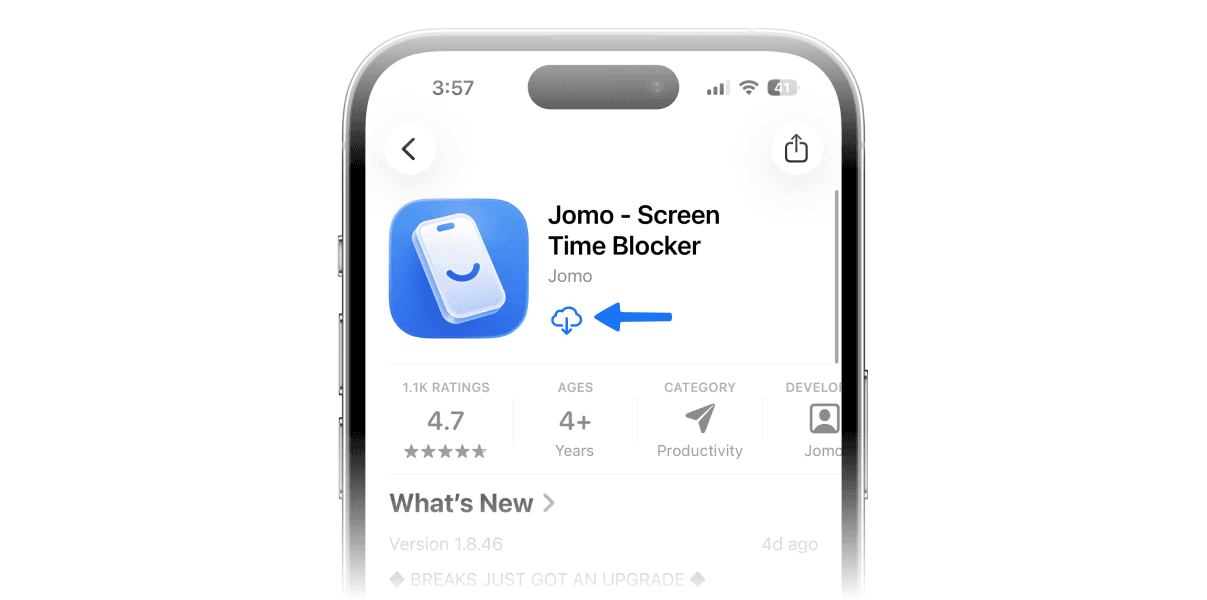
Once the habit is ingrained, it’s hard to get rid of it with the snap of a finger. External tools designed for this can become real allies. One example is the Jomo app, available for free on the App Store.

This app wasn’t vibe-coded (i.e., built with AI in 48 hours). We’ve been working on it intensively for 4 (!) years. We took the time to analyze the world around us, think deeply, iterate constantly—and we’re still improving it every day. This app was built by two HUMAN brains. And it will help you avoid burning out yours.

  1. Download Jomo from the App Store.

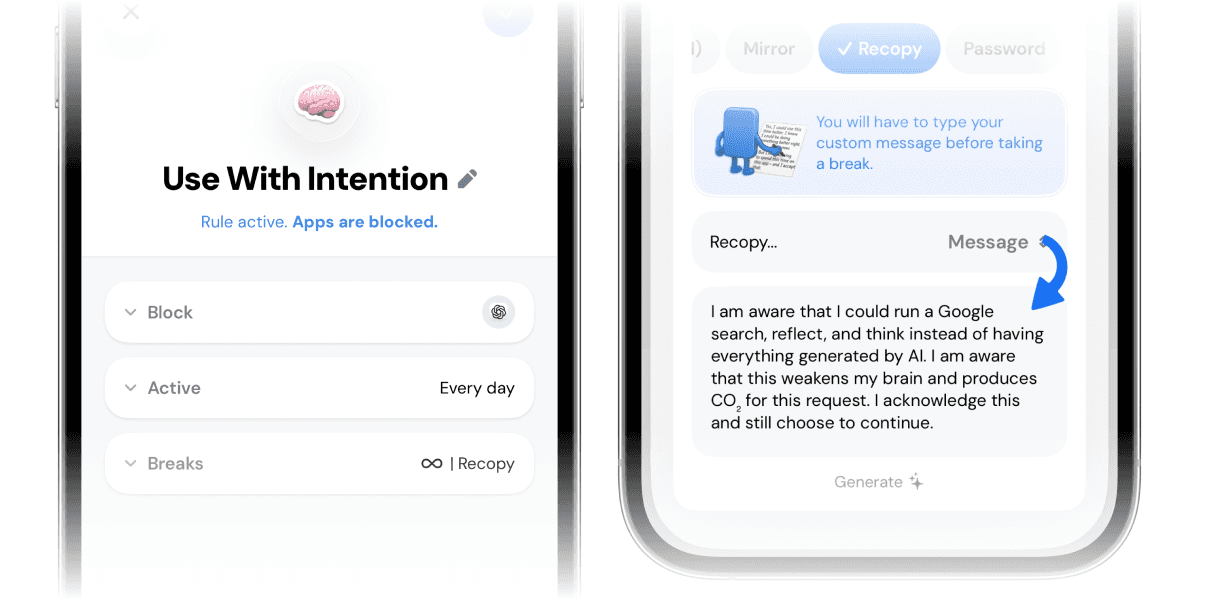
  2. Go to Rules > Templates and enable the rule “Use with Intention.

  3. In the Block section, add the AI agents you use.

  4. In the Breaks section, choose the exercise “Recopy.” Then paste this text:


    I am aware that I could run a Google search, reflect, and think instead of having everything generated by AI. I am aware that this weakens my brain and produces CO₂ for this request. I acknowledge this and still choose to continue.


  5. Then add the rule.

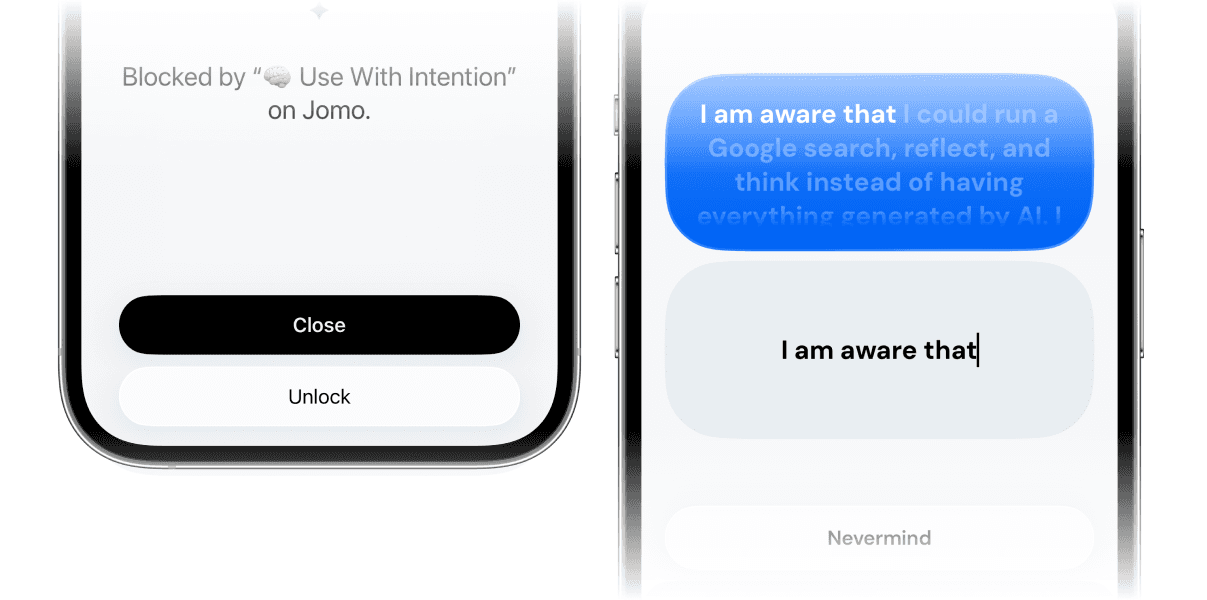
From now on, you won’t be able to open your AI agent with a single tap. You’ll first have to copy this short pledge before using it. The goal is to make you aware of your dependency and help you step out of this vicious cycle. And if you truly need it, you’ll still be able to use it. But this time, you’ll do it consciously.


Thanks for reading this far! I hope this article taught you something and maybe even made you want to change. As usual, I wrote this article with the help of the internet—and my small human brain. If you’d like to try Jomo’s premium version, you can use my referral code FG2HA9 to get a 14-day free trial. And if you found this interesting, feel free to share your feedback and pass it along to people around you.

Why Does It Matter?

Even though the technology is very recent (it only really reached the mainstream around 2023), we’re already seeing some worrying signs of excessive use. Purists will say, “It’s the same thing people said about smartphones… blah blah blah.But it’s not.

Loss of mental capacity

When AI is used for everything, there’s a real cognitive risk. If AI writes everything for you, you stop analyzing, you stop structuring your thoughts, you stop memorizing. Your brain becomes weaker. And the brain is like a muscle: the less you train it, the weaker it gets. Just imagine what conversations will sound like in 10 years…

And this isn’t something unique to AI. We’ve already seen it with other technologies:

  • GPS → massive loss of sense of direction

  • Calculators → decline in mental math skills

Loss of Identity

Yes, AI can produce “high-quality” content. But not original content. And that’s a huge issue. How do you find your place in society when you live only through a machine? In the end, who are you? You’re not the AI—but without it, are you even yourself anymore? Scary, right?

Because you might think that if you generate content with your GPT, you’re the only one who has it. Wrong. That content is often shared with many other people. AI has limits. Its outputs are often average, follow similar structures, and tend to move in the same direction. The result? We all start to “think” the same way and “write” the same way…

Let me give you an example. Recently, in France, at a university in Lyon, a professor asked students to write an essay on: “Define the main features of the medical approach to disability in Europe.” While reading the papers, the professor noticed that the structure of many of them was extremely similar—and not only that. In 50% of the papers written with AI, every student included a personal example about having a relative with a disability.

“Finally, they [the essays] were all illustrated with a personal example involving a grandmother or a grandfather… It was therefore obvious that these essays were not normal.” — Le Parisien

© Art by Rena

Learning Stops

We often think that learning only happens when you’re a child. But that’s not true. You learn throughout your entire life. And contrary to what many of us believe, it’s not the result that makes you learn — it’s the process of getting there. Everything that happens during the effort, during your thinking journey, is what forms real learning. The result is part of it, of course.

With AI, you focus 150% on the result. Which makes sense: there’s no thinking process involved. It’s just generation. And that contributes to the gradual disappearance of learning in humans.

Is It a Problem if I Don’t Practice Friction-Maxxing?

Yes and no. It really depends on how you use AI todayand how you plan to use it tomorrow.

No

Personally, yes, I use AI. Do I think that’s a problem? No, I don’t. I don’t rely on it for everything. I have two hands, ten fingers, and a brain—I can manage on my own. But in some situations, it has become convenient. Since I’m French, I don’t speak English like a native speaker. AI helps me spot my mistakes and improve my grammar. I could have everything translated for me—but I don’t want that. I also tend to be a bit verbose (meaning I sometimes stretch things out in writing), and I occasionally need help structuring my ideas into something clearer. So I use AI tools to help with that, but I still write my blog articles myself 🙂.

If you’re like me, that’s perfectly fine.

Yes

However, if you delegate everything and develop a real dependency on the tool, then yes, it becomes a problem. You’re locking yourself into a relationship that could have serious long-term consequences.

Imagine tomorrow that OpenAI shuts down its tools. What would happen in your life at that moment? Would you still be able to rely on yourself? Would you still be able to live your life normally?

Think about all the people who already use AI to replace human interactions: generating replies—or even sending them—to messages (both personal and professional), using it as a therapist, and so on…

But Why Does Nobody Seem To Care, While I Should?

Them…

First, there’s a kind of blindness effect. This technology is evolving so quickly that people rarely take five minutes to stop and ask themselves whether it’s actually a good thing. We’re constantly pulled toward the next new feature; there’s clearly a lot of FOMO involved.

On top of that, all this technology encourages hyper-consumption rather than moderate use. The interfaces remove friction, deliver everything instantly, and require almost no effort. And your brain loves that. To it, it’s like junk food or doomscrolling: endless dopamine hits. But what’s easiest to get isn’t always what’s best for you.

… vs. You

Think about your own value. About who you are. Your essence is made of YOUR ideas, YOUR understanding, YOUR judgment. If people trust YOU at work or in your personal life, it’s because YOU bring something unique that makes you interesting.

With AI, that uniqueness can disappear. You become interchangeable. You turn into a clone of another person hooked on AI. You stop being different.

Friction-maxxing isn’t some fringe trend. It’s a practice meant to protect your most important skill: your ability to think.

How Can You Do It, Concretely?

Once the habit is ingrained, it’s hard to get rid of it with the snap of a finger. External tools designed for this can become real allies. One example is the Jomo app, available for free on the App Store.

This app wasn’t vibe-coded (i.e., built with AI in 48 hours). We’ve been working on it intensively for 4 (!) years. We took the time to analyze the world around us, think deeply, iterate constantly—and we’re still improving it every day. This app was built by two HUMAN brains. And it will help you avoid burning out yours.

  1. Download Jomo from the App Store.

  2. Go to Rules > Templates and enable the rule “Use with Intention.

  3. In the Block section, add the AI agents you use.

  4. In the Breaks section, choose the exercise “Recopy.” Then paste this text:


    I am aware that I could run a Google search, reflect, and think instead of having everything generated by AI. I am aware that this weakens my brain and produces CO₂ for this request. I acknowledge this and still choose to continue.


  5. Then add the rule.

From now on, you won’t be able to open your AI agent with a single tap. You’ll first have to copy this short pledge before using it. The goal is to make you aware of your dependency and help you step out of this vicious cycle. And if you truly need it, you’ll still be able to use it. But this time, you’ll do it consciously.


Thanks for reading this far! I hope this article taught you something and maybe even made you want to change. As usual, I wrote this article with the help of the internet—and my small human brain. If you’d like to try Jomo’s premium version, you can use my referral code FG2HA9 to get a 14-day free trial. And if you found this interesting, feel free to share your feedback and pass it along to people around you.

Sources
Illustrations and images by Lummi and Unsplash.
[1] ChowChatGPT May Be Eroding Critical Thinking Skills, According to a New MIT Study, Time, 2025.
[2] RoxinGenerative AI: the risk of cognitive atrophy, Polytechnique Insights, 2025.
[3] Le ParisienFac de Lyon : un professeur découvre que ses élèves ont fait rédiger leurs copies par ChatGPT, Le Parisien, 2023.
[4] Jezer-MortonIn 2026, We Are Friction-Maxxing, The Cut, 2026.

The Joy Of Missing Out

Crafted in Europe

All rights reserved to Jomo SAS, 2026

The Joy Of Missing Out

Crafted in Europe

All rights reserved to Jomo SAS, 2026