Understand
7 min
What Is Bed Rotting and How To Stop It?
Bed rotting. Maybe you’ve come across content about it on TikTok, or maybe you’ve already experienced it yourself.


If I Keep Going, What Happens?
Nothing dramatic—no need to panic. But it is a bad habit. And once it settles in, it can become surprisingly persistent and gradually start affecting both your physical and mental health.
What It Can Lead To
It can start with the normalization of extreme inactivity—treating doing nothing, lying around, and staying in bed as something normal. But in reality, your body needs movement.
There can also be a glorification of social withdrawal: accepting the idea of being someone who “needs no one,” isolating yourself, normalizing avoidance—and, in the long run, potentially triggering social anxiety or other mental health issues.
What It Might Be Hiding
Bed rotting can sometimes be a sign of a deeper struggle. It can act as a quick and easy “solution” to something more serious—like burnout, depression, or symptoms of generalized anxiety. These are real health issues that shouldn’t be taken lightly, and they certainly shouldn’t be disguised as a supposedly “healthy” trend.

So Is There Really Nothing Good To Take From Bed Rotting?
Yes and no.
The practice itself isn’t something to encourage, but the underlying issue it reveals is worth addressing. In a way, bed rotting is how social media talks about the exhaustion many people feel from modern life. It highlights a real need: finding time for yourself to slow down, allow yourself to do nothing, and take some distance from social pressure.
What’s harmful is the how: lying in bed with your phone. That’s the part to avoid. Your bed should be a place for rest—especially for sleep.
So How Do You Resist It?
Personally, I don’t like articles that talk about a problem without offering solutions. So here are a few practical tips to help you push back against this habit and move toward a healthier daily rhythm.
1 – Get Out of Bed Within 5 Minutes of Waking Up
The first thing almost nobody does: move as soon as the alarm goes off. Recent surveys show that 42% of adults wake up or fall asleep while using at least one social media app. That’s huge.
As soon as the alarm rings:
Put your feet on the floor
Open the curtains, blinds, or shutters
Change rooms
Don’t touch your phone
How do you avoid grabbing your phone?
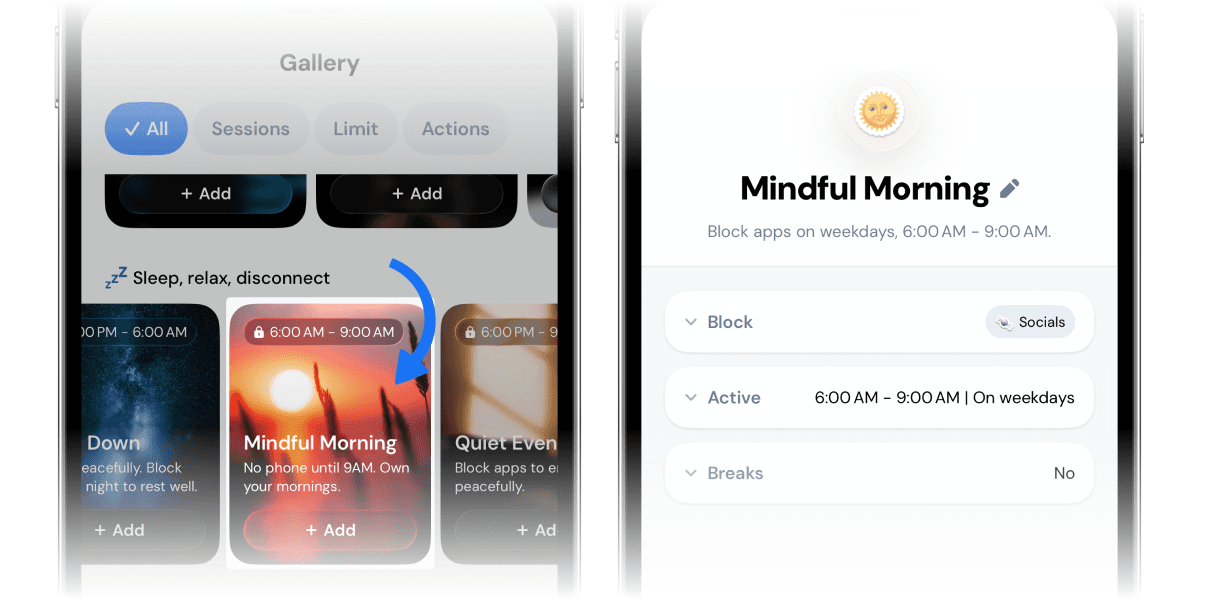
Set up a Session in the Jomo app, available for free on iPhone, iPad, and Mac. Choose the time window when you usually wake up (for example, 7:00–7:45 AM) and block distracting apps like social media. That way, even if you feel tempted, you won’t be able to open them.

2 – Create a Simple Morning Ritual
Many people don’t have a clear morning routine. When you don’t know what to do, scrolling becomes the default. Your phone is a perfect time-filler.
Instead, define a simple ritual after waking up. For example:
Make your bed
Air out your room for 10 minutes
Do a few stretches
Prepare breakfast
Take a shower
You don’t need a perfect, Instagram-worthy morning routine. Just something simple and structured that gets you moving.
3 – No Phone in Bed
A bit of common sense here. It’s like trying to diet while keeping a giant chocolate bar next to you at all times—you’re setting yourself up for failure.
Try to keep your phone outside the bedroom as much as possible.
If you use it as an alarm, you have two options:
Buy a real alarm clock (they don’t cost $2000).
Block all apps except the clock so your phone only serves that purpose.
4 – Replace Bed Rotting With Real Rest
At its core, bed rotting is about taking time for yourself—slowing down and enjoying a quiet moment. That part is valid. Just skip the bed and choose healthier activities instead.
Here are a few ideas (not exhaustive):
Walk
Cook
Read
Write
Garden
Sit outside and do nothing
Walk a dog (yours or try dog sitting)
Even 10 minutes a day of these activities can be incredibly beneficial. Don’t underestimate their impact.
5 – Use the 10-Minute Rule
Sometimes the urge to stay in bed isn’t real fatigue—it’s just laziness.
In winter, the floor is cold and the air feels chilly, so leaving your warm blankets is harder. In summer, it’s suddenly much easier, right? That’s usually not exhaustion—it’s just inertia.
So try this:
If you really want to stay in bed, tell yourself: “I’ll just get up for 10 minutes.”
If after getting up you feel fine, continue your day.
If you genuinely feel unwell or exhausted, then depending on your schedule and responsibilities, you can allow yourself more rest.
The Takeaway 🍔
The real problem with bed rotting isn’t the need to rest or slow down. That need is completely valid. The issue is how it’s done.
It’s basically dopamine-loaded rest—like junk food for your brain. Your brain doesn’t actually recover because it’s constantly stimulated, and your body isn’t cared for either—it’s just left there like a blob.
If this habit is starting to affect you, ask yourself one question:
Are you truly resting, or are you trying to avoid something?
Thanks for reading this far. I hope it helped you better understand the issue—and maybe even inspired you to make a change. If so, you can use my referral code to get 14 days of free trial on Jomo: FG2HA9. Feel free to give it a try.