Is Cinema Dead in the Age of Streaming?

Today, we’re going to talk about a screen—but not just any screen. The big one.
Understand

Jan 26, 2026

7 min

One of my deepest interests: cinema. Movies, of course, but also the experience of the movie theater itself. A unique sanctuary of attention, and an engaging, intentional activity. And above all, a moment that goes against the grain of the zapping economy and short-form content. You’ll see what I mean.

Silence, camera, rolling and… action! 🎬 (not quite sure if that’s the right phrase)

Cinema Is No Longer Just at the Cinema

181 million cinema tickets were sold in France in 2023, according to the National Center for Cinema and the Moving Image (CNC). That’s an 18.9% increase in theater attendance compared to 2022.

The French are gradually returning to theaters, but it’s still well below pre-Covid levels—around 15% less than between 2017 and 2019, for instance. The virus obviously shook up the industry, but a second challenge had already emerged and has since intensified: streaming.
Salty popcorn for the silver screen

One of my deepest interests: cinema. Movies, of course, but also the experience of the movie theater itself. A unique sanctuary of attention, and an engaging, intentional activity. And above all, a moment that goes against the grain of the zapping economy and short-form content. You’ll see what I mean.

Silence, camera, rolling and… action! 🎬 (not quite sure if that’s the right phrase)

Cinema Is No Longer Just at the Cinema

181 million cinema tickets were sold in France in 2023, according to the National Center for Cinema and the Moving Image (CNC). That’s an 18.9% increase in theater attendance compared to 2022.

The French are gradually returning to theaters, but it’s still well below pre-Covid levels—around 15% less than between 2017 and 2019, for instance. The virus obviously shook up the industry, but a second challenge had already emerged and has since intensified: streaming.

Salty popcorn for the silver screen

One of my deepest interests: cinema. Movies, of course, but also the experience of the movie theater itself. A unique sanctuary of attention, and an engaging, intentional activity. And above all, a moment that goes against the grain of the zapping economy and short-form content. You’ll see what I mean.

Silence, camera, rolling and… action! 🎬 (not quite sure if that’s the right phrase)

Cinema Is No Longer Just at the Cinema

181 million cinema tickets were sold in France in 2023, according to the National Center for Cinema and the Moving Image (CNC). That’s an 18.9% increase in theater attendance compared to 2022.

The French are gradually returning to theaters, but it’s still well below pre-Covid levels—around 15% less than between 2017 and 2019, for instance. The virus obviously shook up the industry, but a second challenge had already emerged and has since intensified: streaming.

Salty popcorn for the silver screen

Your phone, your rules. Block on command and own your time.

Your phone, your rules. Block on command and own your time.

Your phone, your rules. Block on command and own your time.

These days, cinema doesn’t necessarily happen in a movie theater anymore. What was once limited to the projection room has moved to the TV, and more recently, to our beloved smartphones.

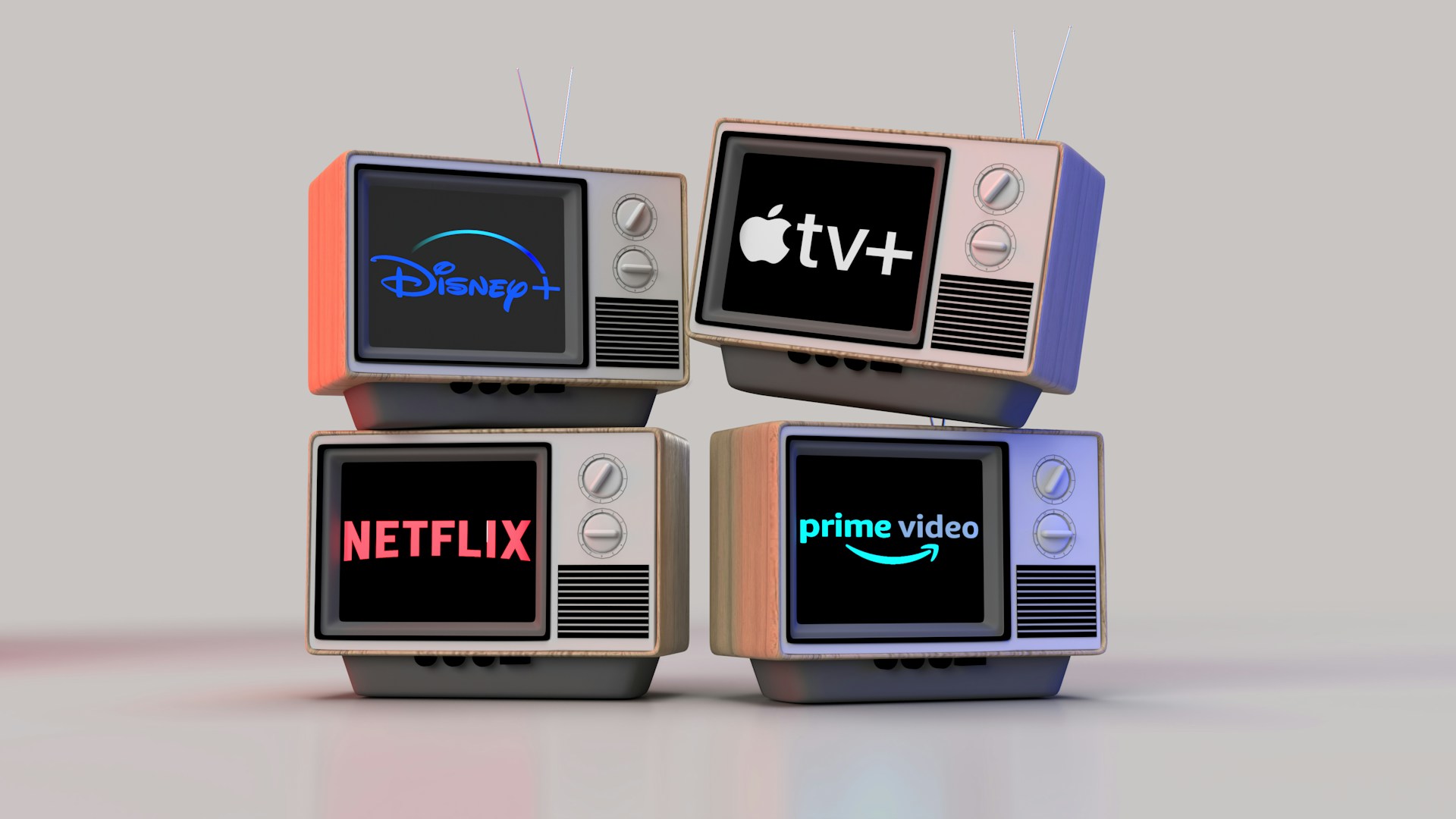
An all-you-can-eat buffet, available on demand through Netflix, Amazon Prime, or Apple TV—right from our couch or bed. But it’s not just the place or platform that’s changed, it’s also the way we consume content.

We can hit pause, we can fast-forward, we can get distracted and watch something else at the same time. What used to be a collective and immersive experience has become a more personal, flexible one. And today, it’s getting more and more fragmented.

The dark projection room still offers something irreplaceable: a unique space for social sharing. Laughing, crying, or reacting together to a film is a vital part of our culture.
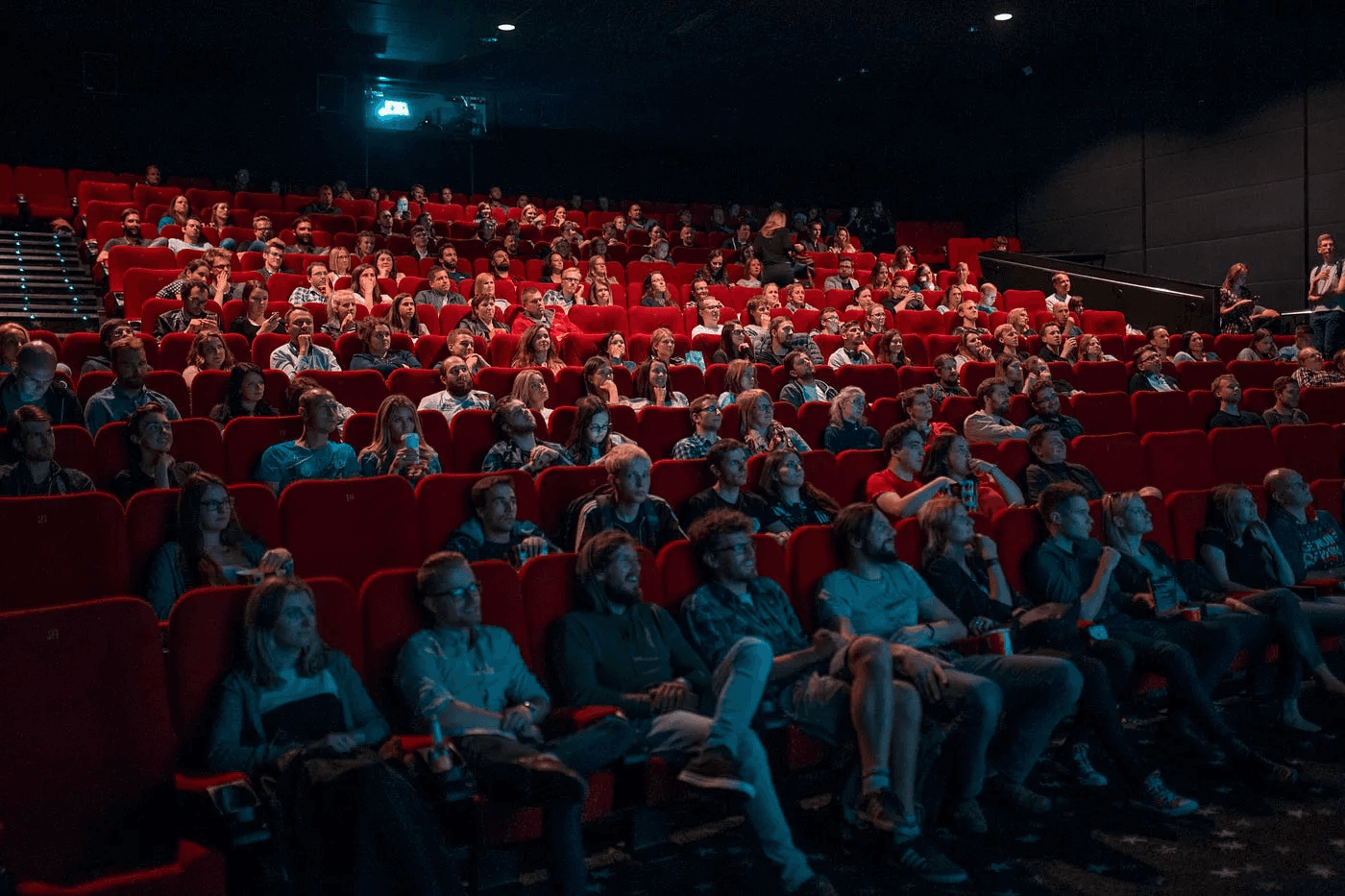
“There’s nothing like going into a big, dark theater with people you’ve never met before and letting the experience wash over you.” — Steven Spielberg

According to a CNC survey, 36% of people aged 15–34 have stopped going to movie theaters because they prefer watching content on other devices.

Post-Covid, 38% also say they’ve “fallen out of the habit.” Another reason seems to play a role: ticket prices. But we’ll come back to that later.

Intention And Focus
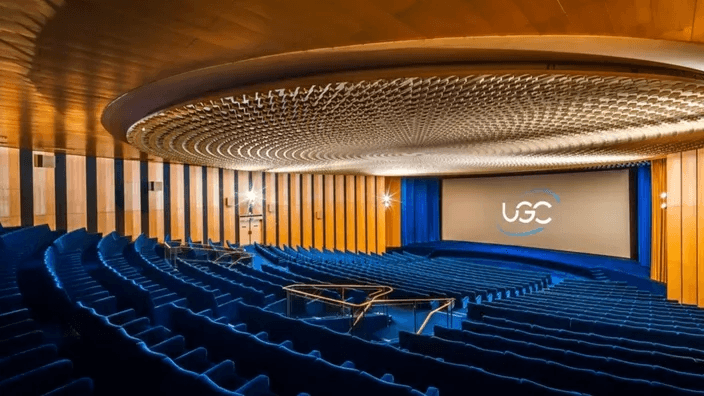
UGC Normandie: a theater set to close in June 2024 after a century of activity

Going to the movies is an intentional act. You choose what film to see, and when to see it. It’s an activity that requires a conscious effort—an engagement. You make a choice: “For the next two hours, I’m dedicating myself to this and nothing else.” And what’s dedicated becomes sacred.

Planning a movie outing, getting ready, and going to a specific place creates a sense of ritual and anticipation that enhances the overall experience. During the screening, your attention is focused on one thing. Our phones are (usually) off or in airplane mode. We’re fully immersed in the present moment and what’s happening on the screen. There are no distractions—except maybe the maddening crunch of popcorn. But no mindless scrolling. The immersive sound and darkness help us emotionally connect to the story and the film.

At home, watching a movie or series, our minds tend to wander.
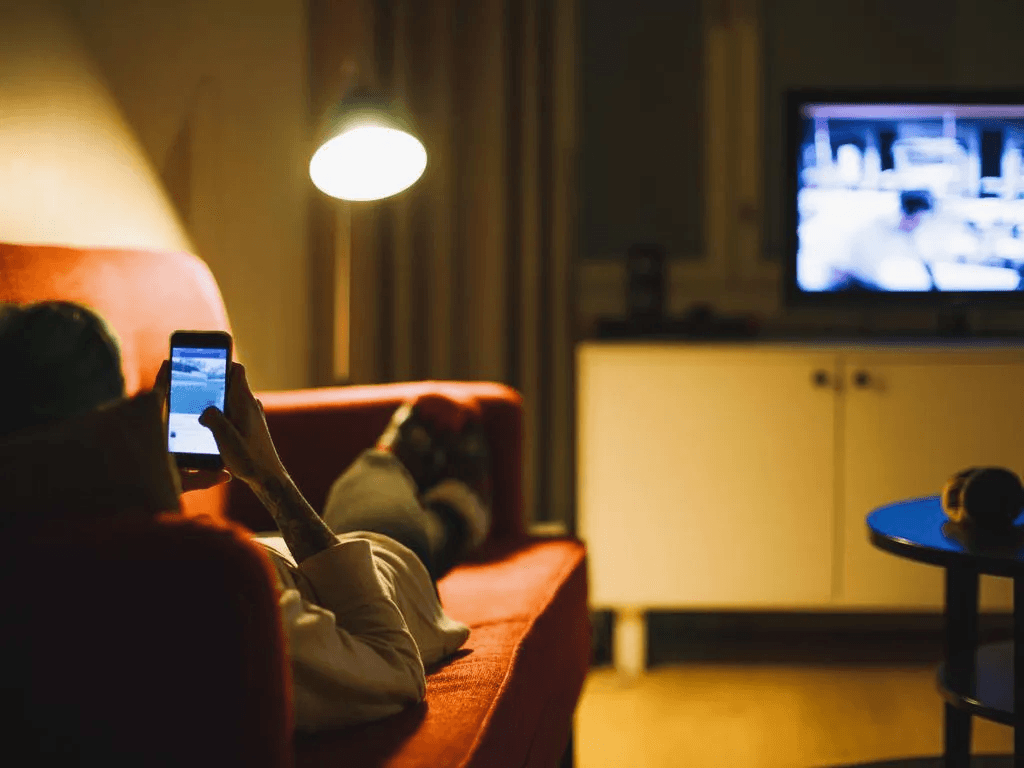
A 2019 study even found that 53% of adults enjoy going to the movies because there are no distractions or interruptions. We know our weaknesses. If the phone is nearby, it tempts us. At the slightest lull or slow moment, we’ve developed the reflex to look at it.

A digital overlay has become the norm. It’s no longer “Netflix & Chill,” but “Netflix & Scroll.” We’ve gotten used to using multiple screens at once—compulsively, briefly, and haphazardly.

I’ve lost count of how many movies I’ve started, paused to do something else, and never finished. The constant drip-feed of ultra-short videos à la TikTok has conditioned us to flit and switch endlessly. Staying fixed on the same content for two hours is now a real challenge: sustained focus on a single task is exhausting. At the theater, you’re forced to give the full product a chance.

The problem is that multitasking doesn’t exist when both tasks require attention. Despite what we think, the brain doesn’t do multiple tasks at once—it handles them sequentially, switching quickly between them. So when you’re Netflix & Scrolling, you’re not really focused on the movie. You miss the details—the very things that give it value.

And yet, this behavior becomes a reflex. Today, any content can be sped up, chopped up, and reduced to clips and sequences. All social networks are converging toward this TikTok-ification. The result? We’re losing our patience.

To avoid boredom during videos, some even resort to speedwatching to keep up the pace. They consume films and series slightly sped up: the “speedwatching” crowd.
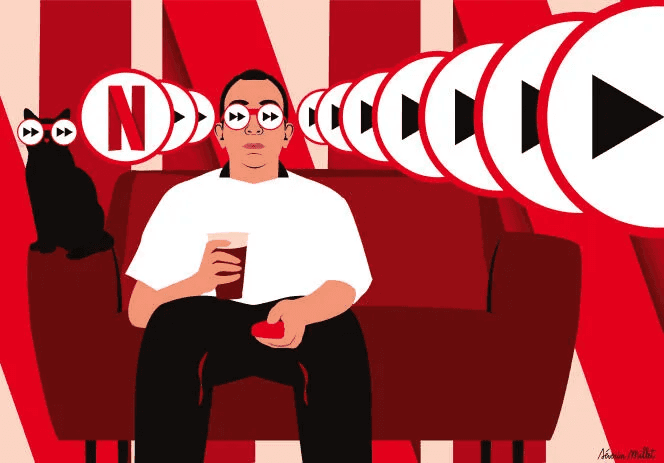
YouTube and Netflix offer 1.5x, 1.75x, or 2x playback speeds. Today, 30% of users reportedly use them. Beyond the fact that these works are distorted, this points to a new paradigm—and a genuine brain shift. In this context, the movie theater becomes a sanctuary of attention.

No rewinding, no pausing, no fast-forwarding.

Every screening is a commitment to fully experience the art as it was meant to be.

“I believe that the main motivation of a person going to the cinema is a search for time: lost time, neglected time, time to recover. Our era imposes an impossible pace on humans, creating the constant feeling of a lack of time.” Andrei Tarkovsky

Cinema gives back to the viewer the full richness of time. A temporary remedy for our inability to live without distractions at home.

The Cultural Food Chain

Entertainment companies are facing challenges no one could’ve predicted a few years ago. Take the film industry:

For more, check out Ted Gioia’s article State of the Culture, 2024, which inspired this section.
Ted Gioian

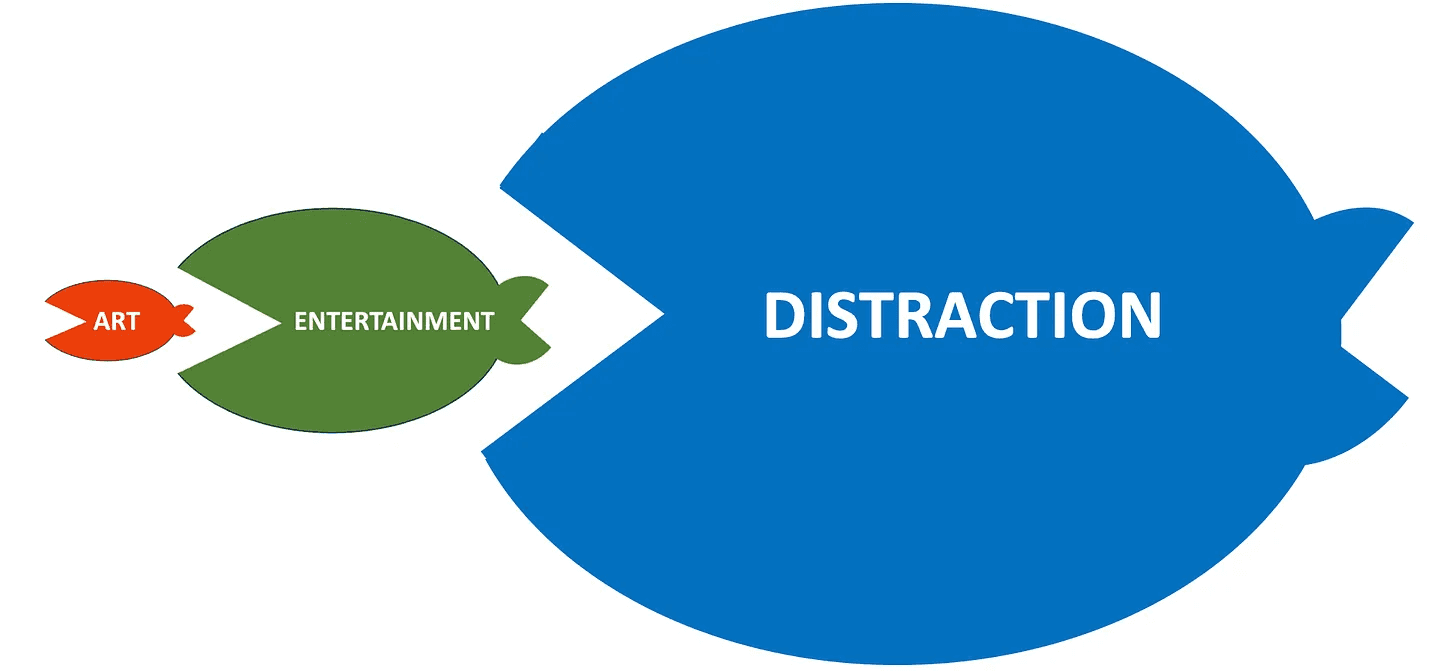
One of the main reasons, according to the author, is that the world has entered the Age of Distraction, led by the dopamine cartel. A cartel that’s devouring the age of simple entertainment. Scrolling, swiping, ultra-short and fragmented content is taking over, reigning supreme in our daily lives.

And it makes sense: it taps directly into the brain’s wiring, forming compulsive habits. These tools exploit our brain’s natural vulnerabilities. Our reward system gets hijacked by content and design that trigger frequent dopamine releases.

Which makes us crave these stimuli more and more often. Everything else starts to feel bland and boring by comparison. We lose patience quickly and struggle to focus on anything longer than your average TikTok.

Tech platforms don’t care about finding the next Michelangelo or Mozart and offering thoughtful, creative content. They just want addicts—because they’re the dealers.

Everything is designed to trap users in a cycle of addiction. All platforms are evolving toward interfaces that optimize the dopamine loop. We’re witnessing the rise of dopamine culture. This diagram really resonated with me:
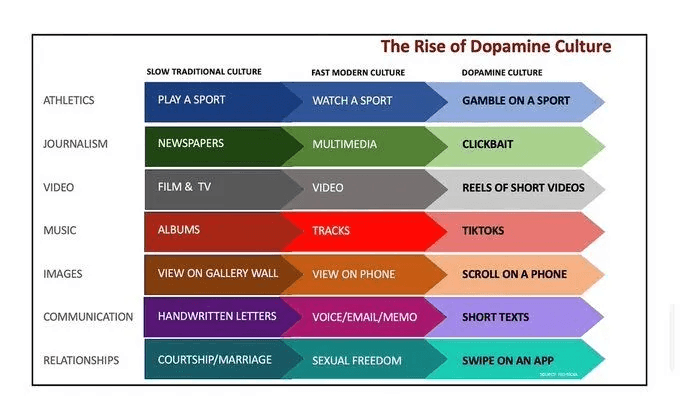
This is a long-term trend that’s here to stay—because the financial stakes are enormous. Major behavioral and neurological changes are underway… but at what cost?

Making an Act of Resistance

The point of this piece isn’t to convince you to go to the movies more often—especially if it’s not something you’re into. The message is simpler: the decision to go sit in a movie theater symbolizes a fully intentional decision, and an immersive activity focused on a single goal. In a world where our attention is constantly pulled in every direction, sitting in the dark for two hours is an act of presence—and resistance.

These are the kinds of activities we should be leaning toward.

Intentional free time. A reclaiming of time that slips away in a blur of feeds and distractions. A resistance to the zapped, shot-sized, Reel-based consumption of culture.

Sure, movie tickets aren’t cheap—I’ll give you that. But is cinema really too expensive? It’s all a matter of comparison. Personally, I’ve had UGC Unlimited for about a year—it costs me €21.90/month. By comparison, Netflix Standard is €13.99/month.

Our brain becomes what we feed it. “Cheat meals” are fine. But junk food that makes us apathetic, unfocused, and numb to deeper pleasures shouldn’t be an everyday thing. So how do we resist?

By balancing distractions with long-form activities—like reading. But also by watching full movies without our smartphone in hand. If the digital world pushes us toward fast, shallow consumption, we need to preserve bastions of focus and single-tasking.

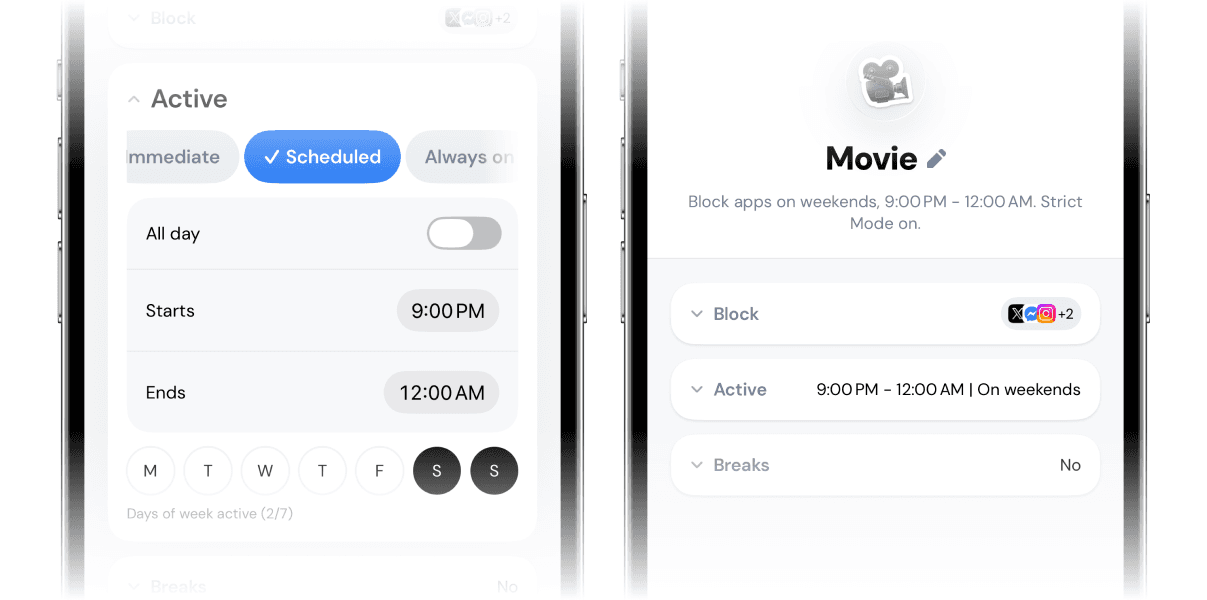
If you struggle to resist on your own, you can absolutely get some help from the Jomo app — available for free on iPhone, iPad, and Mac. With Jomo, you can block apps during specific time windows. Perfect if you’re planning to watch a movie (at home or at the cinema — yeah, we see you using your phone in the theater, so please do everyone a favor and block your apps 😄).

Here’s a rule that works really well:

  1. Download Jomo from the App Store.

  2. Go to the Rules section and tap “+” (the black button at the bottom).

  3. Choose “Recurring Session.

  4. In the “Block” section, select distracting apps (the ones you don’t need during a movie or that might interrupt you).

  5. In “Active,” select the time slot of the movie. For example, we like to watch movies on weekends from 9:00 pm to midnight.

  6. In “Breaks,” make sure it’s set to “No.”

  7. Enable Strict Mode so you can’t cheat.

  8. And that’s it!

By recognizing the hidden costs of our digital tools, we can make more informed choices about how we spend our time and attention.

These days, cinema doesn’t necessarily happen in a movie theater anymore. What was once limited to the projection room has moved to the TV, and more recently, to our beloved smartphones.

An all-you-can-eat buffet, available on demand through Netflix, Amazon Prime, or Apple TV—right from our couch or bed. But it’s not just the place or platform that’s changed, it’s also the way we consume content.

We can hit pause, we can fast-forward, we can get distracted and watch something else at the same time. What used to be a collective and immersive experience has become a more personal, flexible one. And today, it’s getting more and more fragmented.

The dark projection room still offers something irreplaceable: a unique space for social sharing. Laughing, crying, or reacting together to a film is a vital part of our culture.

“There’s nothing like going into a big, dark theater with people you’ve never met before and letting the experience wash over you.” — Steven Spielberg

According to a CNC survey, 36% of people aged 15–34 have stopped going to movie theaters because they prefer watching content on other devices.

Post-Covid, 38% also say they’ve “fallen out of the habit.” Another reason seems to play a role: ticket prices. But we’ll come back to that later.

Intention And Focus

UGC Normandie: a theater set to close in June 2024 after a century of activity

Going to the movies is an intentional act. You choose what film to see, and when to see it. It’s an activity that requires a conscious effort—an engagement. You make a choice: “For the next two hours, I’m dedicating myself to this and nothing else.” And what’s dedicated becomes sacred.

Planning a movie outing, getting ready, and going to a specific place creates a sense of ritual and anticipation that enhances the overall experience. During the screening, your attention is focused on one thing. Our phones are (usually) off or in airplane mode. We’re fully immersed in the present moment and what’s happening on the screen. There are no distractions—except maybe the maddening crunch of popcorn. But no mindless scrolling. The immersive sound and darkness help us emotionally connect to the story and the film.

At home, watching a movie or series, our minds tend to wander.

A 2019 study even found that 53% of adults enjoy going to the movies because there are no distractions or interruptions. We know our weaknesses. If the phone is nearby, it tempts us. At the slightest lull or slow moment, we’ve developed the reflex to look at it.

A digital overlay has become the norm. It’s no longer “Netflix & Chill,” but “Netflix & Scroll.” We’ve gotten used to using multiple screens at once—compulsively, briefly, and haphazardly.

I’ve lost count of how many movies I’ve started, paused to do something else, and never finished. The constant drip-feed of ultra-short videos à la TikTok has conditioned us to flit and switch endlessly. Staying fixed on the same content for two hours is now a real challenge: sustained focus on a single task is exhausting. At the theater, you’re forced to give the full product a chance.

The problem is that multitasking doesn’t exist when both tasks require attention. Despite what we think, the brain doesn’t do multiple tasks at once—it handles them sequentially, switching quickly between them. So when you’re Netflix & Scrolling, you’re not really focused on the movie. You miss the details—the very things that give it value.

And yet, this behavior becomes a reflex. Today, any content can be sped up, chopped up, and reduced to clips and sequences. All social networks are converging toward this TikTok-ification. The result? We’re losing our patience.

To avoid boredom during videos, some even resort to speedwatching to keep up the pace. They consume films and series slightly sped up: the “speedwatching” crowd.

YouTube and Netflix offer 1.5x, 1.75x, or 2x playback speeds. Today, 30% of users reportedly use them. Beyond the fact that these works are distorted, this points to a new paradigm—and a genuine brain shift. In this context, the movie theater becomes a sanctuary of attention.

No rewinding, no pausing, no fast-forwarding.

Every screening is a commitment to fully experience the art as it was meant to be.

“I believe that the main motivation of a person going to the cinema is a search for time: lost time, neglected time, time to recover. Our era imposes an impossible pace on humans, creating the constant feeling of a lack of time.” Andrei Tarkovsky

Cinema gives back to the viewer the full richness of time. A temporary remedy for our inability to live without distractions at home.

The Cultural Food Chain

Entertainment companies are facing challenges no one could’ve predicted a few years ago. Take the film industry:

For more, check out Ted Gioia’s article State of the Culture, 2024, which inspired this section.

Ted Gioian

One of the main reasons, according to the author, is that the world has entered the Age of Distraction, led by the dopamine cartel. A cartel that’s devouring the age of simple entertainment. Scrolling, swiping, ultra-short and fragmented content is taking over, reigning supreme in our daily lives.

And it makes sense: it taps directly into the brain’s wiring, forming compulsive habits. These tools exploit our brain’s natural vulnerabilities. Our reward system gets hijacked by content and design that trigger frequent dopamine releases.

Which makes us crave these stimuli more and more often. Everything else starts to feel bland and boring by comparison. We lose patience quickly and struggle to focus on anything longer than your average TikTok.

Tech platforms don’t care about finding the next Michelangelo or Mozart and offering thoughtful, creative content. They just want addicts—because they’re the dealers.

Everything is designed to trap users in a cycle of addiction. All platforms are evolving toward interfaces that optimize the dopamine loop. We’re witnessing the rise of dopamine culture. This diagram really resonated with me:

This is a long-term trend that’s here to stay—because the financial stakes are enormous. Major behavioral and neurological changes are underway… but at what cost?

Making an Act of Resistance

The point of this piece isn’t to convince you to go to the movies more often—especially if it’s not something you’re into. The message is simpler: the decision to go sit in a movie theater symbolizes a fully intentional decision, and an immersive activity focused on a single goal. In a world where our attention is constantly pulled in every direction, sitting in the dark for two hours is an act of presence—and resistance.

These are the kinds of activities we should be leaning toward.

Intentional free time. A reclaiming of time that slips away in a blur of feeds and distractions. A resistance to the zapped, shot-sized, Reel-based consumption of culture.

Sure, movie tickets aren’t cheap—I’ll give you that. But is cinema really too expensive? It’s all a matter of comparison. Personally, I’ve had UGC Unlimited for about a year—it costs me €21.90/month. By comparison, Netflix Standard is €13.99/month.

Our brain becomes what we feed it. “Cheat meals” are fine. But junk food that makes us apathetic, unfocused, and numb to deeper pleasures shouldn’t be an everyday thing. So how do we resist?

By balancing distractions with long-form activities—like reading. But also by watching full movies without our smartphone in hand. If the digital world pushes us toward fast, shallow consumption, we need to preserve bastions of focus and single-tasking.

If you struggle to resist on your own, you can absolutely get some help from the Jomo app — available for free on iPhone, iPad, and Mac. With Jomo, you can block apps during specific time windows. Perfect if you’re planning to watch a movie (at home or at the cinema — yeah, we see you using your phone in the theater, so please do everyone a favor and block your apps 😄).

Here’s a rule that works really well:

  1. Download Jomo from the App Store.

  2. Go to the Rules section and tap “+” (the black button at the bottom).

  3. Choose “Recurring Session.

  4. In the “Block” section, select distracting apps (the ones you don’t need during a movie or that might interrupt you).

  5. In “Active,” select the time slot of the movie. For example, we like to watch movies on weekends from 9:00 pm to midnight.

  6. In “Breaks,” make sure it’s set to “No.”

  7. Enable Strict Mode so you can’t cheat.

  8. And that’s it!

By recognizing the hidden costs of our digital tools, we can make more informed choices about how we spend our time and attention.

These days, cinema doesn’t necessarily happen in a movie theater anymore. What was once limited to the projection room has moved to the TV, and more recently, to our beloved smartphones.

An all-you-can-eat buffet, available on demand through Netflix, Amazon Prime, or Apple TV—right from our couch or bed. But it’s not just the place or platform that’s changed, it’s also the way we consume content.

We can hit pause, we can fast-forward, we can get distracted and watch something else at the same time. What used to be a collective and immersive experience has become a more personal, flexible one. And today, it’s getting more and more fragmented.

The dark projection room still offers something irreplaceable: a unique space for social sharing. Laughing, crying, or reacting together to a film is a vital part of our culture.

“There’s nothing like going into a big, dark theater with people you’ve never met before and letting the experience wash over you.” — Steven Spielberg

According to a CNC survey, 36% of people aged 15–34 have stopped going to movie theaters because they prefer watching content on other devices.

Post-Covid, 38% also say they’ve “fallen out of the habit.” Another reason seems to play a role: ticket prices. But we’ll come back to that later.

Intention And Focus

UGC Normandie: a theater set to close in June 2024 after a century of activity

Going to the movies is an intentional act. You choose what film to see, and when to see it. It’s an activity that requires a conscious effort—an engagement. You make a choice: “For the next two hours, I’m dedicating myself to this and nothing else.” And what’s dedicated becomes sacred.

Planning a movie outing, getting ready, and going to a specific place creates a sense of ritual and anticipation that enhances the overall experience. During the screening, your attention is focused on one thing. Our phones are (usually) off or in airplane mode. We’re fully immersed in the present moment and what’s happening on the screen. There are no distractions—except maybe the maddening crunch of popcorn. But no mindless scrolling. The immersive sound and darkness help us emotionally connect to the story and the film.

At home, watching a movie or series, our minds tend to wander.

A 2019 study even found that 53% of adults enjoy going to the movies because there are no distractions or interruptions. We know our weaknesses. If the phone is nearby, it tempts us. At the slightest lull or slow moment, we’ve developed the reflex to look at it.

A digital overlay has become the norm. It’s no longer “Netflix & Chill,” but “Netflix & Scroll.” We’ve gotten used to using multiple screens at once—compulsively, briefly, and haphazardly.

I’ve lost count of how many movies I’ve started, paused to do something else, and never finished. The constant drip-feed of ultra-short videos à la TikTok has conditioned us to flit and switch endlessly. Staying fixed on the same content for two hours is now a real challenge: sustained focus on a single task is exhausting. At the theater, you’re forced to give the full product a chance.

The problem is that multitasking doesn’t exist when both tasks require attention. Despite what we think, the brain doesn’t do multiple tasks at once—it handles them sequentially, switching quickly between them. So when you’re Netflix & Scrolling, you’re not really focused on the movie. You miss the details—the very things that give it value.

And yet, this behavior becomes a reflex. Today, any content can be sped up, chopped up, and reduced to clips and sequences. All social networks are converging toward this TikTok-ification. The result? We’re losing our patience.

To avoid boredom during videos, some even resort to speedwatching to keep up the pace. They consume films and series slightly sped up: the “speedwatching” crowd.

YouTube and Netflix offer 1.5x, 1.75x, or 2x playback speeds. Today, 30% of users reportedly use them. Beyond the fact that these works are distorted, this points to a new paradigm—and a genuine brain shift. In this context, the movie theater becomes a sanctuary of attention.

No rewinding, no pausing, no fast-forwarding.

Every screening is a commitment to fully experience the art as it was meant to be.

“I believe that the main motivation of a person going to the cinema is a search for time: lost time, neglected time, time to recover. Our era imposes an impossible pace on humans, creating the constant feeling of a lack of time.” Andrei Tarkovsky

Cinema gives back to the viewer the full richness of time. A temporary remedy for our inability to live without distractions at home.

The Cultural Food Chain

Entertainment companies are facing challenges no one could’ve predicted a few years ago. Take the film industry:

For more, check out Ted Gioia’s article State of the Culture, 2024, which inspired this section.

Ted Gioian

One of the main reasons, according to the author, is that the world has entered the Age of Distraction, led by the dopamine cartel. A cartel that’s devouring the age of simple entertainment. Scrolling, swiping, ultra-short and fragmented content is taking over, reigning supreme in our daily lives.

And it makes sense: it taps directly into the brain’s wiring, forming compulsive habits. These tools exploit our brain’s natural vulnerabilities. Our reward system gets hijacked by content and design that trigger frequent dopamine releases.

Which makes us crave these stimuli more and more often. Everything else starts to feel bland and boring by comparison. We lose patience quickly and struggle to focus on anything longer than your average TikTok.

Tech platforms don’t care about finding the next Michelangelo or Mozart and offering thoughtful, creative content. They just want addicts—because they’re the dealers.

Everything is designed to trap users in a cycle of addiction. All platforms are evolving toward interfaces that optimize the dopamine loop. We’re witnessing the rise of dopamine culture. This diagram really resonated with me:

This is a long-term trend that’s here to stay—because the financial stakes are enormous. Major behavioral and neurological changes are underway… but at what cost?

Making an Act of Resistance

The point of this piece isn’t to convince you to go to the movies more often—especially if it’s not something you’re into. The message is simpler: the decision to go sit in a movie theater symbolizes a fully intentional decision, and an immersive activity focused on a single goal. In a world where our attention is constantly pulled in every direction, sitting in the dark for two hours is an act of presence—and resistance.

These are the kinds of activities we should be leaning toward.

Intentional free time. A reclaiming of time that slips away in a blur of feeds and distractions. A resistance to the zapped, shot-sized, Reel-based consumption of culture.

Sure, movie tickets aren’t cheap—I’ll give you that. But is cinema really too expensive? It’s all a matter of comparison. Personally, I’ve had UGC Unlimited for about a year—it costs me €21.90/month. By comparison, Netflix Standard is €13.99/month.

Our brain becomes what we feed it. “Cheat meals” are fine. But junk food that makes us apathetic, unfocused, and numb to deeper pleasures shouldn’t be an everyday thing. So how do we resist?

By balancing distractions with long-form activities—like reading. But also by watching full movies without our smartphone in hand. If the digital world pushes us toward fast, shallow consumption, we need to preserve bastions of focus and single-tasking.

If you struggle to resist on your own, you can absolutely get some help from the Jomo app — available for free on iPhone, iPad, and Mac. With Jomo, you can block apps during specific time windows. Perfect if you’re planning to watch a movie (at home or at the cinema — yeah, we see you using your phone in the theater, so please do everyone a favor and block your apps 😄).

Here’s a rule that works really well:

  1. Download Jomo from the App Store.

  2. Go to the Rules section and tap “+” (the black button at the bottom).

  3. Choose “Recurring Session.

  4. In the “Block” section, select distracting apps (the ones you don’t need during a movie or that might interrupt you).

  5. In “Active,” select the time slot of the movie. For example, we like to watch movies on weekends from 9:00 pm to midnight.

  6. In “Breaks,” make sure it’s set to “No.”

  7. Enable Strict Mode so you can’t cheat.

  8. And that’s it!

By recognizing the hidden costs of our digital tools, we can make more informed choices about how we spend our time and attention.

Credits
This article is a revised version of Edition #35 of the Screenbreak newsletter created by Julien Rousset. With his permission, we're sharing this high-quality content with you today! So many thanks to Julien. 😌
Photographies by Unsplash, Dall-e, ScreenBreak and the Internet.
[1] Blondeau - Netflix, l’aliénation en série
[2] Gioan - The State of Culture, 2024
[3] A 181 millions d’entrées, la fréquentation des salles en 2023 confirme sa forte dynamique, CNC, 2024.
[4] Chatterjee - Netflix and chill is cool, but can your brain really Netflix and text?, Tweak, 2020.
[5] Brown - The Impact of Streaming on the Cinema Experience: Is the Movie Theater Doomed?, Medium, 2023.
[6] Pritchard - People who scroll on their phone while watching a film warned by experts, Proper Mcr, 2024.

The Joy Of Missing Out

Crafted in Europe

All rights reserved to Jomo SAS, 2026

The Joy Of Missing Out

Crafted in Europe

All rights reserved to Jomo SAS, 2026

The Joy Of Missing Out

Crafted in Europe

All rights reserved to Jomo SAS, 2026