Brain Rot: Grow Your Brain Instead of Rotting It
Brain rot. If you’ve never heard of it, here’s a trendy term we actually like.

Understand
Feb 16, 2026
4 min


Brain rot is what happens when your brain is so overloaded with rapid stimulation that it becomes almost impossible to do anything else. It’s just too hard. So you keep consuming this poisonous content… and slowly “self-rotting.” Yummy.
Let’s introduce ourselves. I’m Laureline. I’m an interface designer, and for nearly 10 years I’ve worked on problematic phone use (since “addiction” still isn’t officially recognized by the WHO in this context). For the past four years, I’ve been working on the Jomo app, which I co-created with Thomas, the developer. We’ve written many articles on this topic and will keep doing so as long as it’s relevant. If this interests you as much as it interests us, feel free to explore our blog. Otherwise, enjoy the read.
What Is Brain Rot?
This isn’t a medical diagnosis or a new disease. It’s a popular term on social media—especially TikTok—used to describe a mental state caused by constant exposure to short, meaningless content.
But don’t dismiss it as just another “TikTok word.” Brain rot, named Oxford Word of the Year 2024, is not new at all. The term dates back to 1854. It was introduced by Henry David Thoreau in Walden:
“While England endeavors to cure the potato rot, will not any endeavor to cure the brain rot — which prevails so much more widely and fatally?”
He was already pointing out information overload, distraction, and the loss of intellectual depth.
Funny how humans seem to learn so well from their mistakes that the term comes back 172 years later. Because it perfectly describes what we’re experiencing today with social media: a brain saturated with short, fast, varied content that loses its ability to focus.
So no, this isn’t a TikTok-made illness. It’s a powerful and very accurate metaphor.
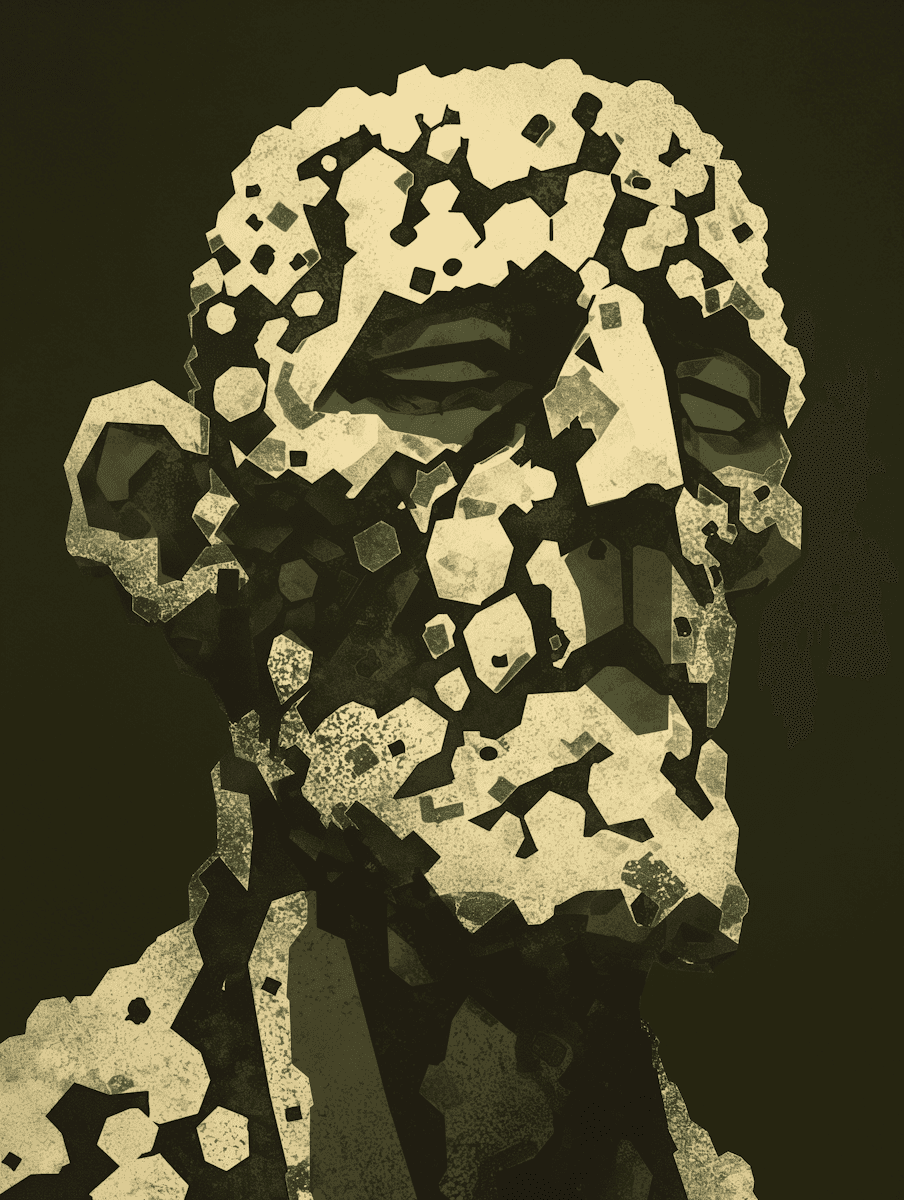
©️ Art by Deep Patel
What Does Brain Rot Look Like in 2026?
Brain rot is the next stage of scrolling.
It looks like:
Scrolling without really paying attention to what you’re seeing.
Opening one app, then another, then another, without knowing why. Just reflex.
Being unable to read even a short text. Five pages of a novel already feels like too much.
Being unable to watch a movie or a show without checking your phone.
A lingering fatigue that never really goes away.
A deep sense of boredom despite having endless stimulation at your fingertips.
That’s brain rot.
Is My Brain Actually Rotting?
Not really. At least not biologically.
You’re not becoming less intelligent. You’re becoming mentally lazy and attention-fragmented—to a point where it becomes a real problem. Your brain has simply adapted to very short, fast, varied, highly stimulating content. In return, it now struggles with slowness, continuity, long attention spans, and silence. It’s stuck in permanent “channel-surfing” mode.
It’s a bit scary. But it’s real.
In short: the more content you consume, the less you enjoy it. The more you scroll to compensate, the less you feel like doing anything else. Your brain gets used to this pattern and starts rejecting real life—the one at 1× speed, without subtitles.
So if this sounds like you: congratulations. Your brain is desensitized from too much easy dopamine.
What Caused This Brain Rot?
First: you’re not the only one responsible. If we’re all addicted to apps like TikTok and Instagram, it’s not by accident. These apps are carefully designed to keep you captive for as long as possible.
Problem #1: Your Brain Loves Novelty
Your brain has always loved what’s new, what moves, what surprises. In human history, this was tied to survival.
Food → Danger → Opportunity.
This is deeply wired into how we function. It’s almost impossible to fight. Well… yes and no.
Problem #2: Modern Platforms Exploit This Perfectly
Apps like YouTube, Instagram, TikTok, and others are built to keep your brain in a constant state of alert.
Think: no natural stopping point (infinite scroll), chains of ultra-short content, constant topic changes (no boredom), and surprises every few seconds.
These design patterns keep your dopamine system firing almost nonstop, making your brain think, “Maybe the next video will be even better than the last 15.” And the result? You stay longer. Always longer.
Problem #3: Speed
For the first time in human history, your brain is exposed to this much information in this little time.
One TikTok ≈ 15 seconds ≈ one piece of information.
If you spend one hour on it:
3,600 seconds ÷ 15 = about 240 videos.That’s 240 different pieces of information in one hour.
Add to that:
Different faces
Different ideas
Different emotions
At high doses, this leaves a mark. Your brain adapts just to survive this flood of content. The result? It becomes unable to stay focused on one thing in real life.
Problem #4: A Habit Takes Root
It’s easy, free, and always within reach. So why stop?
Even if you know the consequences, it’s now part of your routine. What used to take a small place now takes up more and more space. And changing habits is hard—especially when it relies entirely on willpower.

Brain rot is what happens when your brain is so overloaded with rapid stimulation that it becomes almost impossible to do anything else. It’s just too hard. So you keep consuming this poisonous content… and slowly “self-rotting.” Yummy.
Let’s introduce ourselves. I’m Laureline. I’m an interface designer, and for nearly 10 years I’ve worked on problematic phone use (since “addiction” still isn’t officially recognized by the WHO in this context). For the past four years, I’ve been working on the Jomo app, which I co-created with Thomas, the developer. We’ve written many articles on this topic and will keep doing so as long as it’s relevant. If this interests you as much as it interests us, feel free to explore our blog. Otherwise, enjoy the read.
What Is Brain Rot?
This isn’t a medical diagnosis or a new disease. It’s a popular term on social media—especially TikTok—used to describe a mental state caused by constant exposure to short, meaningless content.
But don’t dismiss it as just another “TikTok word.” Brain rot, named Oxford Word of the Year 2024, is not new at all. The term dates back to 1854. It was introduced by Henry David Thoreau in Walden:
“While England endeavors to cure the potato rot, will not any endeavor to cure the brain rot — which prevails so much more widely and fatally?”
He was already pointing out information overload, distraction, and the loss of intellectual depth.
Funny how humans seem to learn so well from their mistakes that the term comes back 172 years later. Because it perfectly describes what we’re experiencing today with social media: a brain saturated with short, fast, varied content that loses its ability to focus.
So no, this isn’t a TikTok-made illness. It’s a powerful and very accurate metaphor.

©️ Art by Deep Patel
What Does Brain Rot Look Like in 2026?
Brain rot is the next stage of scrolling.
It looks like:
Scrolling without really paying attention to what you’re seeing.
Opening one app, then another, then another, without knowing why. Just reflex.
Being unable to read even a short text. Five pages of a novel already feels like too much.
Being unable to watch a movie or a show without checking your phone.
A lingering fatigue that never really goes away.
A deep sense of boredom despite having endless stimulation at your fingertips.
That’s brain rot.
Is My Brain Actually Rotting?
Not really. At least not biologically.
You’re not becoming less intelligent. You’re becoming mentally lazy and attention-fragmented—to a point where it becomes a real problem. Your brain has simply adapted to very short, fast, varied, highly stimulating content. In return, it now struggles with slowness, continuity, long attention spans, and silence. It’s stuck in permanent “channel-surfing” mode.
It’s a bit scary. But it’s real.
In short: the more content you consume, the less you enjoy it. The more you scroll to compensate, the less you feel like doing anything else. Your brain gets used to this pattern and starts rejecting real life—the one at 1× speed, without subtitles.
So if this sounds like you: congratulations. Your brain is desensitized from too much easy dopamine.
What Caused This Brain Rot?
First: you’re not the only one responsible. If we’re all addicted to apps like TikTok and Instagram, it’s not by accident. These apps are carefully designed to keep you captive for as long as possible.
Problem #1: Your Brain Loves Novelty
Your brain has always loved what’s new, what moves, what surprises. In human history, this was tied to survival.
Food → Danger → Opportunity.
This is deeply wired into how we function. It’s almost impossible to fight. Well… yes and no.
Problem #2: Modern Platforms Exploit This Perfectly
Apps like YouTube, Instagram, TikTok, and others are built to keep your brain in a constant state of alert.
Think: no natural stopping point (infinite scroll), chains of ultra-short content, constant topic changes (no boredom), and surprises every few seconds.
These design patterns keep your dopamine system firing almost nonstop, making your brain think, “Maybe the next video will be even better than the last 15.” And the result? You stay longer. Always longer.
Problem #3: Speed
For the first time in human history, your brain is exposed to this much information in this little time.
One TikTok ≈ 15 seconds ≈ one piece of information.
If you spend one hour on it:
3,600 seconds ÷ 15 = about 240 videos.That’s 240 different pieces of information in one hour.
Add to that:
Different faces
Different ideas
Different emotions
At high doses, this leaves a mark. Your brain adapts just to survive this flood of content. The result? It becomes unable to stay focused on one thing in real life.
Problem #4: A Habit Takes Root
It’s easy, free, and always within reach. So why stop?
Even if you know the consequences, it’s now part of your routine. What used to take a small place now takes up more and more space. And changing habits is hard—especially when it relies entirely on willpower.
Brain rot is what happens when your brain is so overloaded with rapid stimulation that it becomes almost impossible to do anything else. It’s just too hard. So you keep consuming this poisonous content… and slowly “self-rotting.” Yummy.
Let’s introduce ourselves. I’m Laureline. I’m an interface designer, and for nearly 10 years I’ve worked on problematic phone use (since “addiction” still isn’t officially recognized by the WHO in this context). For the past four years, I’ve been working on the Jomo app, which I co-created with Thomas, the developer. We’ve written many articles on this topic and will keep doing so as long as it’s relevant. If this interests you as much as it interests us, feel free to explore our blog. Otherwise, enjoy the read.
What Is Brain Rot?
This isn’t a medical diagnosis or a new disease. It’s a popular term on social media—especially TikTok—used to describe a mental state caused by constant exposure to short, meaningless content.
But don’t dismiss it as just another “TikTok word.” Brain rot, named Oxford Word of the Year 2024, is not new at all. The term dates back to 1854. It was introduced by Henry David Thoreau in Walden:
“While England endeavors to cure the potato rot, will not any endeavor to cure the brain rot — which prevails so much more widely and fatally?”
He was already pointing out information overload, distraction, and the loss of intellectual depth.
Funny how humans seem to learn so well from their mistakes that the term comes back 172 years later. Because it perfectly describes what we’re experiencing today with social media: a brain saturated with short, fast, varied content that loses its ability to focus.
So no, this isn’t a TikTok-made illness. It’s a powerful and very accurate metaphor.

©️ Art by Deep Patel
What Does Brain Rot Look Like in 2026?
Brain rot is the next stage of scrolling.
It looks like:
Scrolling without really paying attention to what you’re seeing.
Opening one app, then another, then another, without knowing why. Just reflex.
Being unable to read even a short text. Five pages of a novel already feels like too much.
Being unable to watch a movie or a show without checking your phone.
A lingering fatigue that never really goes away.
A deep sense of boredom despite having endless stimulation at your fingertips.
That’s brain rot.
Is My Brain Actually Rotting?
Not really. At least not biologically.
You’re not becoming less intelligent. You’re becoming mentally lazy and attention-fragmented—to a point where it becomes a real problem. Your brain has simply adapted to very short, fast, varied, highly stimulating content. In return, it now struggles with slowness, continuity, long attention spans, and silence. It’s stuck in permanent “channel-surfing” mode.
It’s a bit scary. But it’s real.
In short: the more content you consume, the less you enjoy it. The more you scroll to compensate, the less you feel like doing anything else. Your brain gets used to this pattern and starts rejecting real life—the one at 1× speed, without subtitles.
So if this sounds like you: congratulations. Your brain is desensitized from too much easy dopamine.
What Caused This Brain Rot?
First: you’re not the only one responsible. If we’re all addicted to apps like TikTok and Instagram, it’s not by accident. These apps are carefully designed to keep you captive for as long as possible.
Problem #1: Your Brain Loves Novelty
Your brain has always loved what’s new, what moves, what surprises. In human history, this was tied to survival.
Food → Danger → Opportunity.
This is deeply wired into how we function. It’s almost impossible to fight. Well… yes and no.
Problem #2: Modern Platforms Exploit This Perfectly
Apps like YouTube, Instagram, TikTok, and others are built to keep your brain in a constant state of alert.
Think: no natural stopping point (infinite scroll), chains of ultra-short content, constant topic changes (no boredom), and surprises every few seconds.
These design patterns keep your dopamine system firing almost nonstop, making your brain think, “Maybe the next video will be even better than the last 15.” And the result? You stay longer. Always longer.
Problem #3: Speed
For the first time in human history, your brain is exposed to this much information in this little time.
One TikTok ≈ 15 seconds ≈ one piece of information.
If you spend one hour on it:
3,600 seconds ÷ 15 = about 240 videos.That’s 240 different pieces of information in one hour.
Add to that:
Different faces
Different ideas
Different emotions
At high doses, this leaves a mark. Your brain adapts just to survive this flood of content. The result? It becomes unable to stay focused on one thing in real life.
Problem #4: A Habit Takes Root
It’s easy, free, and always within reach. So why stop?
Even if you know the consequences, it’s now part of your routine. What used to take a small place now takes up more and more space. And changing habits is hard—especially when it relies entirely on willpower.

Your phone, your rules. Block on command and own your time.
For 30min
Everyday
On weekends
During workhours
From 10 pm to 8 am
For 7 days
All the time

Your phone, your rules. Block on command and own your time.
For 30min
Everyday
On weekends
During workhours
From 10 pm to 8 am
For 7 days
All the time

Your phone, your rules. Block on command and own your time.
For 30min
Everyday
On weekends
During workhours
From 10 pm to 8 am
For 7 days
All the time
The Good News?
Brain rot is not permanent. It’s reversible. You have the keys.
This is similar to dopamine regulation. We all have a baseline level, and sometimes it goes above normal. You simply need to bring it back down to a healthy threshold.
And don’t worry. This won’t cost you $800 in a course or require the wisdom of a monk.
You’re going to reprogram your environment to make doomscrolling as difficult as possible—the behavior that leads to brain rot.
Step 1: Cut the Problem at the Source
You can’t lose weight if you keep eating burgers and chocolate bars back to back. It’s the same with brain rot: you can’t help yourself if you keep bingeing on endless short-form content. It’s simple math. It’s common sense. It’s obvious—and still easy to ignore.
So yes, you’ll need to reduce your consumption a bit. To help with that, here are a few methods (from the gentlest to the most radical):
Turn off all notifications. Yes, you’ve read this everywhere. And yet, 81% of Android users still accept notifications when prompted. The message clearly isn’t getting through. Notifications are one of the main triggers that make you pick up your phone. In fact, 4.6% of users who receive a push notification react to it.
Set up a blocking rule in Jomo to gradually reduce your usage (especially by adding friction when opening social media apps) → you’ll find the full tutorial just below.
Delete your most addictive apps (TikTok, Instagram, Snapchat, …) and try using the browser versions for the ones with more varied use cases (like YouTube, which offers both long, educational content and short, viral videos).
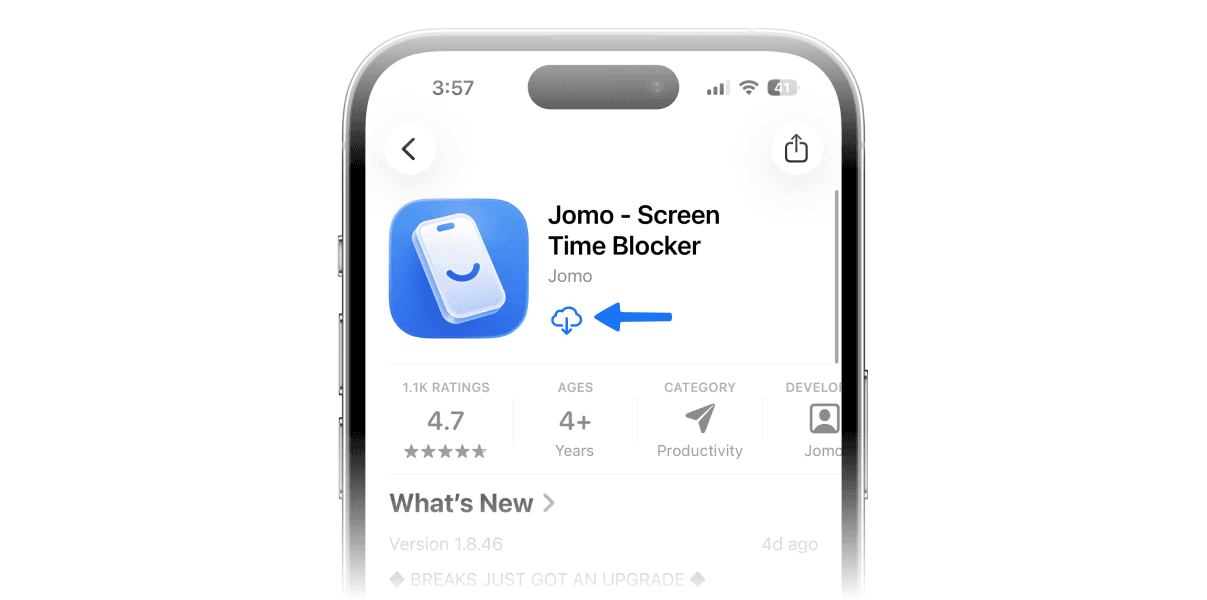
As promised, here’s the quick Jomo tutorial:
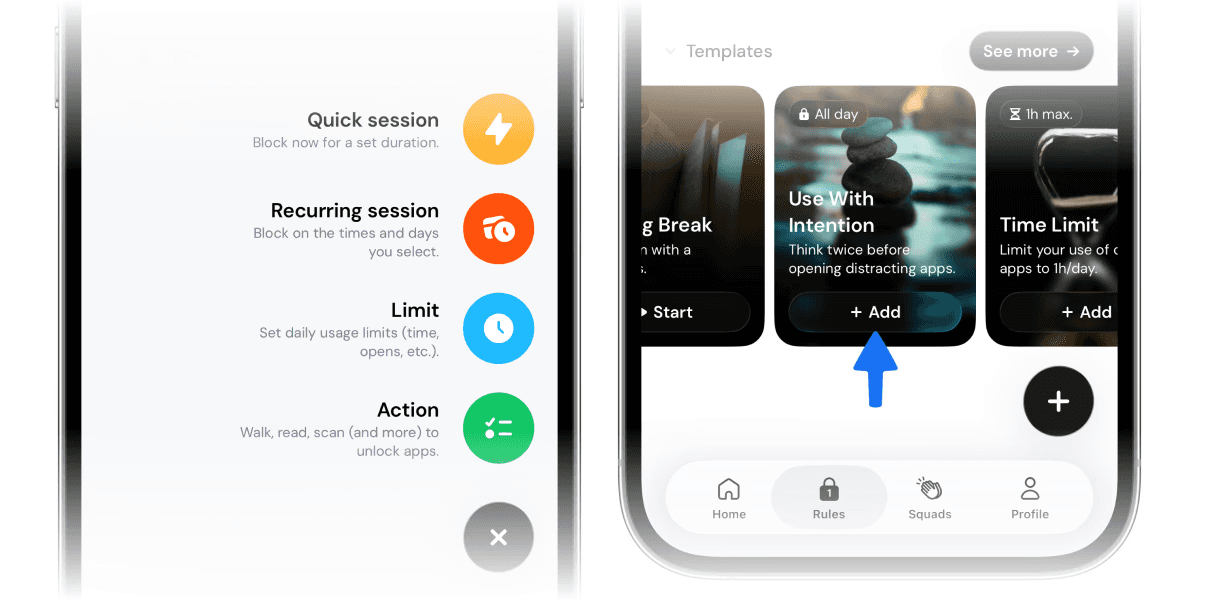
Open Jomo, then go to Rules.
At the bottom, tap the “Use With Intention” template.
In Block → add your social media apps to start.
In Active → set it to Always-On.
In Breaks → allow yourself only 4–5 breaks per day (that’s more than enough… If you take just 5 breaks of 15 minutes, that’s already 1h25 per day on these apps).
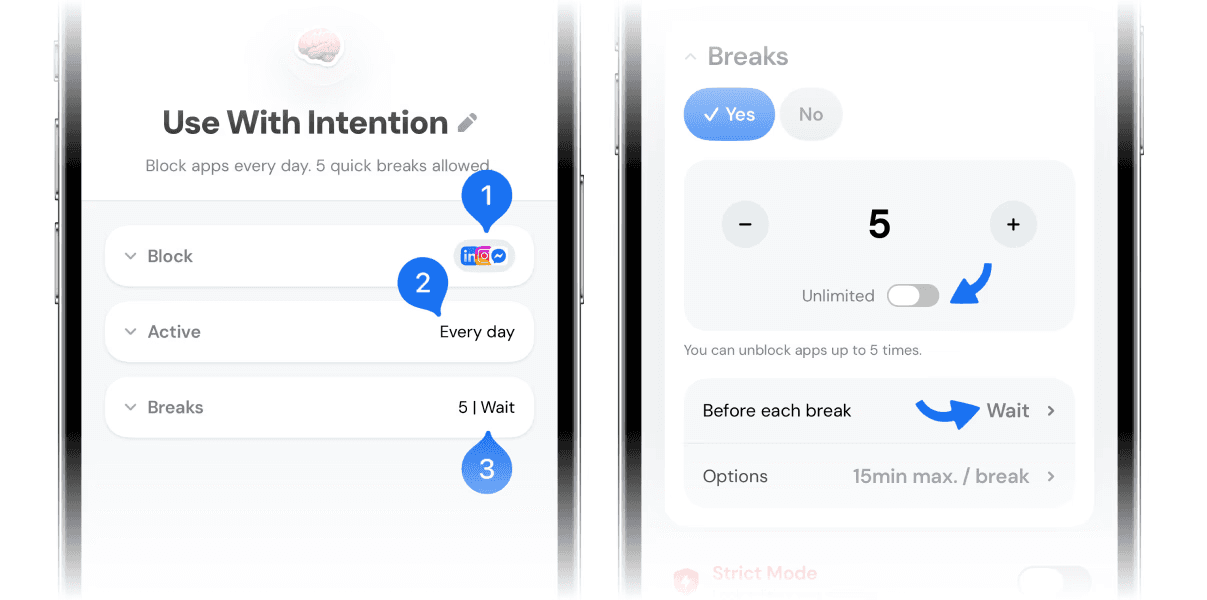
Before each break, the best exercises are:
Wait: you’ll have to wait before using the apps, and the delay increases over time.
Intention: you’ll need to state why you want to use the apps.
Recopy: you’ll have to copy a long text that discourages you from using the apps.
Take a photo (AI): you’ll need to take a photo of a completed action to unlock access (for example: dishes done, dishwasher emptied, laundry hung up, etc.).
Then just tap “Schedule” to get started.
What does this rule actually do? Simple: by default, the selected apps are blocked. You’ll have to complete an action—something intentional—to access them. And of course, the time you spend on them will be limited. You can still use them, but in small, controlled doses.
Step 2: Relearn Boredom (This Is the Key)
What’s funny about boredom is that you think it’s something bad, something to avoid at all costs. But it’s not. In fact, boredom is good for your brain. It allows it to digest the information you’ve seen, heard, and absorbed throughout the day. It sorts, discards, and compiles new data. Without this time, it simply can’t do that work. It’s like eating endlessly without ever taking time to digest… At some point, you don’t need a diagram to understand that it just won’t fit anymore.
Here are a few simple things you can do every day to “bore” yourself properly:
Force yourself to spend at least 10 minutes without your phone.
Spend time in silence (no music, no podcast, nothing) and actually enjoy it.
Take moments to deliberately think and build mental images.
At first, it will feel uncomfortable and strange. But you know what? That’s normal. Your brain is repairing itself.
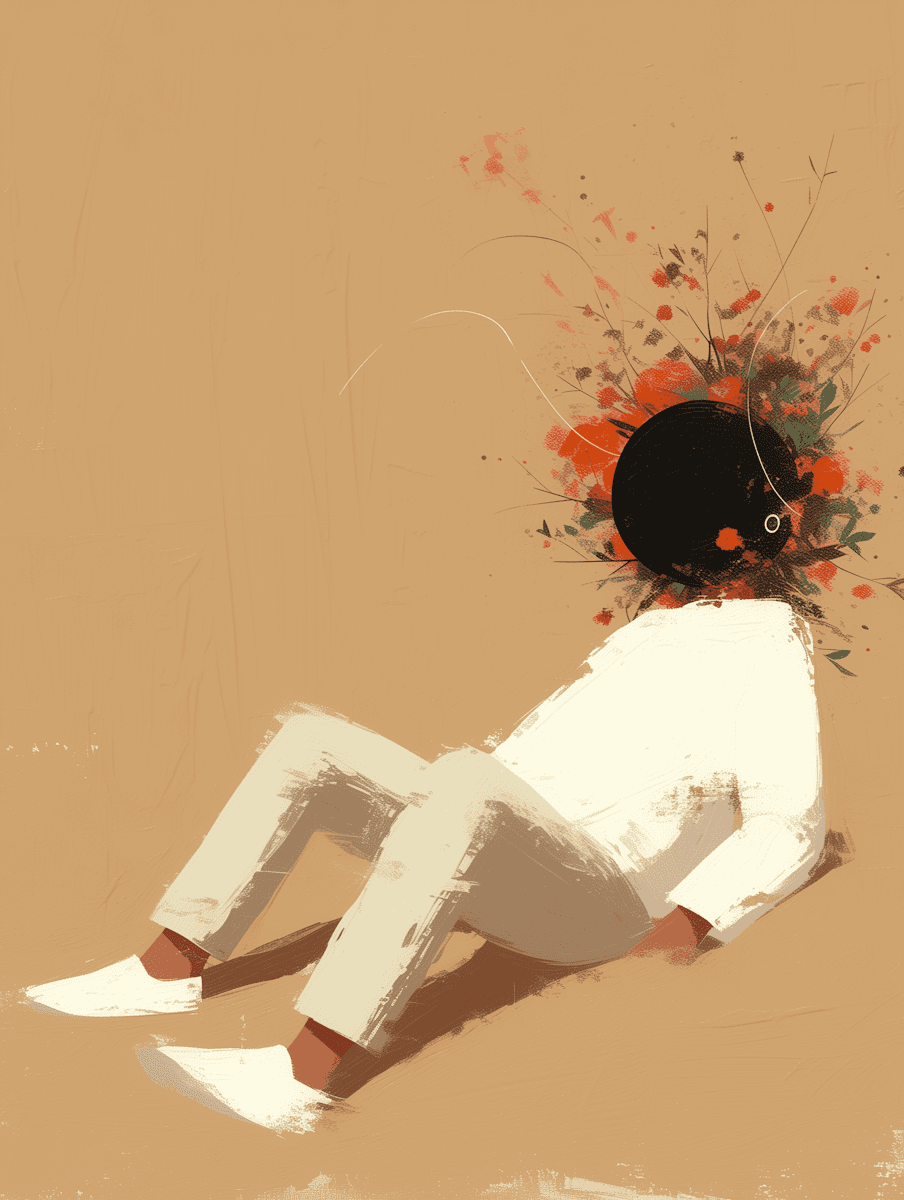
©️ Art by West Kast.
Step 3: Replace Cheap Dopamine With Good Dopamine
The goal isn’t to drain your life of meaning, but to give it more. This often comes from doing real actions and activities. The idea is to replace the bad dopamine (generated by social media) with higher-quality dopamine.
For example, try the 1-for-1 technique:
If you scroll for 20 minutes, make yourself run for 20 minutes in return (according to your fitness level).
If you binge-watch for 1.5 hours, make yourself cook for 1.5 hours.
If you watch short content for 45 minutes, make yourself do a long activity (like reading) for 45 minutes.
After a few days, you’ll really notice:
The benefits of keeping this ratio.
A form of “punishment” that gradually turns into something positive.
What Should You Expect? (Important)
Mostly discomfort. But nothing serious or impossible to handle.
First few days: you’ll feel restless. You’ll constantly want to grab your phone. Your willpower will feel weak, and you’ll want to give up. This is where you need to hold on.
Second week: the deep boredom will start to fade. It may still appear at times, but overall, it will get better.
After the second week: calm returns.
Many people think they have ADHD based on a TikTok self-diagnosis or believe their focus is “destroyed” for one reason or another. But according to recent studies, only 3.1% of adults worldwide actually have ADHD.
The reality is that most people are simply overloaded with “cheap” dopamine, which undeniably affects their ability to focus. But it doesn’t cause an incurable disease or a permanent attention disorder.
Brain rot is reversible. Simply. For free. And quickly. Because brain rot is just a brain that got used to too much speed… and can no longer tolerate slowness.
Thank you for reading this far, it truly means a lot. I wrote this article with my brain and the help of the internet. I add sources when I think of them and remember, so you can keep exploring the topic. If you want to try the Jomo app, you can use my referral code FG2HA9 to get 14 days of free access to the paid version.
The Good News?
Brain rot is not permanent. It’s reversible. You have the keys.
This is similar to dopamine regulation. We all have a baseline level, and sometimes it goes above normal. You simply need to bring it back down to a healthy threshold.
And don’t worry. This won’t cost you $800 in a course or require the wisdom of a monk.
You’re going to reprogram your environment to make doomscrolling as difficult as possible—the behavior that leads to brain rot.
Step 1: Cut the Problem at the Source
You can’t lose weight if you keep eating burgers and chocolate bars back to back. It’s the same with brain rot: you can’t help yourself if you keep bingeing on endless short-form content. It’s simple math. It’s common sense. It’s obvious—and still easy to ignore.
So yes, you’ll need to reduce your consumption a bit. To help with that, here are a few methods (from the gentlest to the most radical):
Turn off all notifications. Yes, you’ve read this everywhere. And yet, 81% of Android users still accept notifications when prompted. The message clearly isn’t getting through. Notifications are one of the main triggers that make you pick up your phone. In fact, 4.6% of users who receive a push notification react to it.
Set up a blocking rule in Jomo to gradually reduce your usage (especially by adding friction when opening social media apps) → you’ll find the full tutorial just below.
Delete your most addictive apps (TikTok, Instagram, Snapchat, …) and try using the browser versions for the ones with more varied use cases (like YouTube, which offers both long, educational content and short, viral videos).
As promised, here’s the quick Jomo tutorial:
Open Jomo, then go to Rules.
At the bottom, tap the “Use With Intention” template.
In Block → add your social media apps to start.
In Active → set it to Always-On.
In Breaks → allow yourself only 4–5 breaks per day (that’s more than enough… If you take just 5 breaks of 15 minutes, that’s already 1h25 per day on these apps).


Before each break, the best exercises are:
Wait: you’ll have to wait before using the apps, and the delay increases over time.
Intention: you’ll need to state why you want to use the apps.
Recopy: you’ll have to copy a long text that discourages you from using the apps.
Take a photo (AI): you’ll need to take a photo of a completed action to unlock access (for example: dishes done, dishwasher emptied, laundry hung up, etc.).
Then just tap “Schedule” to get started.
What does this rule actually do? Simple: by default, the selected apps are blocked. You’ll have to complete an action—something intentional—to access them. And of course, the time you spend on them will be limited. You can still use them, but in small, controlled doses.
Step 2: Relearn Boredom (This Is the Key)
What’s funny about boredom is that you think it’s something bad, something to avoid at all costs. But it’s not. In fact, boredom is good for your brain. It allows it to digest the information you’ve seen, heard, and absorbed throughout the day. It sorts, discards, and compiles new data. Without this time, it simply can’t do that work. It’s like eating endlessly without ever taking time to digest… At some point, you don’t need a diagram to understand that it just won’t fit anymore.
Here are a few simple things you can do every day to “bore” yourself properly:
Force yourself to spend at least 10 minutes without your phone.
Spend time in silence (no music, no podcast, nothing) and actually enjoy it.
Take moments to deliberately think and build mental images.
At first, it will feel uncomfortable and strange. But you know what? That’s normal. Your brain is repairing itself.

©️ Art by West Kast.
Step 3: Replace Cheap Dopamine With Good Dopamine
The goal isn’t to drain your life of meaning, but to give it more. This often comes from doing real actions and activities. The idea is to replace the bad dopamine (generated by social media) with higher-quality dopamine.
For example, try the 1-for-1 technique:
If you scroll for 20 minutes, make yourself run for 20 minutes in return (according to your fitness level).
If you binge-watch for 1.5 hours, make yourself cook for 1.5 hours.
If you watch short content for 45 minutes, make yourself do a long activity (like reading) for 45 minutes.
After a few days, you’ll really notice:
The benefits of keeping this ratio.
A form of “punishment” that gradually turns into something positive.
What Should You Expect? (Important)
Mostly discomfort. But nothing serious or impossible to handle.
First few days: you’ll feel restless. You’ll constantly want to grab your phone. Your willpower will feel weak, and you’ll want to give up. This is where you need to hold on.
Second week: the deep boredom will start to fade. It may still appear at times, but overall, it will get better.
After the second week: calm returns.
Many people think they have ADHD based on a TikTok self-diagnosis or believe their focus is “destroyed” for one reason or another. But according to recent studies, only 3.1% of adults worldwide actually have ADHD.
The reality is that most people are simply overloaded with “cheap” dopamine, which undeniably affects their ability to focus. But it doesn’t cause an incurable disease or a permanent attention disorder.
Brain rot is reversible. Simply. For free. And quickly. Because brain rot is just a brain that got used to too much speed… and can no longer tolerate slowness.
Thank you for reading this far, it truly means a lot. I wrote this article with my brain and the help of the internet. I add sources when I think of them and remember, so you can keep exploring the topic. If you want to try the Jomo app, you can use my referral code FG2HA9 to get 14 days of free access to the paid version.
The Good News?
Brain rot is not permanent. It’s reversible. You have the keys.
This is similar to dopamine regulation. We all have a baseline level, and sometimes it goes above normal. You simply need to bring it back down to a healthy threshold.
And don’t worry. This won’t cost you $800 in a course or require the wisdom of a monk.
You’re going to reprogram your environment to make doomscrolling as difficult as possible—the behavior that leads to brain rot.
Step 1: Cut the Problem at the Source
You can’t lose weight if you keep eating burgers and chocolate bars back to back. It’s the same with brain rot: you can’t help yourself if you keep bingeing on endless short-form content. It’s simple math. It’s common sense. It’s obvious—and still easy to ignore.
So yes, you’ll need to reduce your consumption a bit. To help with that, here are a few methods (from the gentlest to the most radical):
Turn off all notifications. Yes, you’ve read this everywhere. And yet, 81% of Android users still accept notifications when prompted. The message clearly isn’t getting through. Notifications are one of the main triggers that make you pick up your phone. In fact, 4.6% of users who receive a push notification react to it.
Set up a blocking rule in Jomo to gradually reduce your usage (especially by adding friction when opening social media apps) → you’ll find the full tutorial just below.
Delete your most addictive apps (TikTok, Instagram, Snapchat, …) and try using the browser versions for the ones with more varied use cases (like YouTube, which offers both long, educational content and short, viral videos).
As promised, here’s the quick Jomo tutorial:
Open Jomo, then go to Rules.
At the bottom, tap the “Use With Intention” template.
In Block → add your social media apps to start.
In Active → set it to Always-On.
In Breaks → allow yourself only 4–5 breaks per day (that’s more than enough… If you take just 5 breaks of 15 minutes, that’s already 1h25 per day on these apps).


Before each break, the best exercises are:
Wait: you’ll have to wait before using the apps, and the delay increases over time.
Intention: you’ll need to state why you want to use the apps.
Recopy: you’ll have to copy a long text that discourages you from using the apps.
Take a photo (AI): you’ll need to take a photo of a completed action to unlock access (for example: dishes done, dishwasher emptied, laundry hung up, etc.).
Then just tap “Schedule” to get started.
What does this rule actually do? Simple: by default, the selected apps are blocked. You’ll have to complete an action—something intentional—to access them. And of course, the time you spend on them will be limited. You can still use them, but in small, controlled doses.
Step 2: Relearn Boredom (This Is the Key)
What’s funny about boredom is that you think it’s something bad, something to avoid at all costs. But it’s not. In fact, boredom is good for your brain. It allows it to digest the information you’ve seen, heard, and absorbed throughout the day. It sorts, discards, and compiles new data. Without this time, it simply can’t do that work. It’s like eating endlessly without ever taking time to digest… At some point, you don’t need a diagram to understand that it just won’t fit anymore.
Here are a few simple things you can do every day to “bore” yourself properly:
Force yourself to spend at least 10 minutes without your phone.
Spend time in silence (no music, no podcast, nothing) and actually enjoy it.
Take moments to deliberately think and build mental images.
At first, it will feel uncomfortable and strange. But you know what? That’s normal. Your brain is repairing itself.

©️ Art by West Kast.
Step 3: Replace Cheap Dopamine With Good Dopamine
The goal isn’t to drain your life of meaning, but to give it more. This often comes from doing real actions and activities. The idea is to replace the bad dopamine (generated by social media) with higher-quality dopamine.
For example, try the 1-for-1 technique:
If you scroll for 20 minutes, make yourself run for 20 minutes in return (according to your fitness level).
If you binge-watch for 1.5 hours, make yourself cook for 1.5 hours.
If you watch short content for 45 minutes, make yourself do a long activity (like reading) for 45 minutes.
After a few days, you’ll really notice:
The benefits of keeping this ratio.
A form of “punishment” that gradually turns into something positive.
What Should You Expect? (Important)
Mostly discomfort. But nothing serious or impossible to handle.
First few days: you’ll feel restless. You’ll constantly want to grab your phone. Your willpower will feel weak, and you’ll want to give up. This is where you need to hold on.
Second week: the deep boredom will start to fade. It may still appear at times, but overall, it will get better.
After the second week: calm returns.
Many people think they have ADHD based on a TikTok self-diagnosis or believe their focus is “destroyed” for one reason or another. But according to recent studies, only 3.1% of adults worldwide actually have ADHD.
The reality is that most people are simply overloaded with “cheap” dopamine, which undeniably affects their ability to focus. But it doesn’t cause an incurable disease or a permanent attention disorder.
Brain rot is reversible. Simply. For free. And quickly. Because brain rot is just a brain that got used to too much speed… and can no longer tolerate slowness.
Thank you for reading this far, it truly means a lot. I wrote this article with my brain and the help of the internet. I add sources when I think of them and remember, so you can keep exploring the topic. If you want to try the Jomo app, you can use my referral code FG2HA9 to get 14 days of free access to the paid version.
Credits
Illustrations & Photographies by Lummi and Unsplash.
[1] Oxford University Press — Brain rot’ named Oxford Word of the Year 2024, 2024.
[2] Siân Boyle — Is doom scrolling really rotting our brains? The evidence is getting harder to ignore, The Guardian, 2024.
[3] Wikipedia — Brainrot, 2026.
[4] Maillé — “Brainrot” : les vidéos courtes abîment-elles notre cerveau ?, Usbek & Rica, 2026.
[5] Levine — What Is Brain Rot?, WebMD, 2025.
Continue reading
Continue reading
The Joy Of Missing Out

Crafted in Europe
All rights reserved to Jomo SAS, 2026
The Joy Of Missing Out

Crafted in Europe
All rights reserved to Jomo SAS, 2026
The Joy Of Missing Out

Crafted in Europe
All rights reserved to Jomo SAS, 2026