Understand
3 min
How to Stop Procrastinating in 2026 (With ADHD or Not)?
Personally, there’s one thing that really annoys me: the confusion people make between being lazy and procrastinating.

Procrastination is something that should actually be taken seriously, and yet it’s so often looked down on… Wait, you don’t see the difference? Perfect — this article is for you.
But before we begin, let me introduce myself. The little voice you’re reading is Laureline. I’m the designer and co-founder of the Jomo app. I’ve been working in ergonomics and interface design for the past 10 years. In 2022, we launched Jomo to finally bring a long-standing idea to life: a great app to help people stop mindless scrolling and take back control of their lives. I wrote this article myself, with my own two hands and my little brain. So if you enjoyed it or found it helpful, feel free to share it and send us your feedback!
Procrastination: What Is It?
Contrary to popular belief, procrastination isn’t about doing nothing. It’s about deliberately postponing a task you know is important in favor of something easier or more enjoyable. The goal isn’t inactivity — it’s comfort.
Classic examples:
Replying to emails or messages instead of working on an important project.
Watching videos or tutorials instead of starting a difficult task.
Tidying up or cleaning to avoid uncomfortable situations.
So Why Do We Do It?
Procrastination is mainly about poor emotional regulation, more than poor time management. When an important task appears, your brain can react in two ways: either it confronts it (so you complete the task), or it looks for an escape (so you avoid it). It’s a defense mechanism against a surge of stress, uncertainty, fear of failure, or sometimes simply boredom. Its only goal is to find an immediate way out.
What makes procrastination particularly complex in 2026 is that these escape routes are incredibly hard to ignore — or even resist. Many of them (social media, videos, small easy tasks…) deliver a quick reward (dopamine) with almost no effort in return… exactly what a dopamine-hungry brain loves.
Procrastination: Is It Just Laziness?
Not really. The two are often confused, but they actually refer to very different things.
Laziness is simply not feeling like doing something. For example, not wanting to go for a walk or do a task. Sometimes that’s perfectly normal—and in certain situations, it can even be healthy.
Procrastination, on the other hand, is when you do want to complete a task and recognize its importance, yet still choose to postpone it. Most of the time, procrastination comes with feelings of guilt, stress, or even frustration.

©️ Art by Amino.
If I Procrastinate Often, Does It Mean Something Is Wrong With Me?
Procrastination isn’t a disease. It’s more of a behavior that people adopt. And don’t worry—it’s extremely common.
However, procrastination can be amplified by certain conditions such as ADHD, anxiety, depression, or, on the opposite end, perfectionism. These can make it harder to take action. Whether it’s due to difficulties with organization, attention management, low motivation, or even an excessive fear of failure, getting started can simply feel much more challenging.

But Why Do We Procrastinate So Much Today? …
Because we’re all completely useless. The end. See you.
No, more seriously. Humans have always procrastinated. The difference between yesterday and today is that distractions have become increasingly appealing, harder to resist, and constantly available.
Just look at the world we live in. Between social media, ultra-short vertical content, notifications… in your pocket sits a real infernal casino. At any moment you can get an instant reward, with no effort, and an unlimited supply.
On the other hand, it’s much harder to deal with tasks that require thinking, creativity, or long periods of focus. These tasks demand a lot, they’re mentally costly, and incredibly easy to avoid… Sometimes it almost feels like there isn’t even a real choice.
… and Why Is That a Problem?
Procrastinating from time to time is fine. It’s normal. But when it becomes a regular pattern, that’s when it starts to cause real problems:
Stress builds up. The longer you postpone a task, the heavier it becomes mentally. It turns into a burden you carry over time (and remember: mental capacity isn’t unlimited, it’s more like a limited “quota”).
Last-minute work. Most tasks end up being finished in a rush, sometimes right before the deadline, under much more pressure. Mistakes also become statistically more likely.
Loss of confidence. Repeated procrastination can make you feel undisciplined, incapable of moving forward, or stuck. Over time, this can seriously affect your self-esteem.

©️ Art by Chris Lynch.
How to Stop Procrastinating (5 Key Tips)
And yes, our signature is practical advice. Step one: we explain. Step two: we act. So I’ve gathered some useful, actionable tips to help you procrastinate less and take back control.
1 – Make the Task as Small as Possible
Procrastination often happens at the very beginning. That moment of “I need to get started” can feel like a wall that’s hard to climb. When a task feels too big, it can trigger stress, uncertainty, and avoidance.
So the idea is to shrink the task as much as possible. Break it down into many tiny steps. Instead of telling yourself “I need to work on my project,” try something like: spend 10 minutes doing research, write down a few initial ideas, take a short break, review what you wrote, add more research, and so on. Once you get started, the momentum shifts to your side.
2 – Remove Distractions (Before You Start)
Sometimes willpower just isn’t enough. A little external help goes a long way. And that starts with removing distractions around you — especially your phone. It’s hard to begin when your brain knows an easy, instant reward is right there within reach. The fewer temptations you have, the easier it is to start.
To do that:
Move your phone as far away as possible.
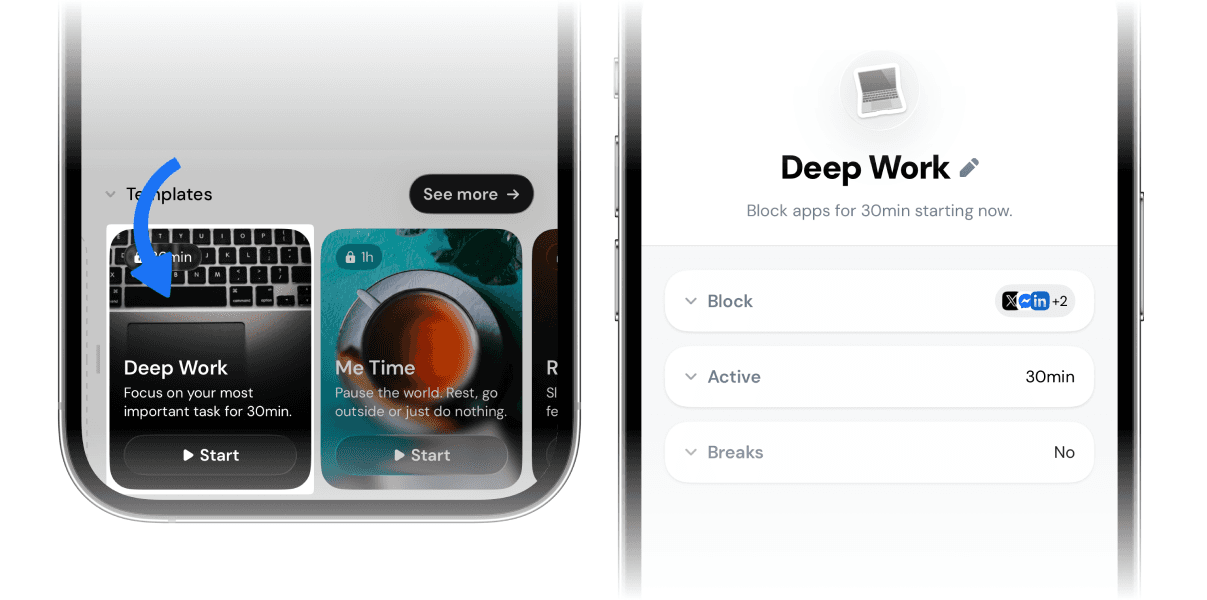
Block distracting apps with Jomo (start a Session that temporarily blocks apps for as long as you need). To do this:
Go to the Rules section > Templates.
Tap “Deep Work.”
Choose the distracting apps you want to block.
Select the duration and start the session.
Close all unnecessary tabs and apps.

3 – Work in Short Cycles
Your brain struggles to stay motivated, so if you tell it you need to work all afternoon, there’s a good chance it won’t cooperate. You need to force yourself to think differently. Instead of saying “I need to work all afternoon,” tell yourself “I’ll work for 25 minutes.” You know you’ll repeat those 25-minute sessions afterward, but to get started, it feels much more manageable.
For this, we recommend the Pomodoro technique. We’ve already covered it in several blog posts, so feel free to check those out.
This approach helps you:
Start more easily
Preserve your mental energy (instead of wasting it just trying to get started)
Avoid cognitive fatigue
4 – Make the First Step Obvious
Procrastination often comes from not having a clear plan in mind. “I’m working on a project”… okay, but that doesn’t say anything about the time, the complexity, or what actually needs to be done. Try to see the “project” not as one big thing, but as a series of smaller elements that make up the whole. Most importantly, the next task should never be a guessing game. You should always know exactly what comes next. For example:
Write the introduction
Review page one
Send a message
5 – Accept Imperfection
Perfectionism is a major cause of procrastination. Many of us delay starting because we’re too afraid of failing. We want to do things right, find the perfect idea, produce something flawless… but that’s not how it works. The real approach is:
Create a first imperfect version
Correct it
Improve it
And repeat
The Takeaway 🍔
Procrastination usually isn’t a discipline problem. It’s often a mix of tasks that feel too big, constant distractions, or emotional discomfort. But don’t worry: when you simplify tasks and reduce distractions, it becomes much easier to get started.
Thanks for reading this far. I hope it helped you understand things better—and maybe even inspired you to make a change. If so, with my referral code you can get a 14-day free trial on Jomo: FG2HA9. Feel free to give it a try.