Productivity
5 min
How Do You Seriously Reduce Your Screen Time in 2026?
Maybe you’ve just realized that you spend more than 5 hours a day on your phone—almost a third of your waking hours…



Let’s Get Practical: Solutions That Actually Work
For us, it’s important to understand the root of a problem before jumping to solutions. You can’t treat something if you don’t understand what it really is, right?
We were honestly a bit tired of the same old tips you see everywhere online. The same recycled hacks you’ve already seen a hundred times, probably tried before, and that often don’t lead to meaningful results. In this article, we tried to find methods that are genuinely original. Simple things you can put into practice without feeling frustrated.
We’re going to share a small list of exercises. You can try all of them, or just pick the ones that resonate with you. The goal is to reduce your screen time intelligently and offer realistic strategies that actually fit into your life. Enjoy exploring them!
Exercise #1: The “Standing Rule”
The idea is simple: you only allow yourself to use your phone while standing. No using it on the couch, in bed, or at your desk. If you want to use your phone, you have to stand up.
Why does it work? Because it adds physical friction. Your brain loves comfort and laziness. If scrolling is allowed on the couch, your brain interprets it as full relaxation mode. And that habit becomes extremely hard to break.
Scrolling while standing creates a small dissonance. It interrupts automatic scrolling and encourages more intentional use. It’s incredibly simple to implement and not that frustrating, because technically you can still scroll… just while standing. You’ll notice very quickly that you spend much less time on your phone.
Art by Steph Meade
Exercise #2: Zero Non-Essential Notifications
Every notification is a dopamine trigger.
Why? Because you never know what it’s going to be. Since the brain can’t predict it, it suddenly becomes excited. It registers this stimulus and starts anticipating the next notification, which could arrive at any moment. It’s the anticipation that becomes addictive.
So for this exercise, remove all unnecessary social notifications:
Social media
Shopping apps
Games
Secondary productivity apps
You’ll realize most of them are honestly useless. Their main purpose is to optimize retention—getting you to come back to the service as often as possible—while providing very little real value to you.
Why does it work? Very quickly, it removes dozens (sometimes hundreds!) of triggers per day, reduces your cognitive load, and lowers the anxiety of constantly checking your phone. Extremely effective.
Exercise #3: Get Someone Else To Approve Your Usage
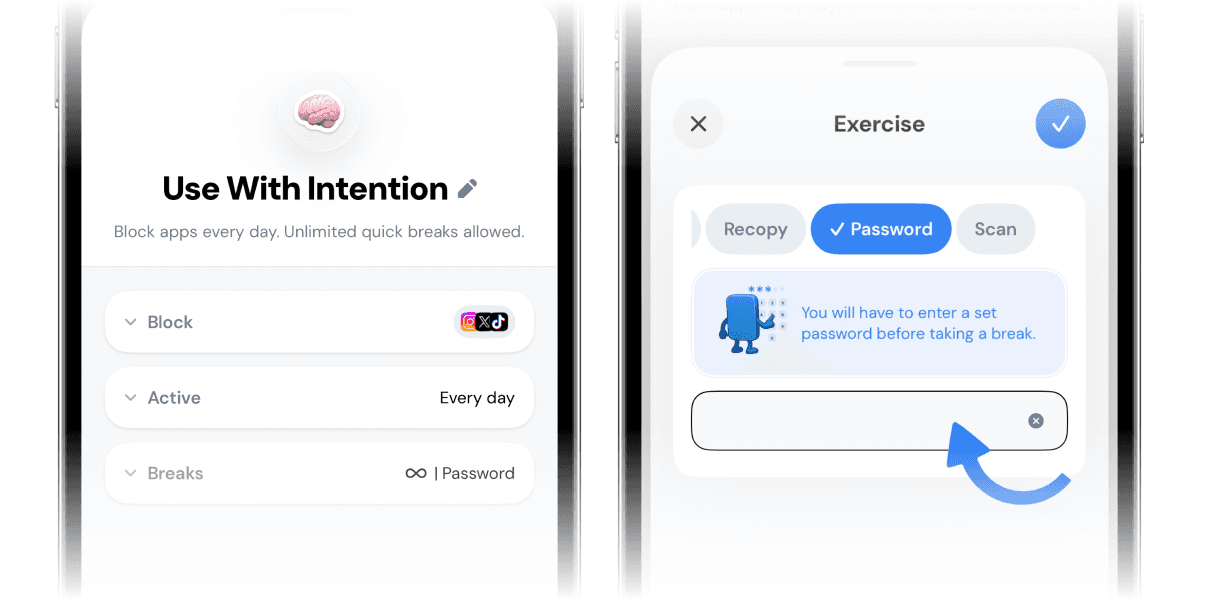
Self-regulation can be really hard. It’s often easier when you challenge yourself together with someone else. So the idea here is to block your apps with Jomo, available for free on iPhone. Each time you want to use them, you’ll need a friend or family member to enter a password on your iPhone so you can access your apps for a limited time. Here’s how to set it up:
In the Rules section, choose the “Use With Intention” template
In the Block section, select the distracting apps
In the Breaks section, choose the “Password” exercise and let your friend set the password
Add the rule
From now on, you’ll need that person to enter the password in Jomo before you can use your apps.

Why does this work? Because you replace unstable self-control with a social constraint — something much harder to break unconsciously. You’re no longer relying only on yourself; you’re also relying on someone else. And very quickly, you’ll realize just how often you reach for your phone when you keep asking them to unlock it!
Exercise #4: Steps in Exchange for Time
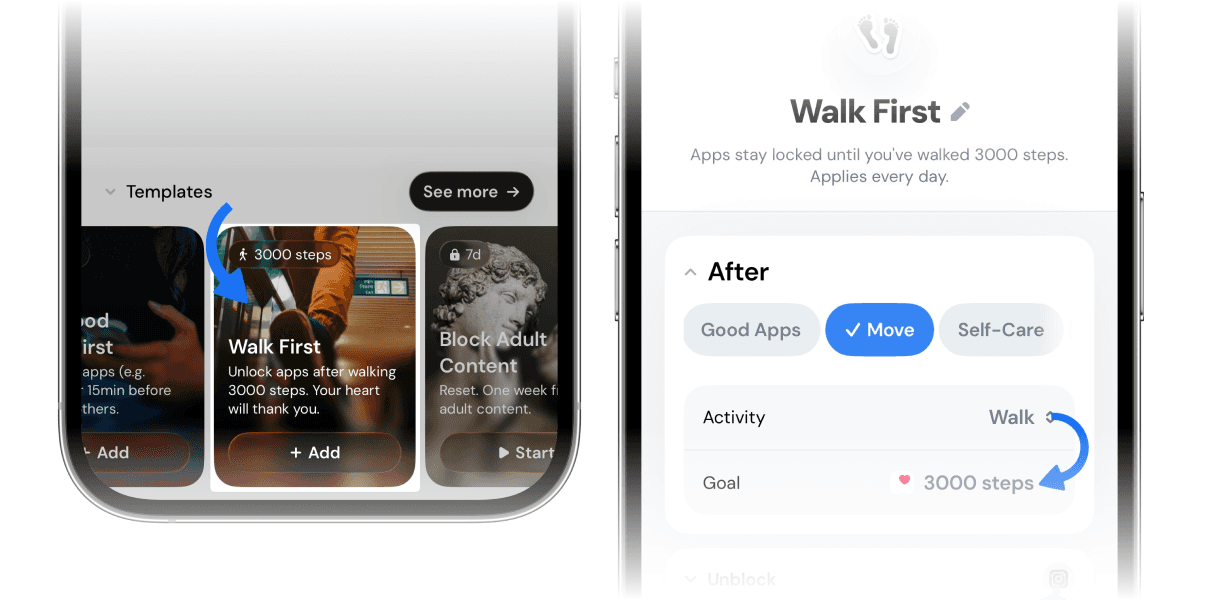
The thing about scrolling is that it’s rarely “earned.” Most of the time it replaces other activities you don’t feel like doing or keep postponing… and you end up slouched on the couch for hours. So the idea here is simple: trade steps (walking) for screen time. To do this, we’ll use the Jomo app (honestly, it’s a great app).
In the Rules section, choose the “Walk First” template
In the After section, set a realistic goal (3,000 steps is a great start)
In the Block section, choose the distracting apps
Add the rule
Now you’ll need to walk 3,000 steps before your apps unlock. Nothing comes for free!
Exercise #5: The Emergency Kit
How are you supposed to disconnect from your phone if you use it for absolutely everything? That just doesn’t work. So for this exercise, you’ll create an “anti-screen emergency kit.” We’re going back to the basics — analog tools, no screens. And you’ll see: your phone isn’t necessarily better than the objects we used before. Your kit could include:
A notebook and a pen: perfect for writing things down. You can also doodle when boredom strikes.
Crossword puzzles: bored? Fill in a grid. It keeps your brain busy and even improves your vocabulary. Sudoku works too.
A good paperback book: long trip or waiting somewhere? Don’t scroll — open your book and continue the story. There are plenty of easy, enjoyable novels out there, so no excuses.
A small knitting kit: keep your hands busy while doing something useful. In many cases, we feel a kind of “restlessness” in our hands, so giving them something to do really helps.
A digital or disposable camera: forget taking photos with your iPhone. We tend to take too many pictures of everything and nothing. Having a camera in your pocket means choosing quality over quantity. You’ll remember each photo because it captures a specific moment.
Of course, you can add anything you want! This is just a starter list we’re offering you.
What Few People Understand…
Spending too much time on your phone isn’t “normal.” Just because “everyone” seems to spend five hours a day on it doesn’t mean you have to accept that. Choosing not to give your time (aka your most valuable resource) to apps and services designed mainly to sell you ads doesn’t make you an outsider or a “weird” person.
Let’s be honest: at the beginning, it can feel a little difficult. That’s normal. Your brain will look for a substitute. These activities might seem a bit boring at first, but you’ll get used to them quickly. And always remember one thing: reducing your screen time isn’t a punishment. It’s a liberation.
You’re choosing an alternative source of dopamine — slower, but far more meaningful.
Thanks for reading this far, it really means a lot. I wrote this article with my own brain and the help of the internet. Whenever I remember, I add sources so you can keep exploring the topic. If you’d like to try the Jomo app, you can use my referral code FG2HA9 to get 14 days of free access to the paid version.