Wellbeing
6 min
How to Build Good Habits (To Make You Unrecognizable)?
Recently, I came across a sentence that made me think: "We are what we repeatedly do", Aristotle.


How Can You Change (Without Making It Difficult)?
Changing happens in two phases. The first is identification: you analyze a habit to understand it better and determine whether it’s positive or harmful for you. Then comes action: you put things in place to change and stick with them.
Identifying a Bad Habit
A bad habit tends to create an imbalance in three areas.
Energy: Does it drain you? Make you more tired? Disrupt your sleep, for example?
Time: Does it make you lose a lot of time? Replace activities that are more important?
Attention: Does it fragment your focus? Make your mind more scattered?
Many modern habits are considered problematic because they attack your attention. That’s why they deserve very close monitoring.
©️ Art by Steph Meade
Turning a Bad Habit Into a Good One
A habit becomes harmful when the dosage changes—when the balance between positive and negative is no longer right. Here are a few simple examples:
Exercise = good for your health. Excessive exercise = risk of injury and pressure.
Coffee = a useful energy boost. Too much coffee = anxiety and heart issues.
Social media = social connection. Too much social media = anxiety and addiction.
In reality, it’s not always the habit itself that needs to be suppressed, but its intensity and frequency. Some people call this behavioral drift.
Most habits don’t need to be eliminated—they need to be adjusted. The balance is off, and that’s where you step in. Here are three tips to help:
Observe the triggers. Habits often follow a loop: trigger → behavior → reward (for example, social media: boredom → open the app → stimulation). Identifying the trigger is 80% of the work. Once you have that, you can start understanding the habit.
Analyze loss of control. When things start to slip, ask yourself: am I doing this longer than I intended? (Example: scrolling. It often starts as “just five minutes” and ends up being 45.) That’s usually where problematic habits hide.
Measure reality. Many people underestimate their habits because they have blind spots. A very concrete example: screen time. Let’s try a quick test. How much time do you spend on your phone each day? If you answer honestly, your guess will probably still be lower than the real number—and you’re not alone. That’s why measuring things matters: it makes the invisible visible.
5 Concrete Examples (With Solutions)
To keep things simple, I looked up some of the most common habits people complain about online. For each one, I’ve included a possible solution. These are just examples—they can and should be adapted to each person—but they offer a good starting point for reflection.
1 – Scrolling Whenever There’s a Moment of Empty Time
For example, on public transport, in a line, while walking… your thoughts start to drift and suddenly you pull out your phone to scroll on social media.
That’s not a good thing. You’re training your brain to stop tolerating even the smallest moments of boredom.
To change this habit, here’s what you can do:
In the Rules section, select the “Use With Intention” template.
Select your social media and other distracting apps.
Enable breaks and choose the “Recopy” exercise.
Add the rule.

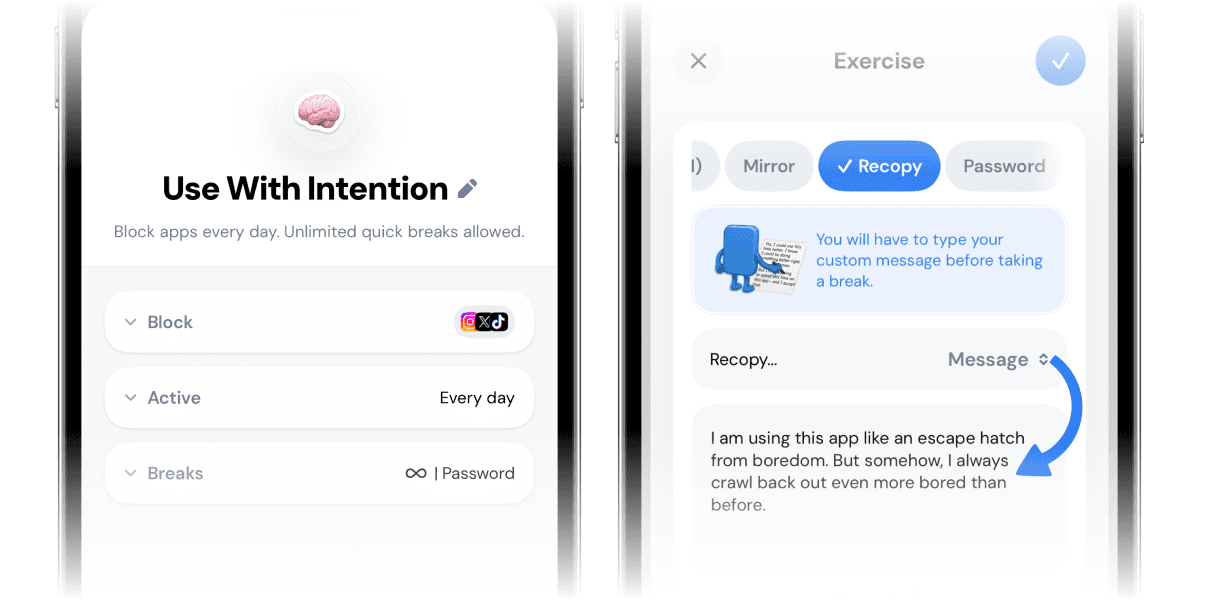
From now on, you won’t be able to open your apps impulsively. You’ll have to rewrite a long text first, forcing yourself to think twice.
2 – Going To Bed Late While Scrolling on Your Phone
Many of us end the day like this: you get home, collapse on the couch, and scroll, scroll, scroll.
Scrolling is designed to be infinite, so it’s normal if stopping feels almost impossible. That’s the whole point (and no, we’re definitely not endorsing it).
The result? Your evening routine gets completely thrown off. Everything becomes disorganized, you feel like you’re constantly running out of time, and you try to compensate by cutting into your recovery time. (Sleeping is useless, right? Hmm… not so sure.)
Here’s a simple way to change that:
In the evening, block distractions early. No social media after 9:30 PM. That prevents endless scrolling.
Avoid binge-watching late into the night. Block streaming services after 11:00 PM. No more screens after that.
Pick up a book to end your evening and wait for sleep to naturally arrive.
To do this, you can use Jomo (on Mac, iPhone, or iPad). Create two sessions: one that strictly blocks social media starting at 9:30 PM, and another that blocks streaming services starting at 11:00 PM.
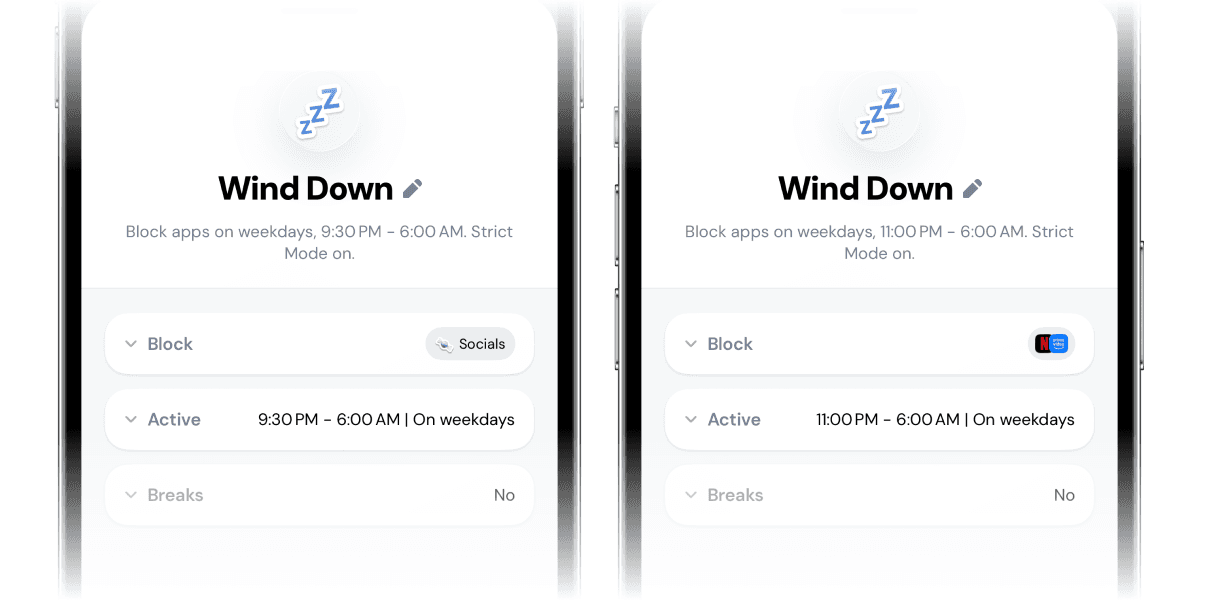
It’s incredibly effective—you’ll see.
3 – Eating on Autopilot (Snacking, Junk Food…)
👉 Note: we’re specifically talking about snacking here. If you struggle with compulsive eating disorders, we strongly encourage you to consult a medical professional.
How many times have you found yourself snacking on cookies, cereal, chocolate… without even realizing it? The bad habit behind this is that you’re often eating out of boredom, stress, or routine rather than actual hunger. And ultra-processed foods are designed to be addictive, rewarding, and to encourage repeat consumption. Here’s how you can break the cycle:
Get rid of snacks at home.
Prepare simple meals in advance (so you don’t end up ordering food or giving in to laziness).
Slow down during meals.
Eat without screens (focus on your plate, not on a TV show).
As with most things: when something requires a bit more effort, your decisions tend to become more conscious.
4 – Checking Your Phone Constantly
Many people check their phone more than 100 times a day (it’s like opening your front door 100 times… completely absurd). And it’s often caused by notifications, habit, unconscious reflexes, or even the feeling of phantom vibrations.
That’s a real problem. It heavily fragments your attention and can have serious long-term consequences. The goal is to move from reactive phone use to intentional phone use.
First step: turn off notifications. Keep only the critical ones (messages, calls, etc.).
Second step: check your messages in batches, at specific times of the day (for example, I process my emails at 9 a.m. every morning, and only then).
Third step: block the most distracting apps by default and only use them when you truly need them (not when you simply feel like it). For that, use the Jomo app!
Remember: your phone is a tool, not a constant source of distraction.
5 – Not Moving During the Day
Our daily routines are far more sedentary than those of previous generations. A typical day can easily look like this: 8 to 10 hours on a computer, then going home to watch TV while scrolling on your phone, and finally ending the day in bed… still looking at a screen. Overall: very little movement.
The solutions here are simple:
Take a 10-minute walk after meals (breakfast, lunch, dinner…).
Take the stairs instead of the elevator.
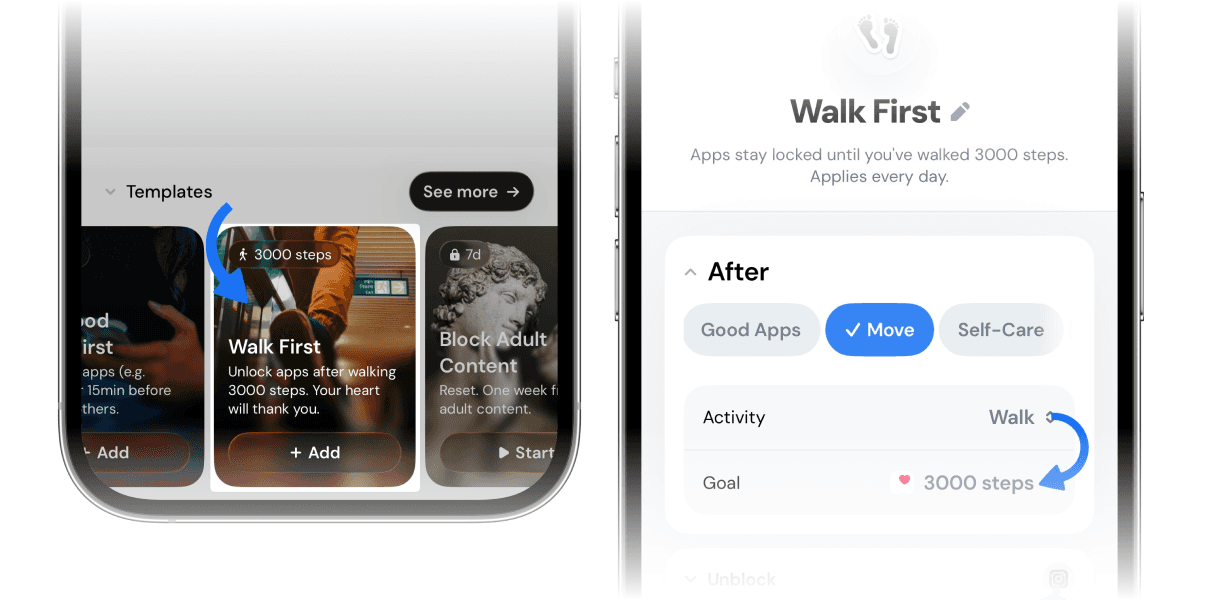
Set a rule that blocks streaming apps or social media until you’ve exercised or walked a certain number of steps using the Jomo app.
The Takeaway 🍔
A habit is essentially a set of actions your brain has automated to save energy. Having bad habits isn’t a life sentence! The goal is to gradually transform them, rather than trying to change everything at once.
Thanks for reading this far. I hope this helped you understand your habits a little better and maybe even inspired you to change them. If that’s the case, you can use my referral code to get a 14-day free trial of Jomo: FG2HA9. Feel free to give it a try.