Unplug
5 min
Defeat Doomscrolling in Just 15 Minutes a Day
“An iPod. A phone and an internet communicator. Are you getting it?”

Those were the words that changed the world in 2007.
When Steve Jobs introduced the iPhone, he didn’t realize it yet, but at that moment he was about to transform the world forever. With Apple’s invention, the phone became a device that put the internet in your pocket, enabled third-party apps, and introduced the idea of a true all-in-one tool.
At the time, no one imagined that this small device would one day capture more than five hours of our attention every day, or that it would lead to massive addiction. Back then, the phone was simply a practical tool: you checked it, put it away, and forgot about it.
Scrolling, doomscrolling… we were still far from all of that.
And yet, in less than twenty years, this tool has completely transformed our world and humanity, and is now at the center of major debates.
So what happened? How did we go from a tool to a highly addictive object? And more importantly, how do we take back control in 2026?
But before we go further, let me introduce myself. I’m Laureline. I’m an interface designer, and for nearly 10 years I’ve been working on the problematic use of smartphones (the notion of addiction itself is still not officially recognized by the WHO). For the past four years, I’ve been working on the app Jomo, which I co-created with Thomas, its developer.
We’ve written many articles on the subject, and we’ll keep writing them as long as the topic remains relevant. So if you’re as interested in this as we are, feel free to explore our blog. Otherwise, enjoy the read.
The Rapid Shift Toward a Toxic Model
By now you probably know us: we like to get straight to the point.
Yes, the smartphone was originally designed to be just a “tool” in our lives, but its mission quickly changed. Features multiplied, and its capabilities evolved so rapidly that it became hard to keep up — and even harder to learn how to live with it in a healthy way.
Push notifications, initially designed to alert us about something new (a useful feature), have become central tools for maximizing retention — keeping you captive on a service almost continuously.
Infinite scroll, originally meant to spare us from pressing “Next” or “Previous” buttons, has turned out to be highly addictive. Recommendation algorithms, originally designed to help you discover interesting content, are now used to capture as much of your attention as possible.
As you can see, many “good” ideas gradually turned into mechanisms that encourage addictive behavior.
Researchers such as Adam Alter (Irresistible), Tristan Harris, and many others have shown that for the first time in history, we’ve created a highly dangerous combination that seems to be slipping out of our control:
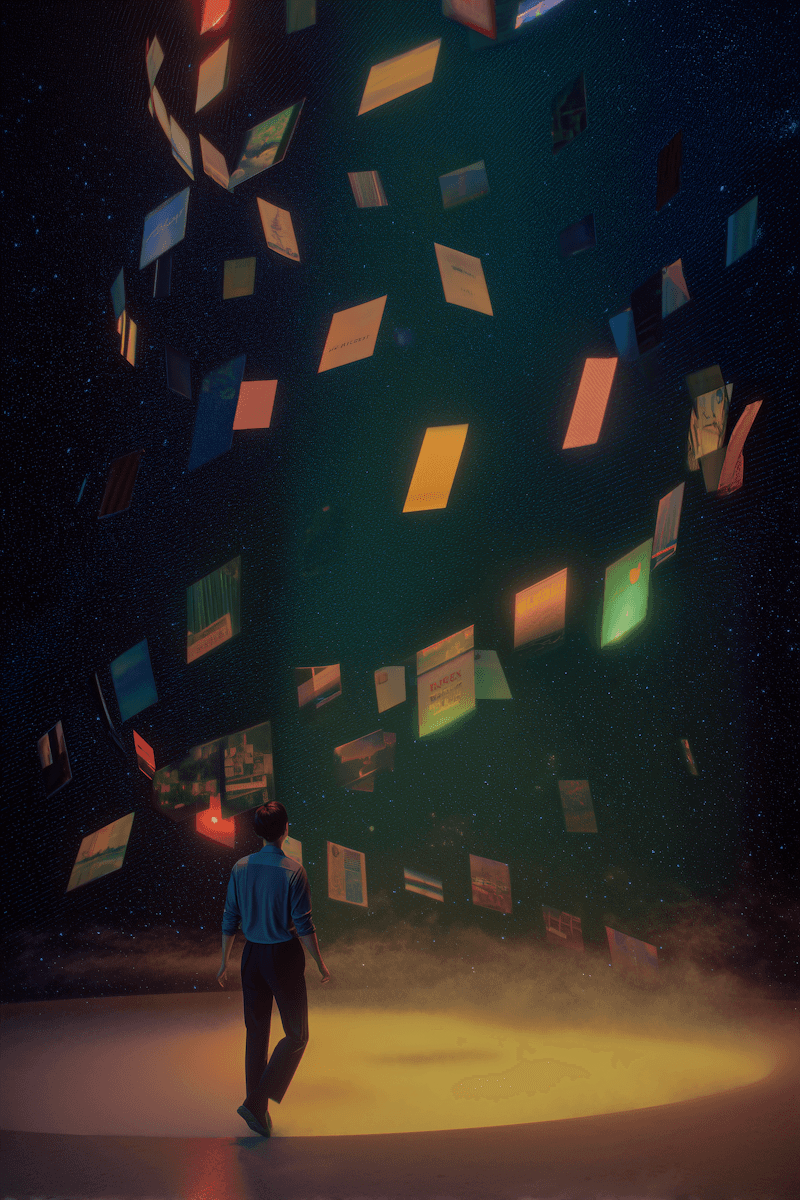
This represents the first massive disruption of human attention. The first time we no longer decide when to stop. The first time we don’t even need to choose — the machine decides for us.This isn’t a conspiracy. It’s a logical product evolution that ended up exceeding our biology.
©️ Art by Tanzim
If I Scroll, Am I Doomscrolling?
People often equate scrolling with doomscrolling. While they may seem similar, they’re actually more like cousins than twins. So let’s clarify the difference.
Scrolling means opening an app for a specific purpose. You can stop easily whenever you want. You choose the content. And when you’re done, you feel fine. Typically, scrolling lasts around 5 to 10 minutes.
Doomscrolling is opening an app without knowing why — sometimes purely out of reflex. It’s the inability, or great difficulty, to stop once you start. You don’t choose what you see; an algorithm does. When you finally manage to stop, you may feel foggy, slightly uneasy, or emotionally drained. These sessions usually last at least 30 minutes and often more than an hour.
Doomscrolling is really about losing intention and losing track of time. Now it’s up to you to decide which scenario best matches your own usage.
Okay, I Doomscroll. But Is It Really That Bad?
Yes… but also, it’s complicated.
The truth is that it’s hard to give a clear answer, mainly because this phenomenon is still relatively new and science lacks long-term perspective. Studies are ongoing, and some already suggest that there is indeed a risk.
What we still don’t fully understand are the long-term effects (10+ years). We know there is an impact on the brain, but its intensity is still being measured.
Before panicking, let’s try to explain what’s happening in simple terms. The goal is simply to help you become aware of it — and hopefully motivate you to take back control of your attention and your time.
Variable Rewards
If platforms like TikTok, Instagram, or YouTube (via Shorts) feel addictive, it’s largely because of the variable reward mechanism.
This concept was demonstrated by B. F. Skinner through experiments with rats.
In the 1930s, Skinner placed rats or pigeons inside a box containing a lever, a light, and a food dispenser. At first, the animal moved randomly. But quickly it realized that pressing the lever produced food.
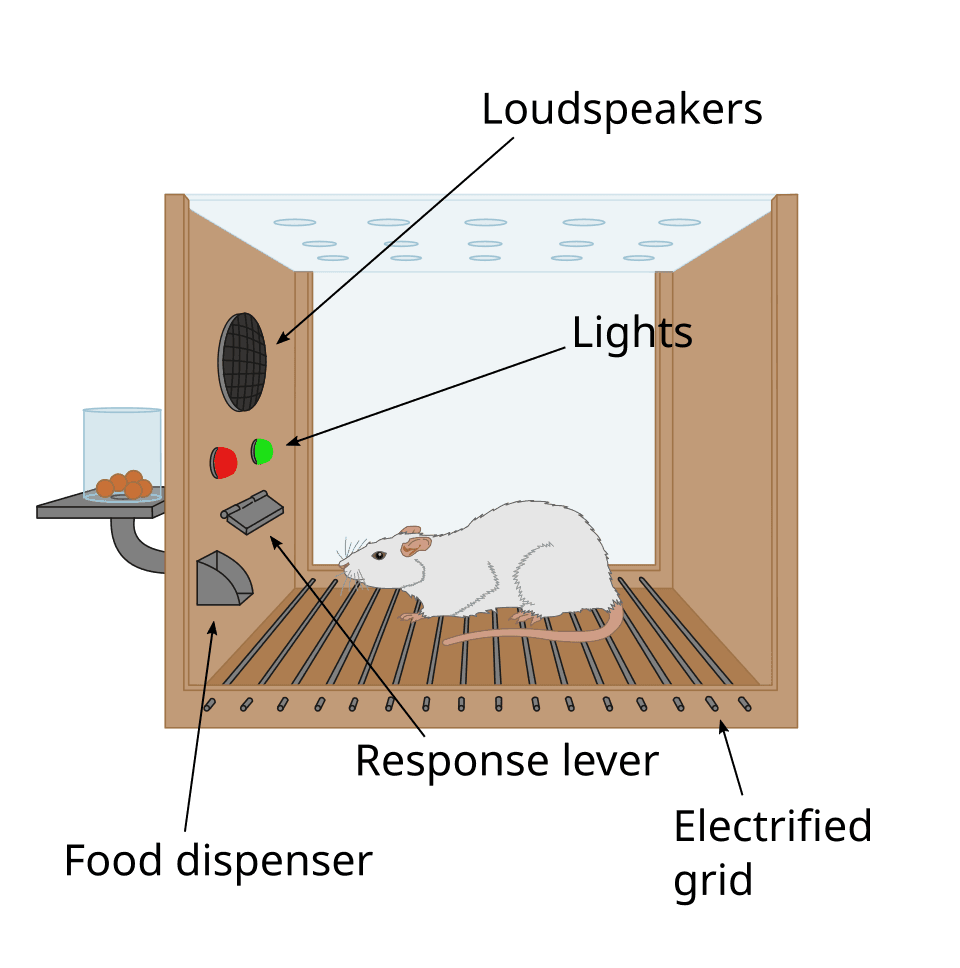
Very quickly, the association formed: lever = reward. This is known as operant conditioning.
Skinner then changed the rules. Instead of delivering food every time the lever was pressed, he made the reward unpredictable. He called this a variable ratio reinforcement schedule.
From that moment on, the animals pressed the lever much more frequently — and most importantly, they never stopped. Even when the dispenser was empty, they kept pressing the lever for a long time.
To this day, this is considered one of the most addictive behavioral patterns ever observed in psychology. And unfortunately, it’s exactly the same mechanism used by social media platforms. As you can imagine, that’s not great news.

Disruption of the Dopamine System
But this isn’t only a behavioral issue. It’s also biological — particularly related to how dopamine is produced and regulated.
So what exactly is dopamine?
“Dopamine is a type of monoamine neurotransmitter. It’s made in your brain and acts as a chemical messenger, communicating messages between nerve cells in your brain and the rest of your body.”
That’s the scientific definition.
In simpler terms, dopamine is a neurotransmitter that links intention (or desire for action) with action itself. Some people call it the “motivation molecule.”
The tricky thing about dopamine, like many molecules in our bodies, is that it’s dynamic. Its levels rise and fall depending on our lifestyle and behaviors. And that’s where the problem begins.
With variable rewards, you create repeated spikes of dopamine. In other words, you start producing far more dopamine than your brain actually needs.
Over time, this has consequences: slow activities like reading, working, or having conversations begin to feel dull. You constantly seek fast stimulation, and you gradually lose motivation for everything else.
Increased Stress and Anxiety
And there’s something else.
Social media platforms don’t just show you content. Their entire business model relies on trading your attention for advertisers’ money. Which means they need to keep you on the platform for as long as possible. Here’s how they do it:
First, they show you what you WANT to see. The goal is to place you inside a comfortable bubble where everything feels familiar.
Then they expand your SPECTRUM. When boredom starts to appear, they introduce slightly different content that might interest you. This expands your interests and keeps you engaged. On platforms like TikTok, where boredom arrives quickly, this happens very fast.
Finally, they reinforce your IDEAS. They don’t want to offend you. So the system begins to validate your beliefs — constantly telling you “yes, you’re right.” This ideological reinforcement flatters the ego and gradually pushes users toward more extreme content, keeping them engaged and feeding their dopamine needs.
So if you’re stressed, you’ll likely become even more stressed. If you’re anxious, even more anxious. And if you’re angry at someone, you might end up angry at the whole world.
Loss of the Sense of Time
These apps are also known for being massive time sinks.
You know when you start using them — but you never know when you’ll stop. They distort your perception of time and blur its real value. There are two main problems:
First: speed.
Your brain gets trained to expect everything instantly. It becomes accustomed to rapid stimulation, making slowness and boredom feel unbearable. This can even lead to an inability to tolerate empty moments — pulling out your phone at the slightest pause and becoming dependent on constant stimulation.
Second: the disappearance of natural stopping points.
Your brain no longer knows when “enough” is enough. It loses the cues that normally signal when to stop. This leads to time distortion (40 minutes feeling like five), the sense that you’re wasting your time or missing out on your life, and sometimes increased guilt and mental fatigue.
©️ Art by West Kast
Okay. How Do I Stop Doomscrolling (In a Simple Way)?
After reading all this, it’s normal to feel like you want to stop. And honestly, that’s probably a good thing. So we’ve put together a simple program: a series of small exercises you can do every day to help you regain control.
Each exercise takes a maximum of five minutes. You can do one per day or all five (which would be about 25 minutes — compared to seven hours of screen time, that should be manageable).
Exercise 1: The Window
Because we rarely allow ourselves to be bored anymore — or give our brain space to breathe — this exercise helps bring that back.
What to do
Sit facing a window.
For five minutes, keep your gaze steady.
Let your thoughts wander.
Important: no music, phone, podcast, or TV allowed.
Exercise 2: Intention
Phone use has become automatic. This exercise helps you become aware of each time you open an app.
What to do
Create a Rule called “Use With Intention.”
In the Breaks section, select the Intention exercise.

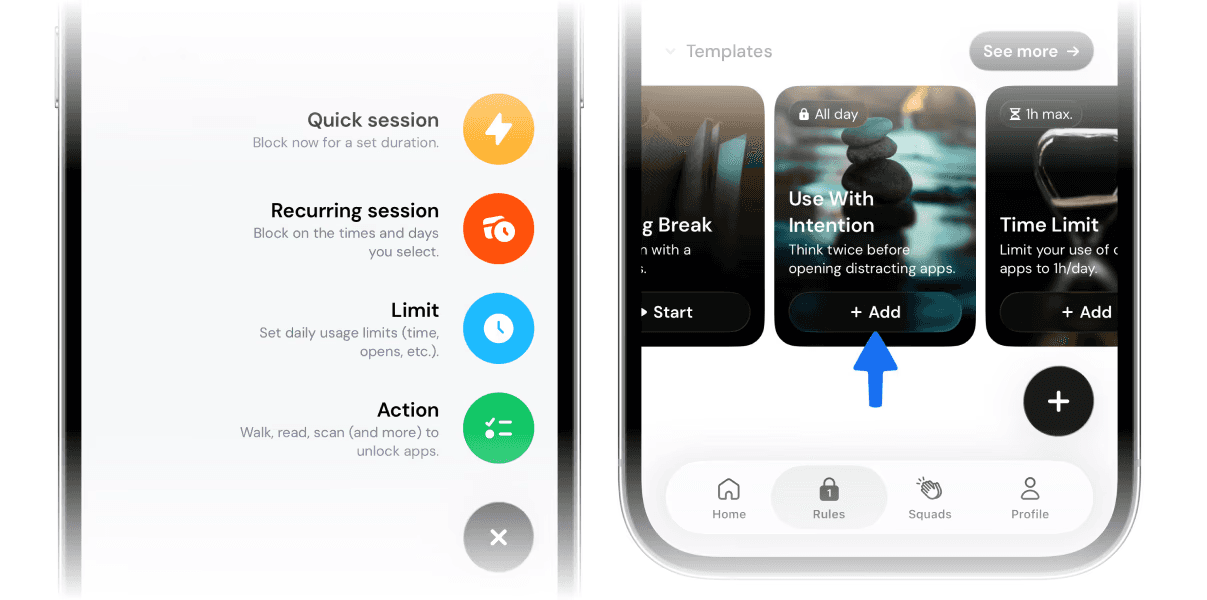
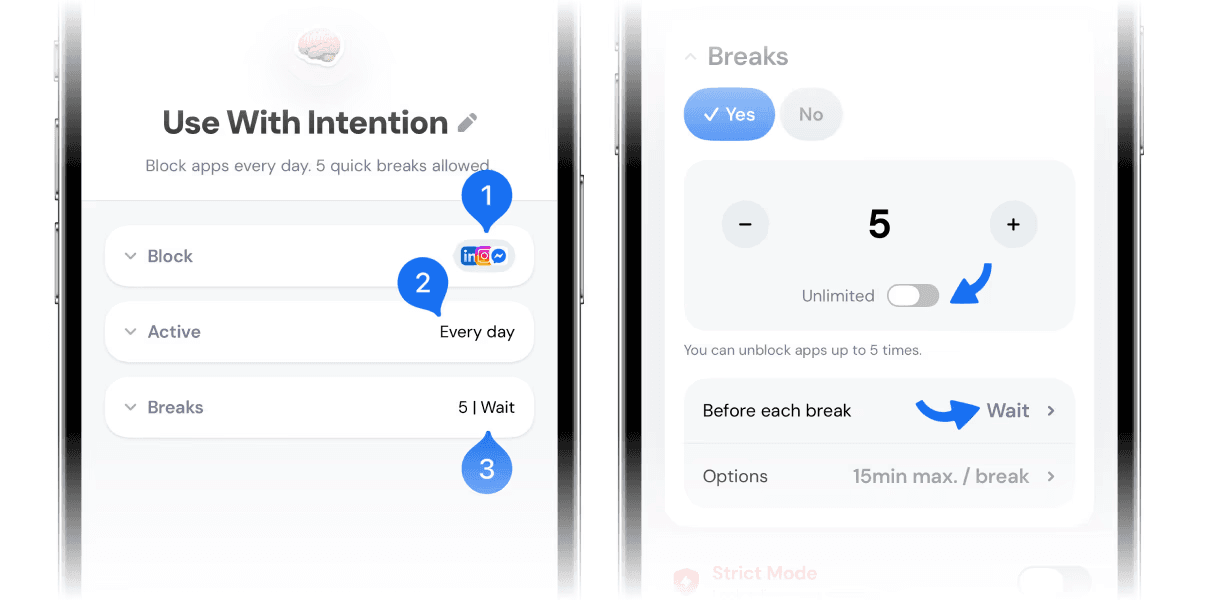
From now on, every time you try to open an app, you’ll have to provide a good reason. You can even say it out loud: “I want to open Instagram to…”
If you can’t answer, put the phone down — you didn’t actually need it.
Exercise 3: Wild Brain Dump
When you open your phone to scroll, it’s often because you’re trying to escape something — usually cognitive overload.
Your brain uses scrolling as a way to cope with too much information. This exercise replaces that reflex by helping you unload those thoughts instead of burying them under endless scrolling.
What to do
Take a small notebook and a pen.
Write down everything that comes to mind: tasks, worries, ideas, “I’m hungry,” “reply to X,” “I’m tired of this,” “I slept badly,” “I should exercise,” fragments of sentences, single words, or names.
Then close the notebook and move on (without rereading it).
The goal isn’t to write something clean or organized — it’s simply to empty your mind. If nothing comes to mind, just write “nothing comes to mind” or “I don’t know” until the time is up. This should take about 2–3 minutes.
Exercise 4: Generate Slow Dopamine
We know that social media tends to generate “cheap dopamine”: easy to access, but short-lived. Here the goal is to generate healthier dopamine — linked to effort and longer-lasting satisfaction.
What to do
Choose ONE slow, physical task (watering a plant, making tea, folding laundry, washing dishes, etc.).
Do this task for 2 to 5 minutes.
Do it slowly and in silence.
Exercise 5: Interrupt The Impulse
Before opening your phone, try to interrupt the impulse.
The idea is to resist the urge for a short moment before acting.
What to do
When the urge appears, place your phone face down or out of sight.
Wait 60 seconds (or 90 seconds if you feel comfortable).
Try not to think about anything.
Once the time is up: if you still want to open the app, move on to Exercise 2. Otherwise, simply do something else.
And that’s it. We’ve covered the essentials, and we hope you found this helpful. We’re not big fans of complicated methods or unrealistic routines. We prefer showing that taking back control mostly comes down to small actions repeated consistently.
It’s also important to note that this isn’t about restriction or harsh control — it’s about retraining your attention system.
Thank you for reading all the way to the end. I truly appreciate it. I wrote this article using my own brain and the help of the internet. I include sources whenever I remember so you can continue exploring the topic yourself. And if you’d like to try the Jomo app, you can use my referral code FG2HA9, which gives you 14 days of free access to the paid version.