Understand
4 min
Are Phones Making Us Dumber?
I really like this question. I find it genuinely interesting. And today, I decided we’re going to try to find an answer to it.

Because let’s be honest—no matter where you are in the world, screen time is becoming a serious issue. Here in Europe, there are more and more attempts to introduce limits, regulations, and safeguards to protect us from its downsides. But does that really convince people that there’s an actual risk sitting right there in their hands as you read these words? Not so sure…
Since this is a topic we’re passionate about, we dug deep and explored the web to find answers—but also concrete ways to take action. Because explaining things is good, but taking action is even better.
But before we begin, let me introduce myself. The voice you’re reading is Laureline. I’m the designer and co-founder of the Jomo app. I’ve been working in ergonomics and interface design for the past 10 years. In 2022, we launched Jomo to finally bring a long-standing idea to life: a powerful app to help you stop mindless scrolling and take back control of your life. I wrote this article myself, with my own two hands and my own brain. So if you enjoyed it or found it helpful, feel free to share it and let us know what you think!
What Does It Mean To Say “It Makes You Stupid”?
You see it everywhere (including on TikTok, which is often at the center of these discussions): using your phone too much supposedly makes you stupid, turns you into a real “zombie.” But if you look a little deeper, what does that actually mean?
When we talk about “making us dumber,” we’re not talking about IQ. We’re talking about a decline in certain cognitive abilities: reduced focus, weaker memory, less capacity for deep thinking, shorter attention spans… that kind of thing. For many people, that’s what “dumber” really is.
In reality, humans aren’t biologically regressing. It’s more that we’re losing our ability to think—especially to think deeply. We become more superficial and increasingly dependent on external tools. Even the smallest effort starts to feel costly.
So who—or what—is really to blame?
Is Your Phone Really What’s Making You “Stupid”?
In a way, your phone is the perfect scapegoat: it’s always with you, you use it for everything, and many services are heavily optimized to capture more and more of your attention. So it’s easy to blame it. But is it really the one responsible?
Yes and no. It does carry a significant share of responsibility:
It’s always within reach, delivering content and dopamine with zero friction.
It centralizes everything, so you have no real reason not to use it. You put in less and less effort to get things done: “There’s definitely an app for that.”
Notifications, infinite scroll, variable rewards—these are real addictive mechanisms. You think you’ll spend five minutes, and it turns into two hours, flooding your brain with an endless stream of information.
It’s designed to eliminate boredom, and with it, all the moments your brain needs to recover (thinking, imagining, stepping back, etc.).
All of these factors combined, each in their own way, contribute to weakening your cognitive abilities over time. But there’s an important nuance: it’s not really the phone that’s responsible—it’s how you use it. Blaming the tool is a bit reductive. It’s mostly a way to avoid taking responsibility.
Yes, it plays a role—but you do too.
So Why Does No One Seem To React?
Because it’s incredibly hard to raise awareness about risks when everyone mostly sees the positives. It’s like swimming against the current. You’re up against a self-reinforcing system: “Everyone uses it, so everything must be fine. If no one is reacting, there must not be a problem.”
And that’s the core issue.
People are blinded by the immediate benefits: instant entertainment, constant connection, effortless access to everything you want (sometimes even before you realize you want it). But that’s not all. People are also largely unaware of the real costs, because they’re invisible and slow. The first “side effects” aren’t immediate, and it takes effort to connect cause and effect. Think about reduced concentration, mental fatigue, or constant distraction (which can sometimes lead to a kind of brain fog).
And on the other side, you have a society that encourages you to look away, because the economic stakes are massive. Companies whose business models depend on capturing attention have become extremely wealthy—and today, they neither want nor can afford to slow down.
The problem is very real. It just doesn’t feel urgent—or even serious.

Art by Mariana Pedroza
So Aren’t We Living in a Two-Speed World?
Yes—and that’s the real problem. In the coming years, you can clearly see a growing divide.
On one side, there are those with excessive, passive consumption. Their days are driven by screens: constant scrolling, constant interruptions (notifications and more), and highly fragmented attention with serious negative effects on both their personal and professional lives. They end up with truly problematic screen time—sometimes more than half of their waking hours (8 hours a day on average!).
On the other side, there are those who choose to protect their attention because they understand it’s one of their most valuable resources. They’ve realized they need to block apps when they take over too much of their lives, and that it’s essential to spend (and actually enjoy) time without screens—especially without their phone. They’ve developed what’s called “intentional consumption”: the ability to decide when, why, and for how long they use their phone.
And this has nothing to do with intelligence or social or economic status. It’s a decision—one you make now, and stick with over time.
So if Taking Action Is Crucial, How Do You Do It?
Your time on Earth isn’t infinite. It’s limited. You know when it starts, but never when it ends. You shouldn’t take anything for granted (that doesn’t mean living every day like it’s your last). You just need to be aware of it so you can protect it.
Realize that every minute you give to a tech giant is time you’re taking away from yourself—from doing what you truly enjoy. That time ends up meaning nothing. It’s just spent consuming content you won’t even remember.
And if you look at it over a lifetime, just 2 hours of scrolling a day adds up to 730 hours a year—that’s 30 full days. One entire month lost.

So What Method Should I Use? Where Do I Start?
At Jomo, we don’t really believe in the whole “life without a phone” idea. What we believe in is a hybrid approach. You use your phone, but on YOUR terms: when you want, why you want, and you stop when you decide.
So First Point: Add Friction.
What does that mean? Adding friction means making usage a bit “harder.” Right now, it’s incredibly easy to unlock your phone, open your favorite app, and spend two hours on it without even noticing. Our goal is to make that process just hard enough so you have time to ask yourself: do you actually NEED to use your phone right now—or do you just feel like it?
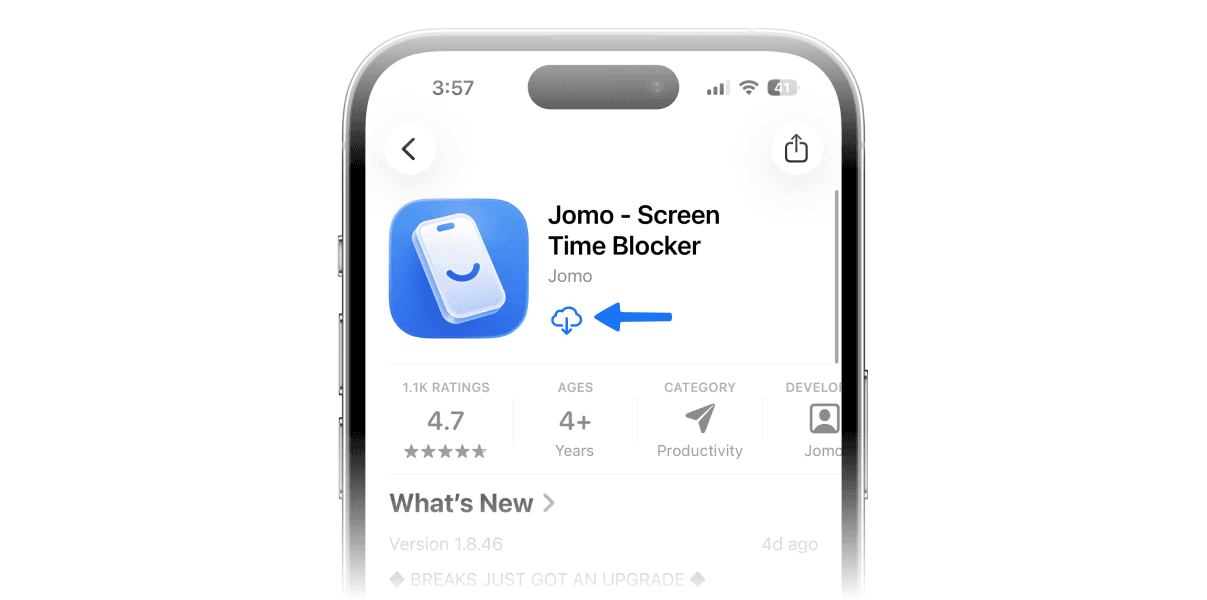
How do you do that? By downloading the Jomo app, available for free.
Go to the Rules tab and tap the pre-made template “Use with intention.”
Select your distracting apps.
In the Breaks section, choose the “Intention” exercise.
Then activate the blocking rule.
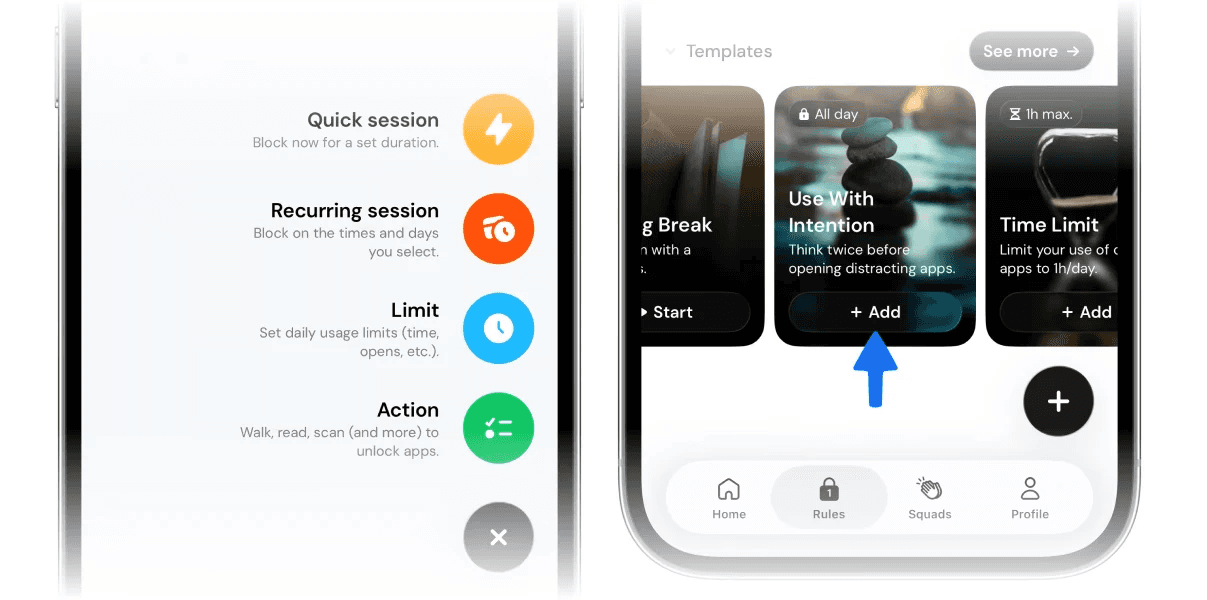
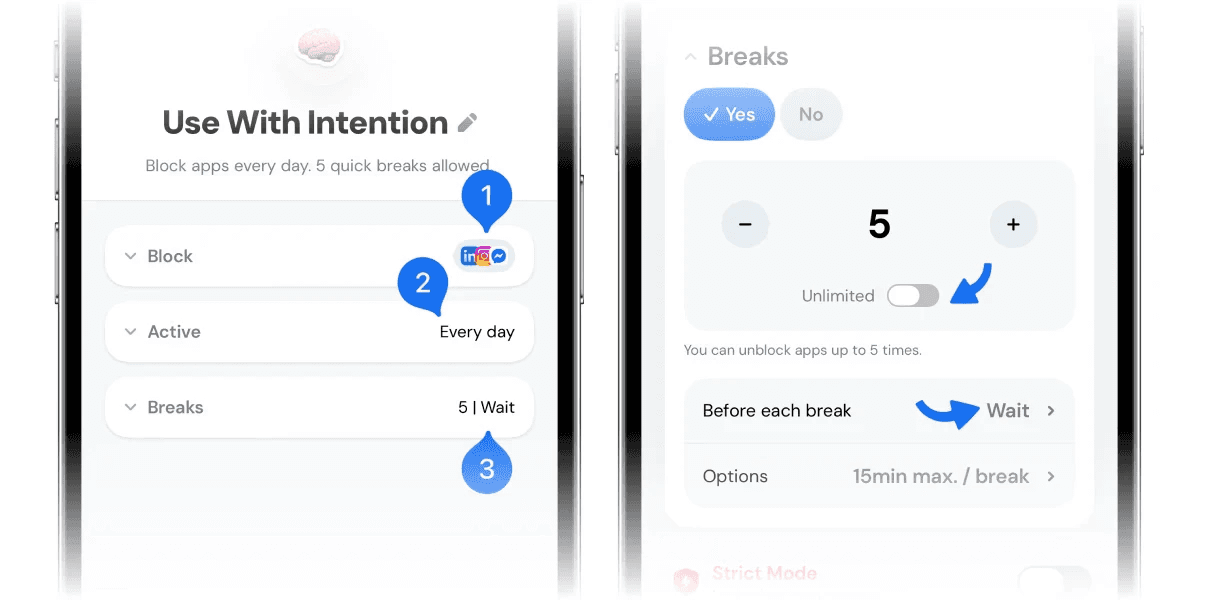
From now on, your apps will be blocked by default. You can still use them—but before you do, you’ll have to tell Jomo why, and more importantly, choose a fair usage duration. That way, you still use your apps—but not for three hours straight doing nothing.
Second Point: Replace, Don’t Just Remove.
Cutting down screen time is the foundation, sure—but the question that quickly follows is: “Okay… so what do I do instead?” You might think you’ll figure it out in the moment—but you won’t. The dependency on smartphones can be so strong that it’s hard to imagine doing anything else.
That’s why you need to actively help yourself avoid falling into the trap. You need a list of go-to activities to replace scrolling.
If you have downtime during your day—breaks, commutes—pick up a book. Go to a bookstore or library once a month and find something you actually want to read. You don’t need images scrolling in front of you—you’ll create them in your own mind. And remember: many Netflix series started as books (Bridgerton, The Witcher, 13 Reasons Why…).
If you tend to get home from work and scroll on the couch, go for a walk instead. Aim for 5,000 steps a day. You’ll hit two birds with one stone: less screen time and better physical health. And if you struggle with motivation, you can set up a Jomo rule that trades steps for screen time. If you’re more athletic, you can trade running distance, swimming, etc., for screen time instead.
If you tend to scroll in bed in the morning, put your alarm on the other side of the room, keep your phone out of the bedroom, and immediately write down what you’re going to do that day—both work and personal. Plan your day to create a clear path to follow.
If you tend to binge-watch series late at night, get yourself a simple board game. If you’re alone, go for a puzzle (1,000 pieces will keep you busy for a while) or a calm hands-on activity. You can also block apps in the evening with Jomo if you need help.

Art by Kuba.
What Are the Risks of Disconnecting vs. Overexposure?
Disconnecting: What Are the Risks?
Honestly, almost none… Your brain will try to convince you otherwise because it fears withdrawal. At first, it will feel uncomfortable. You’ll experience FOMO (fear of missing out), and you might feel a bit socially out of sync. But the people who truly care about you will wait for you. In fact, it’s often in these moments that you realize who your real friends are—and what you mean to each other.
Keep this in mind:
If it’s urgent, people will call you—they won’t DM you on Instagram.
If something is truly essential, it’s things like air or water—not TikTok.
If you’re afraid of being left out, ask yourself: who’s really missing out—the one spending 8 hours a day on social media, or the one actually living?
If you’re afraid of missing a trend, it’ll be gone by tomorrow anyway. In many cases, you’ll save both energy and money.
Overexposure: What Are the Risks?
Overall, it’s not good.
Attention degradation: you lose your ability to stay focused. Your attention becomes fragmented and scattered. With 8 hours of screen time, you’d be interrupted roughly every 2 minutes by your phone. That means just 2 minutes of real focus at a time. (For context, my kettle takes 2 minutes to heat water…)
Superficial thinking: you consume a lot but understand very little. You become less sharp, less insightful. In the age of AI, it also raises a deeper question: if you stop thinking, who are you?
Chronic mental fatigue: it’s simple—your brain doesn’t grow just because you consume more content. Everything just gets compressed and overloaded. The result? Mental overload… and overload leads to burnout.
Passive life & loss of control: you become a spectator of your own life instead of the one living it. And honestly… that’s scary. How many decisions have you made under someone else’s influence (content creators, influencers…) versus decisions that truly came from you?
The Takeaway 🍔
You get it: your phone can be your ally—or quickly become your enemy, depending on how much space and freedom you give it. You won’t become “stupid” overnight, but over the years, you can lose a significant part of yourself if you don’t take control now.
Thanks for reading this far—it really means a lot. I wrote this article using my own thoughts, supported by what I’ve found online. I add sources when I can and when I remember, so you can keep exploring if you want. And if you’d like to try the Jomo app, you can use my referral code FG2HA9 to get 14 days of free access to the paid version.