Understand
4 min
Micro-Procrastination: Why You Open Apps Between Tasks
I’m just like you: I don’t have productivity superpowers, and sometimes, I procrastinate.

It’s something that really makes me feel guilty because the time I lose is so precious… So I looked a bit into how to counter it, and I came across something interesting: micro-procrastination. And that is totally what happens to me.
It’s not that I ever push back deadlines, or that I end up doing absolutely nothing for several hours. Let’s say it’s more that between two tasks, it’s not impossible for my brain to wander. And that, I’m sure I’m not the only one.
So this week, we’re going to talk about micro-procrastination. A much more sneaky and much more dangerous form of procrastination. The goal: to understand it, and above all, to leave with a method and tips to change things if you’re concerned too.
But before going any further, let me introduce myself. The little voice talking to you is Laureline, designer and co-founder of Jomo. Since 2022, my days have been entirely dedicated to you, and my mission is simple: helping you take back control of your phone (and your time!). So if you need a little boost: download Jomo for free.
Procrastination: What Exactly Are We Talking About?
Often, when we talk about procrastination, we mean putting something off until tomorrow, a kind of laziness and poor organization (with a little bad faith sprinkled in). But in psychology, it’s different. We’re mainly talking about an emotional regulation mechanism that pushes us to temporarily avoid a task that creates discomfort (stress, boredom, fear of failure, mental overload, uncertainty, etc.), sometimes despite tight deadlines, which can have a significant impact on our professional and personal lives…
Art by Dona Mara
Why Do We Procrastinate?
There are several reasons that can push us to procrastinate:
The task creates emotional friction. It requires significant mental effort, strategic decision-making, facing uncertainty, and sometimes accepting that we won’t be perfect. The brain doesn’t really like this internal tension, so it will naturally try to reduce it, or even avoid it.
The brain loves immediate rewards. One of the major issues we have today is the duality between earned rewards and immediate rewards. The first is acquired by completing a task that will have delayed benefits later on. For example, succeeding in a project, moving forward in your career, or even writing this blog post. The second is immediate and addictive, meaning its intensity will need to gradually increase to keep satisfying us.
Transitions between tasks are mentally costly. Multitasking, as we’ve already discussed in other articles, is a myth. The brain is made to process one thing at a time. Moving from one task to another means ordering it to change context, and that is truly exhausting for it. At first, it’s on board, but when we pile interruption after interruption, it eventually gives up and chooses the easy option: letting go.
And it’s often in this last context that we talk about micro-procrastination.
Micro-Procrastination: What Are We Talking About?
Micro-procrastination is an ultra-fragmented and unconscious version of procrastination. We’re no longer talking about consciously putting work off in favor of another activity. We’re talking about a form of temporary escape for a few minutes, or even hours.
Does that sound abstract? I’ll give you a few examples of micro-procrastination:
Opening Instagram “just between two emails” while “it loads.”
Watching 3 TikToks before starting because “after that, I’ll get going.”
Watching a YouTube video while waiting for the exact hour to start: “I’ll start at 1:00 PM, and right now it’s only 12:54 PM.”
Checking notifications after a meeting, just to “take a little breather.”
All these little actions seem harmless, and I think we can agree on that. The real problem is that we rarely do them only once a day, but dozens of times, or even more. And over a 16-hour waking day, that can end up representing quite a lot of minutes. But above all, it can truly impact your ability to focus deeply and have really regrettable long-term effects.
But Why Do We Do This?
It’s actually pretty simple. In these transition moments, we are “cognitively vulnerable,” meaning our brain is “weaker” and less resistant to temptation. During this task-switching phase, the brain is in the middle of migrating from one task to another. But this process isn’t immediate: one part stays attached to the previous task (it’s closing the topic, so to speak), while the other is already starting to tackle the next one (it’s opening the topic).
And it’s often in this in-between space that we add a little layer of distraction: our phone. Just like that, the brain likes it, and it starts getting interested (a little too interested) in this new action between the two tasks it was trying to manage. Obviously, because it feels pretty pleasant at first, unlike the tasks waiting for it, it has a harder time diving back into work and suddenly experiences a kind of mental fatigue. The result? More mistakes, a feeling of mental fog and… zero motivation!
But the brain isn’t the only one to blame. Apps know very well the context in which their services are used, and how to slide perfectly into that opening.
Art by Dona Mara
Apps Designed To Increase Procrastination?
At first glance, their goal isn’t to sell a special procrastination service. But it is still one of the most noticeable side effects.
It’s simple. Many apps are optimized to reduce the time between desire and reward (zero effort, maximum reward), maximize reflexive openings (the less you think, the better), and exploit every fraction of a second of boredom or transition (notifications rarely arrive by chance).
On their services, I can guarantee you: there is almost never any friction. It’s full dopamine, in a continuous stream.

Why Does Everyone Do It, and Why Does No One Talk About It?
Because once again, with digital, everything has kind of become “normal.” Micro-procrastination has become socially validated and normalized. What could be more basic than checking your phone between two files?
The thing is, most people don’t really see the long-term dangers, and yet… What we have to keep in mind is that time adds up. If we spend 3 minutes here, 10 there, 30… Well, if we add up all those lost minutes over the course of the day, they eventually turn into hours! And then it’s more than just a problem.
So How Do We Fix It? (4 Simple and Concrete Actions)
As always, we try to approach a topic both theoretically (to understand what we’re talking about) and practically (to give you our best tips to solve the problem). You can apply all these tips, or only the ones that fit you. It’s up to you!
Tip 1: Block Apps at Work
Well yes, this is probably the simplest and most effective one. We’re not saying you shouldn’t use them all day long, but that you should avoid making them too easily accessible and letting them trap you in a micro-procrastination loop.
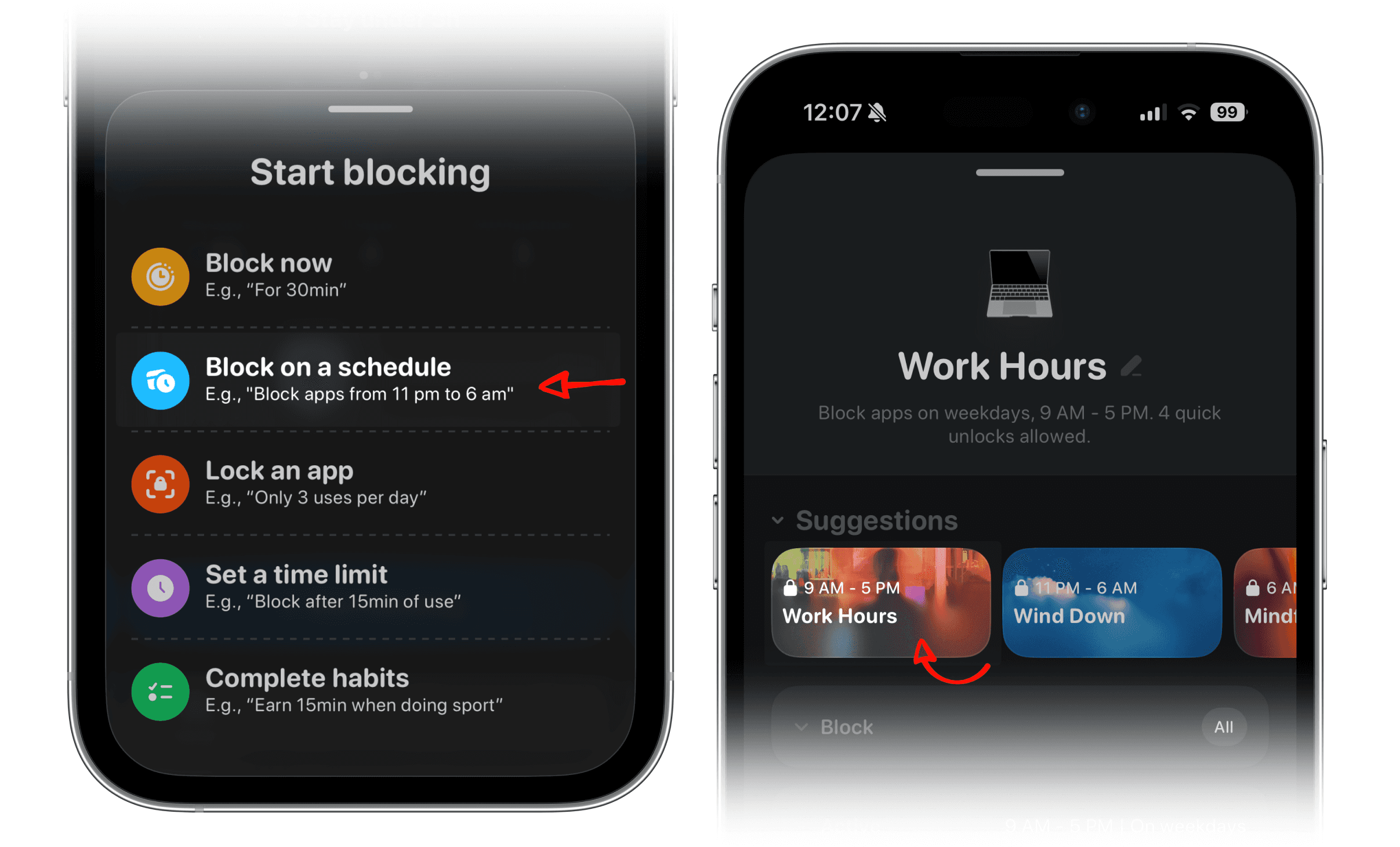
To do this, we’re going to use the Jomo app, available for free on iPhone, iPad, and Mac. We’ll set up a block during our office arrival and departure hours (for example, 9 AM to 5 PM). We’ll allow a few unlocks, but short ones (to avoid scrolling for hours).
Tap Start blocking ▸ Block on schedule.
Tap Work Hours.
Choose the apps to block.
Tap Schedule.
You don’t need a strict block that’s impossible to stick to, or to delete the apps. Sometimes, simply seeing that the app is blocked is enough to create a little wake-up call. Those few seconds often help us realize that we didn’t actually need to open that app after all.
Tip 2: Prepare Your Tasks Properly
The problem with micro-procrastination is that it often comes from a lack of preparation beforehand. That floating moment happens because everything still needs to be set up, and the brain reaches a kind of “peak” effort level, so it starts looking for an escape route.
To avoid this, we recommend preparing each task in advance so the switch happens as naturally and simply as possible:
Open the documents in advance.
Write the next step clearly in your to-do list.
Make a plan rather than a list (for example, “Step 1: do this” instead of “Do this”).
All of this massively reduces the mental friction of restarting.
Tip 3: Replace the Phone With a Real Break
So yes, of course, sometimes taking a breather feels good. The thing is, taking a break on your phone… well, it’s useless. Taking a break on your phone means creating more stimulation, not resting your brain. So the idea is to take a “real” break:
Go get some fresh air. Take deep breaths. Look at a point on the horizon.
Drink a glass of water, coffee, or tea. Wait until it cools down enough to drink. Enjoy every sip.
Walk, move your body, stretch. Take a moment to physically relax your body.
Tip 4: Disable the Triggers
What often pushes our brain to use the phone is, of course, all those little reminders. You don’t know what I’m talking about… ding ding, tiiing, bzzzz? Come on: turn off notifications, remove widgets, out they go. How are you supposed to stay focused if you have to take your selfie at 11 AM, then receive a like notification at 11:04, then some app reminds you that the super deal expires in 3 hours…
For this, you can change how your phone is organized and automatically turn off notifications when you’re at work.
Go to your iPhone Settings.
Go to Focus ▸ + ▸ Work ▸ Customize Focus.
Under Silence Notifications, select Allow Notifications From and only choose CRITICAL apps (social media is not critical… sorry), then confirm ✓.
Under Customize Screens, tap Choose on the one on the right. There, you can choose an app page to display. What you can do is configure it beforehand on your side and hide it by default so you only use it through this Focus mode.
Under Set a Schedule ▸ Add Schedule ▸ Time, enter your office hours. You can also set the location if you prefer.
Optionally, you can add a Filter and choose Jomo, then select a rule template created in the app. This will automatically block apps when this mode is activated.
Fewer signals means the brain thinks about apps less, so there are fewer distractions!
The Takeaway 🍔
What you should remember from this article is that distractions evolve at the same pace as technology. Just because it’s 20 minutes here and there doesn’t mean the impact should be minimized (quite the opposite).
By making these small changes, you may quickly feel like your mind is calmer, with less mental fatigue, better focus, less of a feeling of being “everywhere at once,” and so many other positive things!
This article is coming to an end! Thank you for reading this far, it genuinely means a lot to me. If you want to try the Premium version of Jomo for free for 14 days, you can use my referral code FG2HA9.
See you next Monday 🫡