Productivity
5 min
Best Productivity Methods for Work
Whether it's during the summer or in the middle of November, there are times when motivation abandons us, leaving us lost with our worst enemy: procrastination. And we all know that between procrastination and us, it often wins, unfortunately.

But that was before we introduced you to our best methods to stay productive at work, no matter what. Some of these methods you might already know, while others will certainly be a pleasant discovery.
But before we begin, let me introduce myself. The little voice you’re reading is Laureline. I’m the designer and co-founder of the Jomo app. For the past 10 years, I’ve been working in ergonomics and interface design. In 2022, we launched Jomo to finally bring a long-standing idea to life: a great app to help people stop mindless scrolling and take back control of their lives. I wrote this article myself, with my own two hands and my own brain. So if you enjoyed it or found it helpful, feel free to share it with people around you and send us your feedback!
Don't forget to bookmark this article so you can return to it whenever you feel a slump and tackle it before it takes over your day!
Pomodoro Technique
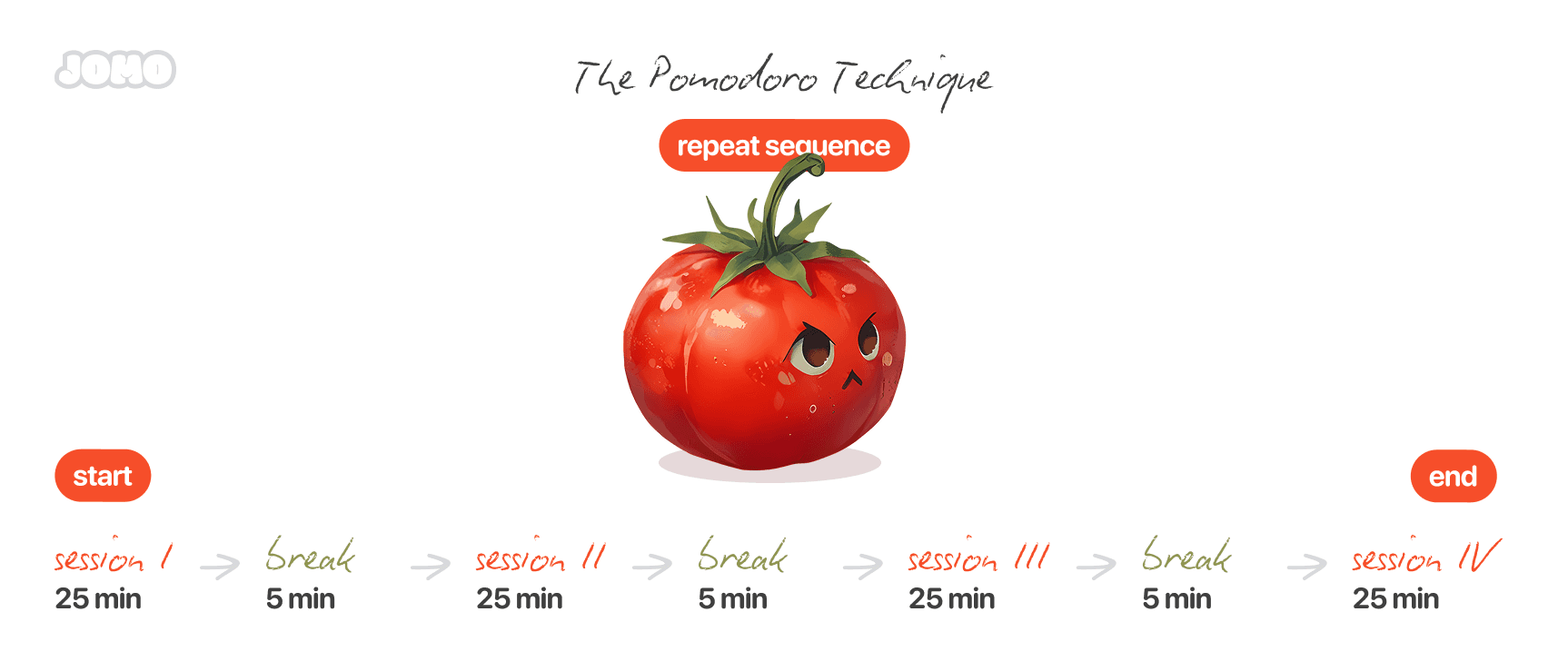
Symbolized by a tomato, the Pomodoro technique involves breaking your work time into several series, separated by brief breaks. At first glance, it may seem a bit contradictory to take a break when you're looking for a method to be more focused. But in reality, a good break = good productivity. If you want to know all the benefits and history of this method, I invite you to read this great article we wrote!
Implementing the Method
It's not too complicated. Start by setting simple, clear goals that you feel you can achieve in 25 minutes. It's best to list them on a physical note or via apps like Reminders or Notes. Then, take a timer and set it for 25 minutes. Start working. Once the first 25 minutes are up, take a 5-minute break. Ideally, stay away from screens: eat a snack, stretch, water plants, or relax outdoors. Once these 5 minutes are up, return to your list, reset the timer, and go for another 25 minutes. Repeat the process 4 times (4*25 minutes), then after 4 sessions, take a longer break of 15 minutes.
Benefits
Studies show that this method makes a mountain of work more manageable. Knowing that you are allowed a short break after a long period of concentration helps establish clear rules for your brain. Since it knows a break is coming, it won't try to avoid the effort at all costs!
Eisenhower Matrix
One of the biggest problems when getting started is knowing where and what to begin with. Everything seems urgent, important, and needs to be done immediately. So, how do you bring some order to all these tasks to focus on what's really important and eliminate distractions? If you're curious to learn more, we've already talked about it in detail in this article.
Implementing the Method
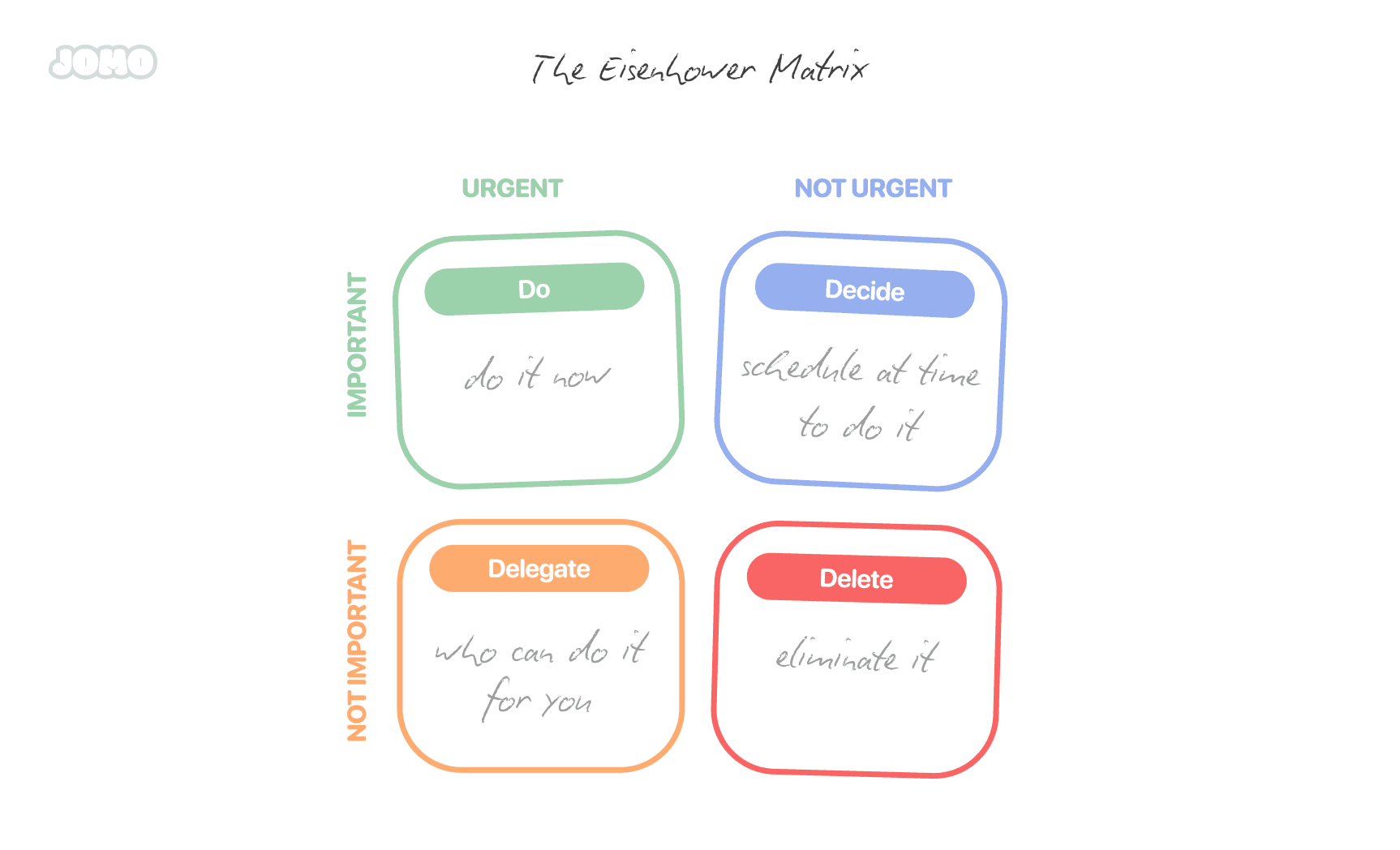
Start by drawing a matrix of 4 squares (as below). For each of these squares, there are specific rules. Then, take your tasks and sort them according to the matrix. Once done: the top left square (DO) is for urgent tasks. The rest goes to the back burner.
Benefits
Cal Newport, author of many productivity books, sums it up well:
“Clarity about what matters provides clarity about what does not.” —Cal Newport.
It's useless to try to do everything at all costs. It's better to admit you can't handle it all and adjust your work method and schedule to fit your actual capabilities.

GTD (Getting Things Done) Method
Invented by David Allen, this method helps avoid the mental fog caused by a lack of organization and a desire to accomplish many tasks within tight deadlines.
“Focus on being productive instead of busy.” —Tim Ferriss
Implementing the Method
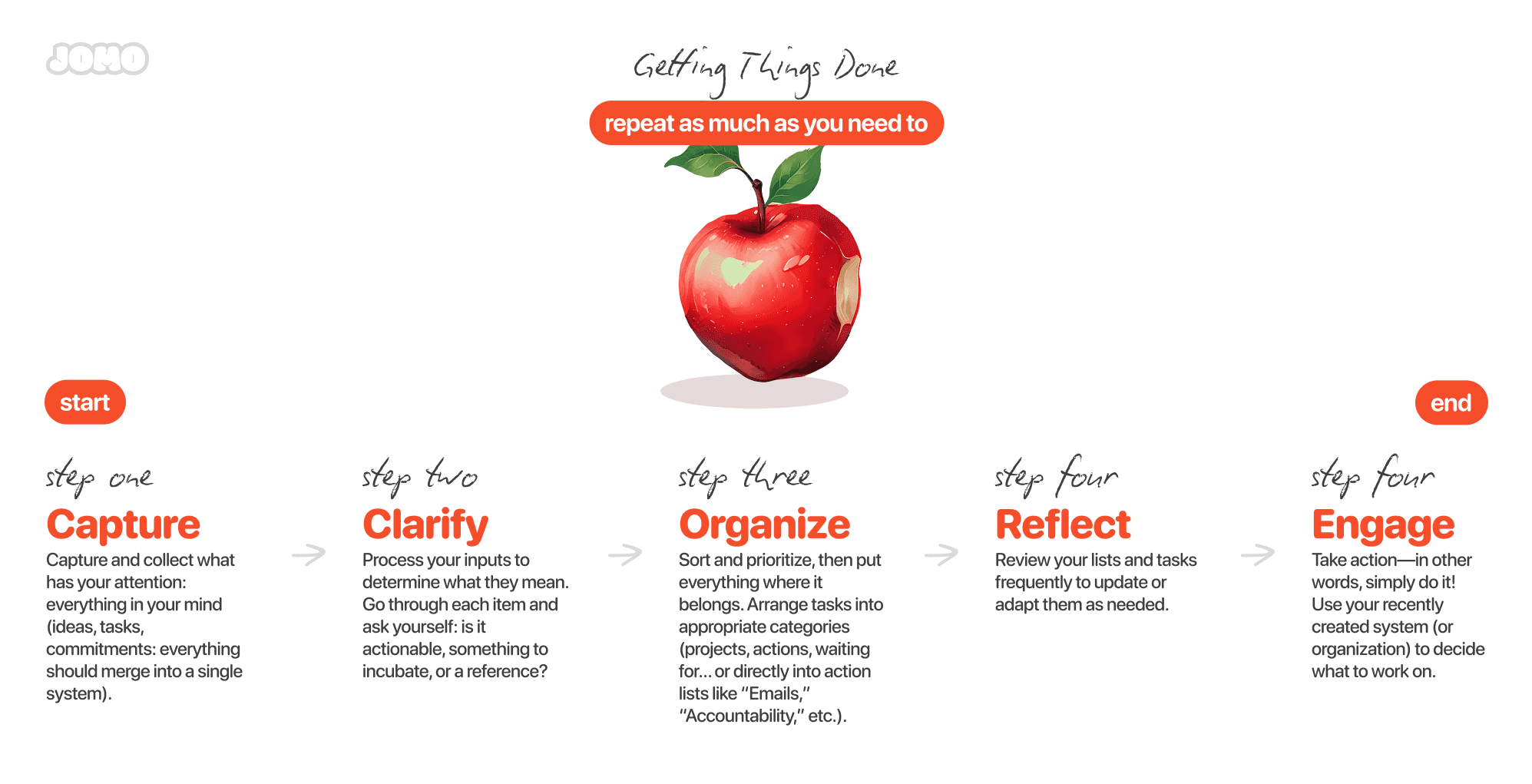
The GTD method is based on 5 key pillars:
Capture: Note all tasks, ideas, and projects that come to mind. Use a reliable medium (paper, app, etc.) to remember everything.
Clarify: Review what you've captured and decide what each item means and what to do with it. For each item, ask yourself: "Is it actionable?" If yes, determine the next action to take. If no, decide whether to keep it for reference, discard it, or save it for later.
Organize: Place actions and projects into appropriate categories. For example: Immediate actions: tasks to be done as soon as possible. Projects: sets of tasks requiring more than one action. Waiting for: tasks others must do or you are waiting for.
Reflect (Review): Regularly review your lists and system to stay updated. Weekly reviews are crucial to ensure everything is under control and you know exactly what needs to be done.
Engage: Take action using your lists to choose what to do at each moment, based on your context, available time, energy, and priorities.
Benefits
The goal of the GTD method is to clear your mind of all the little things to do and organize them in a way that allows you to focus on important tasks without feeling overwhelmed. It's a flexible system that can be tailored to your personal and professional needs.
Time Blocking Method
There's always a significant gap between theory and practice. We want to do many things, but once we start, time flies, and tasks stagnate! The reason is simple: we often underestimate the actual time needed to complete a specific task, causing it to overflow into others. And eventually, some tasks are entirely set aside.
“The key is not to prioritize what's on your schedule, but to schedule your priorities.” —Stephen Covey
Implementing the Method
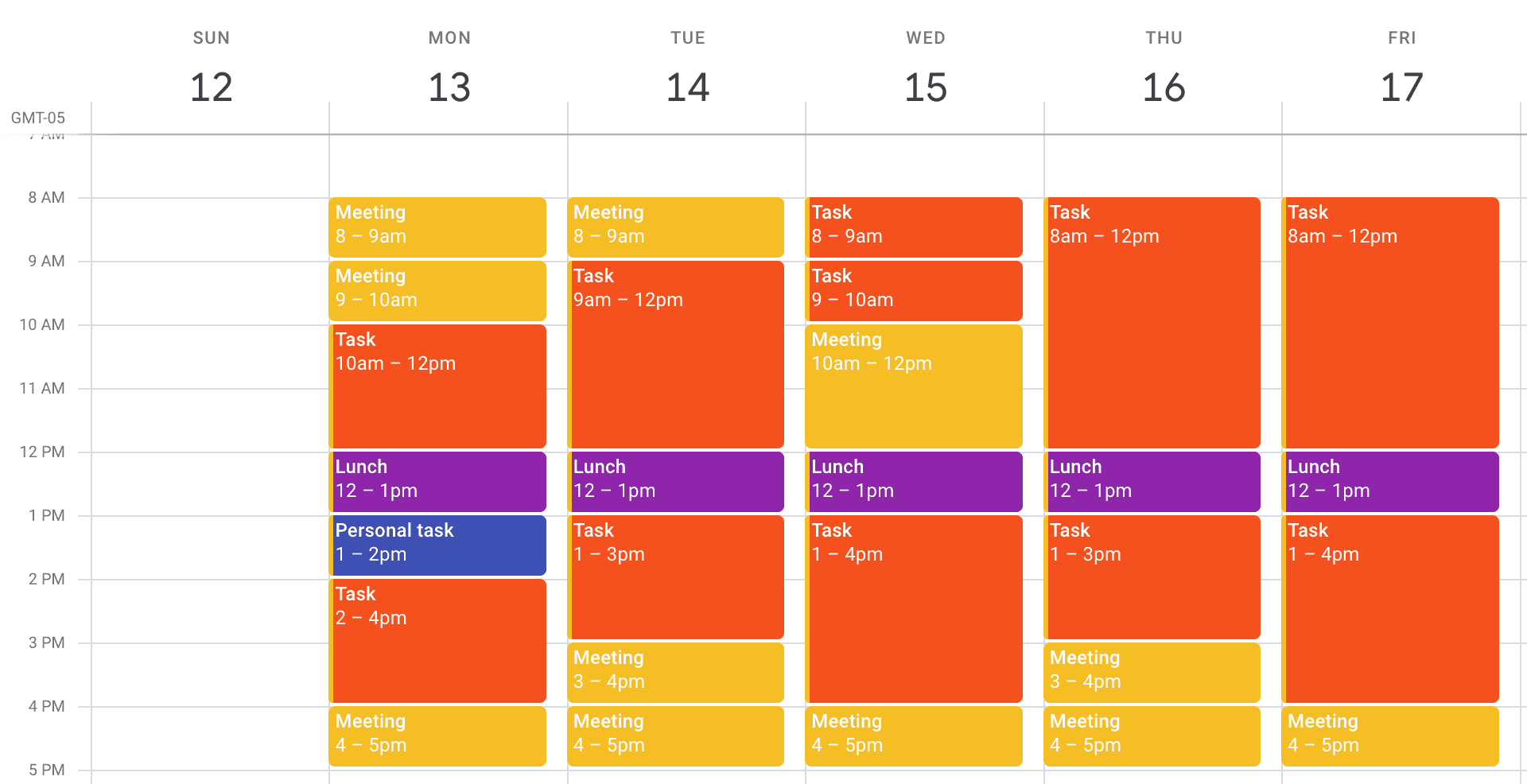
Time Blocking is a time management technique that involves dividing your day into specific blocks, each dedicated to a particular task or activity.
Pre-planning: Every evening or at the beginning of each week, take a moment to plan the upcoming days.
Define priorities: Identify the most important and urgent tasks that need to be accomplished.
Create time blocks: Allocate specific periods of the day to these tasks. For example, you might decide to dedicate 9 am to 11 am to an important task, 11 am to 12 pm to meetings, etc.
Include breaks and personal activities: It's also essential to schedule time for breaks, meals, and other personal activities to avoid burnout.
Stick to the time blocks: During each block, focus only on the scheduled task. Avoid distractions and try not to exceed the allocated time.
Adjust and evaluate: At the end of each day or week, evaluate what worked well and what could be improved. Then, adjust your time blocks accordingly for the next planning session.
Benefits
Overall, this method requires some preparation time, but the benefits are clear:
Better focus: By concentrating on one task at a time, distractions are reduced, and productivity increases.
Proactive management: You have better control over your schedule and priorities.
Reduced stress: Having a clear plan for the day can reduce time management anxiety.
Blocking Distractions (especially your phone!)
One of the well-known enemies of our productivity is our phone: between calls, messages, notifications, and social networks, it's easy to be tempted to spend a few minutes here and there. However, studies show that a brief interruption of this kind makes us lose an average of 23 minutes of our time. Once distracted, the brain has to start over (the famous "Where was I?" might sound familiar). To avoid creating real time sinkholes, we suggest installing an app blocker right away! For this, you have the most comprehensive iOS application, Jomo, available for free on iPhone, iPad, and Mac. You don't need to be a phone pro; everything is designed so you can recover your time and focus with one tap. Here’s how it works:
Tap "+ Start Blocking", then "Block now"
Start with one of our suggestion (Deep work is perfect to start)
Choose the apps to block, and tap "Start."

That's it — really, it was that easy!
The Takeaway 🍔
Whether you choose these methods or not, the important thing to remember is that we are human, not bionic beings. Our brain has limited capacity, and there's no need to overload it with a ton of tasks and unnecessary information. Take a little more time to create a good working environment for your brain, and it will repay you!
Thanks for reading this far. I hope this helped you understand your habits a little better and maybe even inspired you to change them. If that’s the case, you can use my referral code to get a 14-day free trial of Jomo: FG2HA9. Feel free to give it a try.