Understand
4 min
Why Do I Keep Saving Posts Or Pictures I Never Look at Again?
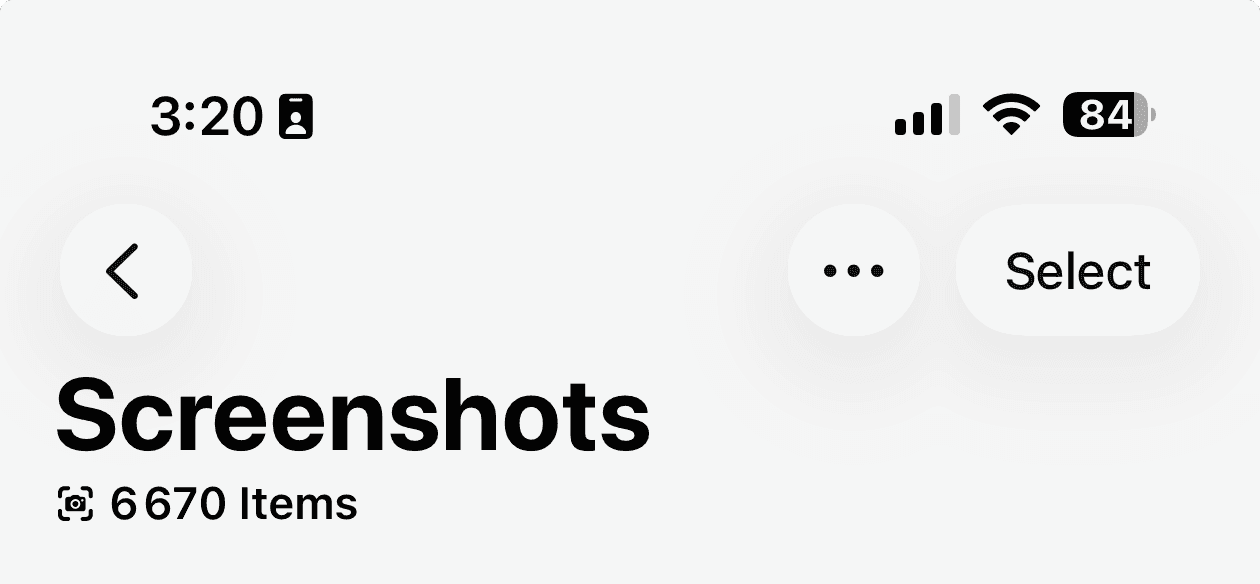
6,670. That’s how many screenshots I currently have on my phone. The pins on my Pinterest boards? My Instagram saves? Far too many, and never looked at again. And don’t even get me started on the apps I’ve installed that I don’t open even once a year.
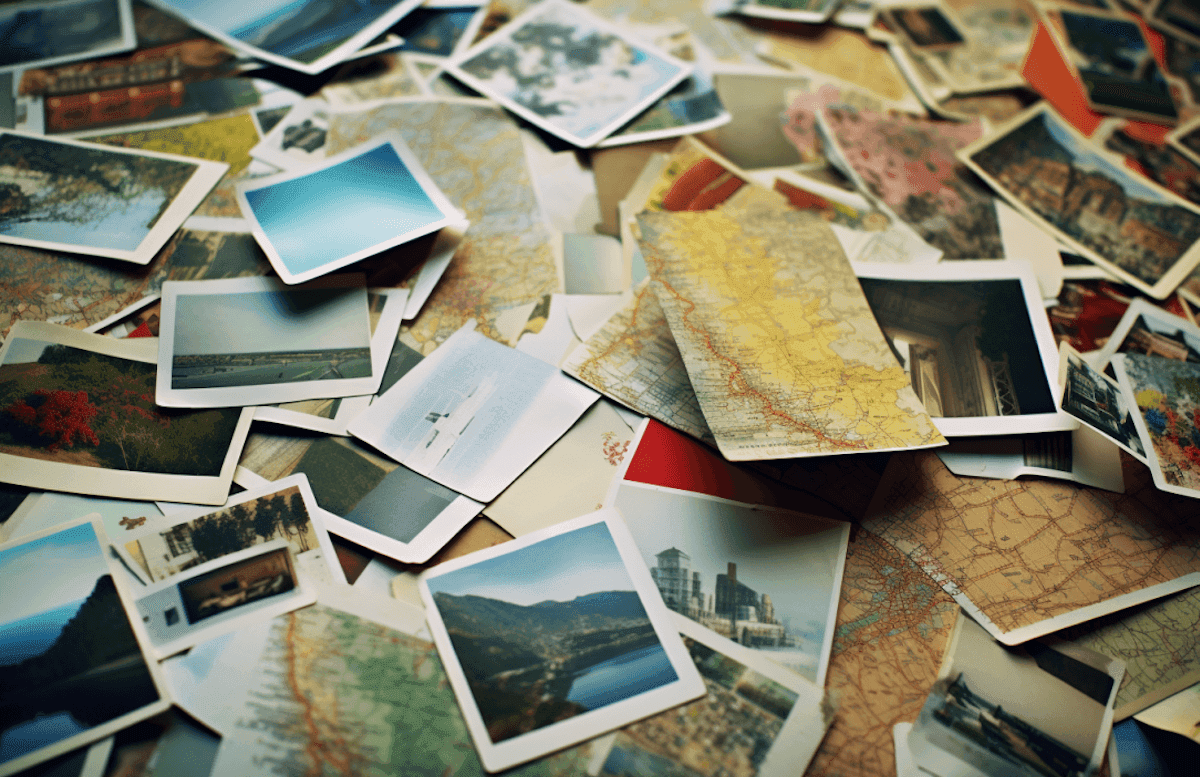
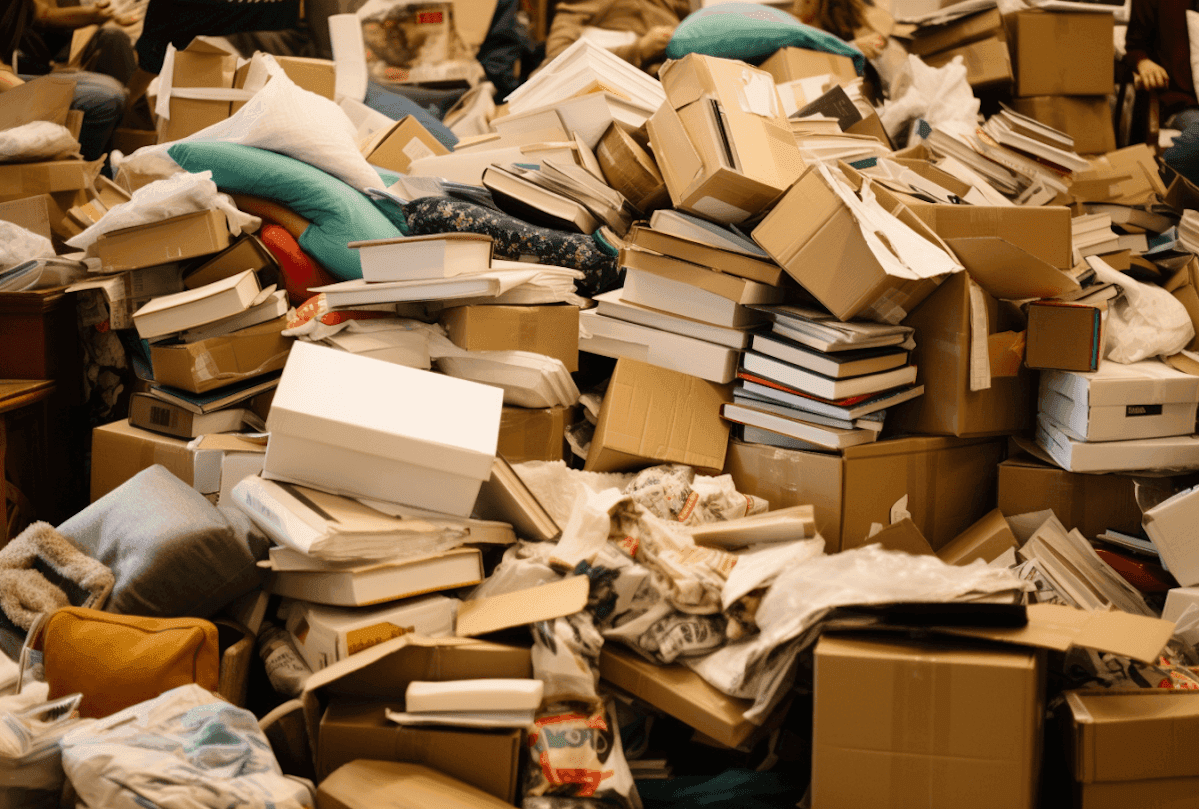
I keep everything. And yet, I never use any of it. When it comes to my phone, I’m practically a hoarder. I thought it was just me, until I stumbled across this study: Digital hoarding behaviours: Underlying motivations and potential negative consequences.
And you know what? I’m pretty sure I’m not alone. There’s even a name for this: digital hoarding. In other words, a lot of us seem to be collecting far more digital stuff than we know what to do with.
Today, we’re going to take a closer look at this phenomenon: what it is, what makes us do it, and, as always, what we can do about it. Because if we think it’s “really no big deal,” we might want to think again.
Whether you’re on the bus, curled up on the couch, or taking a coffee break, let’s spend a few minutes together making sense of the world we live in.
The little voice behind this article? That’s me, Laureline. I’m the designer at Jomo. For the past four years, we’ve been helping you reduce your screen time by building a great screen time app. As always, I wrote this article with my own two hands and my own little brain, and I sincerely hope you’ll find something useful in it for your everyday life.
“I’m Saving This for Later”: The Later That Never Comes
We’ve all been there. You come across something fun, interesting, or useful that you might need later. A tutorial, a recipe, a book recommendation, a handy tip. One tap, and there it is: saved.
Such a small gesture… repeated so many times. When that collecting becomes excessive, researchers talk about digital hoarding: accumulating or keeping large amounts of digital material.
What can make it problematic, and what interests researchers, is the combination of accumulating content and finding it difficult to delete it. And in the digital world, things can pile up very quickly:
Photos, especially several almost identical versions.
Screenshots you no longer remember taking.
Saved posts on Instagram, TikTok, or Pinterest.
Videos on a “Watch Later” list.
Articles, bookmarks, and tabs you can’t bring yourself to close.
Emails, conversations, notes, and old documents.
So where does this come from? Why do we do it?
The term itself isn’t new. It was already appearing in blogs and media coverage around 2011. But the first published clinical case appeared in 2015. It described a man who took over 1,000 photographs a day, kept very similar pictures, and spent three to five hours a day organizing them. This accumulation was interfering with his sleep and other activities.
Obviously, this was a severe case. Having 200 saved recipes doesn’t put you in the same situation as that patient. But his story raises an interesting question: when does keeping things start getting in our way?
Digital stuff has one unusual feature: you can accumulate enormous amounts of it without seeing the clutter around you. Files don’t spill out of your closet. Yet you may still need to find them, organize them, and decide what to keep. Because the pile stays out of sight, it can take longer to realize that it has become more than you can comfortably manage.
So, if I have 10,000 photos, do I have a problem?
Relax: that number alone doesn’t tell us anything. You’re allowed to love your memories, collect references, and keep documents. You don’t even have to look through your vacation photos every Sunday to justify their existence.
What deserves your attention is how much this accumulation affects your everyday life.
Why Do We Feel the Need to Keep Everything?
Every time, we have a good reason. This post could come in handy. That photo brings back a lovely memory. This video explains something interesting or shows us THE hack we absolutely have to try.
Taken individually, every save seems perfectly reasonable. So why does it always end up in a folder, board, or gallery we never open again?
The “Just in Case” Habit: “It Might Come in Handy One Day.”
We’ve all opened our saved posts intending to clear things out, only to delete almost nothing. And you know exactly why: it could come in handy. You never know. Better keep it.
That tiny doubt can bring the whole operation to a halt. You haven’t looked at that post in three years, but you can easily imagine the day you’ll need it… immediately after deleting it, obviously.
Researchers refer to anticipated regret: imagining how we might feel after making a decision. A 2024 study on digital hoarding and regret found an association between anticipated regret and digital hoarding. Keeping something lets us leave the question open. The decision can wait. So can the post.
The FOMO Habit: “I’ll Watch It Later.”
On social media, there’s always something that seems capable of improving our lives: a better way to work, an exercise to ease back pain, a new skill to learn. And when we see everything other people can do, we may feel like we should be getting started too.
So we save it. To learn, to improve, to make sure we don’t miss something important.
This is where FOMO, the fear of missing out, can come in. A study involving 927 young Chinese adults found links between comparing ourselves with others, FOMO, and digital hoarding. That doesn’t mean every save hides a problem, but the association helps explain some of our habits.
Think about your Pinterest board full of tutorials and hacks. It might contain a few projects you really care about… and plenty of ideas that interested you for about thirty seconds. In the moment, it isn’t always easy to tell the difference.
The Memory Habit: “I Don’t Want to Forget.”
Photos and messages are a different story. Their value can be deeply personal. A blurry picture, an ordinary conversation, or an old note might remind you of a person, a period of your life, or a past version of yourself.
Deleting something becomes an emotional decision. You know you have twenty almost identical photos, but each one seems to preserve a slightly different detail.
Researchers have observed this emotional attachment to digital possessions, particularly photos and videos.
And that attachment makes sense. Our phones hold pieces of our history, too. The thing is, quantity doesn’t guarantee quality. Keeping fragments of absolutely everything can sometimes feel counterproductive: the moments that really matter get lost among countless little snippets we may never revisit.
The “It’s Free” Habit: “Saving It Doesn’t Cost Anything.”
One tap, and it’s saved. You can get on with your day. Sorting things out takes more effort: opening, looking, comparing, choosing. Sometimes, you first need to work out why you saved something before you can decide what to do with it.
Available storage and the ease of keeping digital content are among the factors explored in digital hoarding research. They allow a collection to grow without requiring many decisions right away, and often with little immediate expense. Even when your iPhone fills up, a small monthly iCloud subscription can make it tempting to postpone the problem.
Imagine having to print every post you save. You’d probably think a little harder before adding another one to the pile. On your phone, that pile is much easier to ignore.
So What? It’s Not Taking Up Space in My Living Room.
True. Your bookmarks don’t stop you from opening the door, and nobody has to move your screenshots to sit on the couch. You can also have a large digital collection and feel perfectly happy with it.
But when it starts to overwhelm you, the cost can show up elsewhere.
Finding Things Becomes a Task of Its Own
You’re looking for a restaurant recommendation. You’re certain you saved it. But where? In your screenshots? Your Instagram saves? A conversation? A note?
You jump from one place to another, open a few other things along the way… and may end up searching for the recommendation all over again.
A study involving 167 participants found an association between stronger digital hoarding tendencies and difficulty finding information.
It’s pretty frustrating: you carefully saved something so you could find it easily later. Now your collection is making that harder.
“For Later” Can Start to Feel Like Homework
Take your saved pins. At first, they represent things you’re interested in. Then you reopen the list and think: “I still haven’t done any of this.”
The same goes for recipes, courses, or activity ideas. Everything you wanted to explore can gradually start looking like something you should already have done.
Of course, a folder isn’t giving you orders. But if you experience it as a list of overdue tasks, it can feel heavy. And you don’t have to turn every passing interest into a commitment. A video that makes you want to learn crochet doesn’t automatically enroll you in a six-month program.
Collecting Can Take the Place of Doing
Imagine you have half an hour to draw. You open Pinterest to find a reference. You spot one, then another, then an interesting technique. You create a board to organize everything.
The half hour is over. Your board looks very promising. Your page is still blank.
Looking for inspiration is part of the fun. But this example gives us a useful question to ask: does the time you spend preparing and collecting still leave room for the thing you wanted to do?
It’s a helpful way to look at your habits, without expecting yourself to make every minute productive.
Clearing Things Out Can Get Harder and Harder
When a collection feels enormous, it’s easy to put off dealing with it. And when you imagine deleting things, the doubts return: Is this important? Will I regret it? Should I check everything first?
Early research into digital hoarding described anxiety associated with accumulation and difficulty deleting content.
That can leave you in an uncomfortable position: wanting fewer things to manage while struggling to let go of what you already have. If that sounds familiar, you don’t need to start deleting ten years of memories tonight. You can begin taking back control through much smaller decisions.
So, How Do We Stop Accumulating Everything?
If you’ve started mentally counting your screenshots while reading this, hold off on deleting everything just yet. You’re allowed to keep memories, ideas, and things you enjoy. You don’t need to justify every photo of your cat.
But if you’re saving a lot, struggling to find anything, and starting to feel weighed down by it all, a few new habits might help.
Start Small
“This weekend, I’m sorting out my phone.” There’s a project that could easily end on Sunday evening with three photos deleted. In other words: probably not the best plan.
Choose one app or one category instead: your screenshots, your saved Instagram posts, or your computer’s Downloads folder. Give it ten minutes.
Start with things that don’t require much thought: duplicates, tickets for an event that’s already happened, or a screenshot of a schedule you no longer need. For everything else, ask yourself a simple question inspired by Marie Kondo’s approach: “If I keep this, do I know why?”
A memory you care about is a perfectly good answer. So is an important document. A vague “you never know” might deserve a few more seconds of thought.
You don’t have to finish today. The idea is to make sorting things out easy enough that you’ll want to do it again.
Need Motivation? Block Social Media Until You’ve Spent a Few Minutes Decluttering
We all know how this goes: we remember to organize our photos when our phone tells us the storage is full. Usually at the exact moment we want to take a picture.
What if clearing things out became a small habit instead?
With Jomo, you can create a routine that keeps social media blocked until you’ve spent a certain amount of time in another app. For example: spend five minutes in Photos before you can open TikTok. The idea is simple: use those few minutes to delete screenshots you no longer need, choose your favorite out of twelve almost identical pictures, or find that recipe you actually wanted to try.
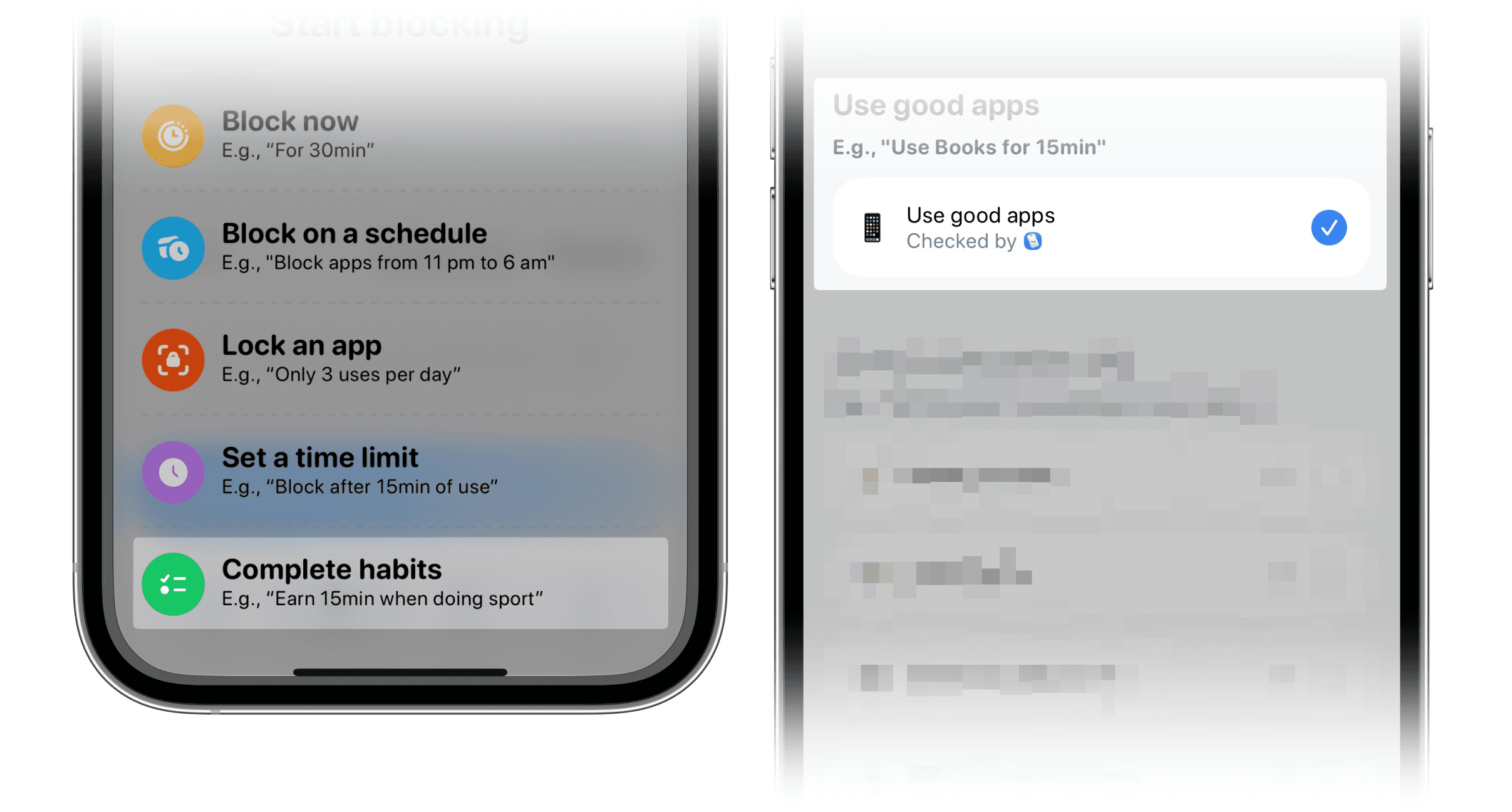
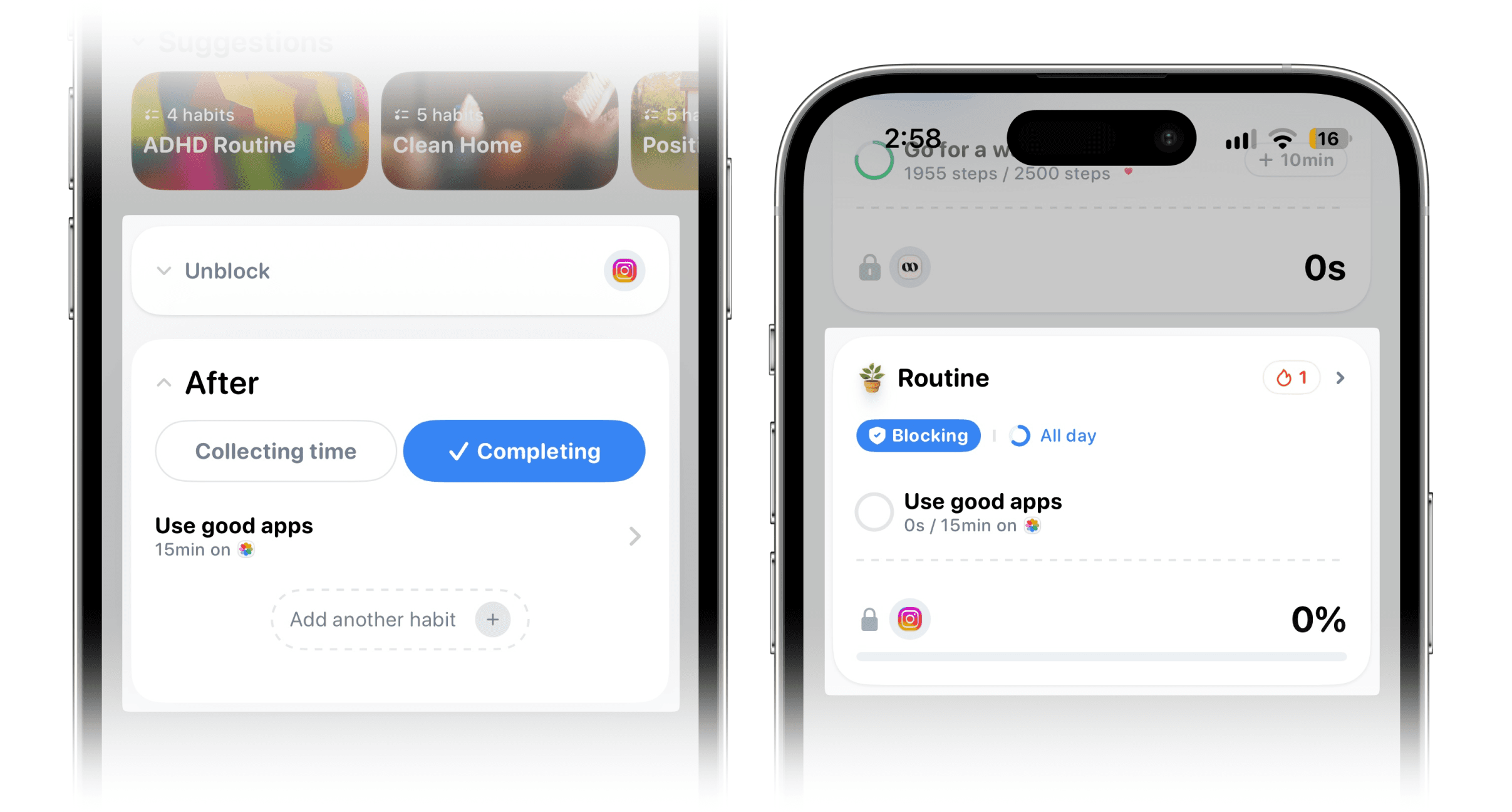
You choose how much time to spend and which apps become available afterward. Start with a duration that feels easy to stick to. Five minutes is already enough to tackle a small corner of your phone you’ve been putting off for months.
Of course, spending time in Photos doesn’t do the sorting for you. You still need to give those minutes a purpose: “Today, I’m going through this week’s screenshots.”
A specific task helps you get started without ending up browsing every vacation you’ve taken since 2018. Little by little, you create a regular moment to revisit what you’ve already saved. You might even rediscover things that deserved better than being forgotten at the bottom of your phone.
Give What You Save a Next Step
A saved recipe is a possibility. A recipe you’ve chosen for Thursday’s dinner is something you’re actually going to use.
Before you save your next piece of content, try to name what you want it for. Want to read that article? Pick a time. Try that exercise? Add it to your next workout. Buy that object? First, check whether it meets a need you had before seeing it.
Not everything that interests you needs to become an item on your to-do list.
You can admire a beautiful interior without planning to redecorate your living room. You can watch a pottery video without mentally signing up for a new hobby.
You could also try a small rule: revisit one idea you’ve already saved before adding ten more. You probably had a good reason for keeping it. You might as well give it a chance.
Protect Time to Enjoy Your Ideas
Let’s return to that drawing you wanted to make. You have the references, the tutorials, and the beginner tips. What’s mostly missing is a moment to sit down and start.
Choose one reference, get it ready, then start a Jomo blocking session for twenty or thirty minutes. You can select the distracting apps and websites you want to block and choose the duration, as explained on the Jomo features page.
Keep the resources you need for your activity accessible. The same approach works for cooking a recipe, reading an article, or trying an exercise you saved.
You don’t need to empty your entire collection. Start with one thing you really want to do today.
Art by Dona Mara.
Thank you for taking the time to read this article. I hope you enjoyed it! We now have more than 200 articles on this blog, and fresh ideas are getting a little harder to come by. So if there’s a topic you’d like us to cover, you can send it our way through this little form.
In the meantime, if you’d like to try Jomo Plus free for 14 days, you can use my referral code: FG2HA9.