Guide
6 min
How to Stop Using Your Phone as an Emotional Escape
If I'm addicted to my phone, it's partly because my real life isn't as interesting as my digital life. It's sad, but it's true for many of us today. And for good reason: compared to a world where you can do almost anything effortlessly, where everything is easier, more beautiful... real life can seem boring.

As a result, we no longer use our phones because we consciously choose to, but because they allow us to escape our dull daily lives. And that's the real problem!
Today, the goal is to understand why we turn to our phones so much that our digital life becomes more interesting than our "real" life. But more importantly, to find concrete solutions to this issue and how to remedy it simply.
But before we continue, it might be time for me to introduce myself! I’m Thomas, co-founder of Jomo. Over the last 4 years, I’ve spent most of my time thinking about screen time habits and building an app that’s used by more than 250,000 people.

Art by Ebrahim Vahidi
Why: 📱= ❤️🩹?
Today, you may have already experienced or felt it: there is a constant pressure to "succeed." To be "considered"—and I put that in big quotation marks—you must excel at all costs. Both in your personal and professional life. After enduring such pressure for so long, you seek a way to escape, to rest and catch your breath.
That's where our phones come into play. With this tiny device, you can escape so easily: between streaming services, games, or social networks. The journey can take us on for hours (and all this, with "almost" no effort).
But what we don't realize is that not only is this distraction temporary—it won't solve our problems—but it also gradually cuts us off from the world. The more we avoid it, the more distant we become.
The Illusion of Productivity
There's a mistaken belief that to be considered a productive person, you must accomplish countless tasks, preferably simultaneously, in a short period. Two things: this is false, and it's also physically impossible. Humans are not capable of multitasking, and scientific studies prove it.
But this comes from our lack of patience: we want everything to go fast, very fast. And this is particularly linked to... the phone. Because on this small screen we can: change content whenever we want, consume 15 at the same time, in ⏩️ 2 or ⏩️ 10! And we love it. This sensation of ultimate speed, of rapidity is... addictive. And so, the more we enjoy it, the more we want!
As a result, we use our phones and these technologies more, and our lives become ultra bland.
The Illusion of Perfection
Yes, real life is not controllable. Some mornings life decides we'll have a bad day, we'll look terrible and we just have to "deal with it." It's frustrating, but for some people, it has gone beyond frustration, becoming a real "haunting." Because yes, on the phone, we control our image, our life—or at least what we want people to think of our life. Between filters that enhance us and retouched photos of our environment, exaggerations of our professional missions, it's easy to be seduced by our digital life more than our real life...

IRL > Virtual
As you might guess, the next step will be to reverse this trend that has made our phone more important than our real life. So, let's break the ice right now: yes, it will require effort, but rest assured: the goal is to give you back your life! As always, we’ve read studies, books, and watched talks to find the best tips and tricks to simply apply to your daily life to take back control of YOUR life! So, let's go.
Appreciate the Imperfection
Life is not linear: it has its ups and downs. It's a bit like a rollercoaster; you need to create sensations, and for that, you need a bit of everything. If things are too... flat: we get bored. We'll seek to compensate or live some experiences vicariously (for example, through vlogs or lifestyle content).
Overstimulating: we quickly get used to it, pushing us to gradually increase the intensity of experiences (this is how we can put ourselves in danger unintentionally).
Perfect: we're not Sims, and controlling everything is not possible. It's mentally exhausting to constantly seek perfection, and at some point, it’s not impossible for the pressure cooker to overflow! Imperfection is what gives charm and depth to our experiences and life, more generally.
Learn to (Re)Appreciate Things
As you gradually reduce your screen time and reorient your priorities, you'll begin to notice a profound shift in your quality of life. Freed from the constant barrage of notifications and distractions, you'll find yourself more present, more engaged, and more alive than ever before. Rediscover the simple pleasures of life – the warmth of the sun on your face, the laughter of a child, the beauty of a sunset. Embrace the richness of human connection – the joy of meaningful conversation, the comfort of a hug, the support of a loving community. And above all, reclaim your inherent sense of worthiness and belonging, independent of external validation or digital distractions.
Art by Steph Meade
Reduce Your Screen Time
If you feel concerned, you probably have a significant amount of screen time on your phone. Even if time, as data, doesn't have real value, it's still important to manage it. For that, we can only recommend the Jomo app, available for free on iPhone, iPad, and Mac. You can simply block applications to reduce their usage, all without frustration.
"Dude I love it. The strict settings help me not be distracted at work & I can put limits on how late I can use the apps. It’s helped a lot in my effort to reduce overall screen time & idk maybe read books or look out of my window every once in a while" — from one of your users on the App Store.
With one tap, you regain control. No weird settings, profiles, or miraculous hacks. Just simple and effective blocking methods. For this article, we've prepared three models to reprogram on the Jomo app.
Screen Time Limit
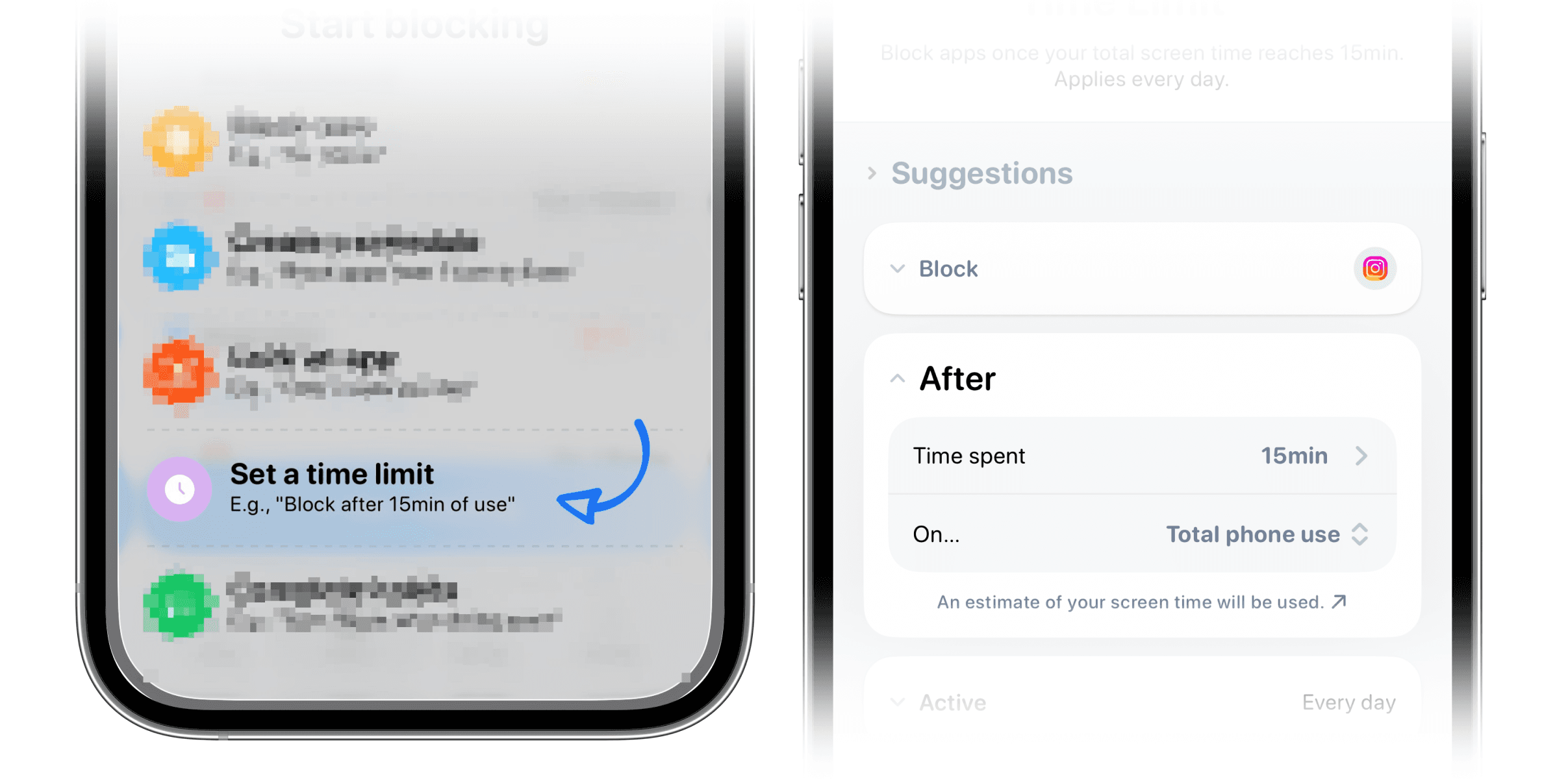
In the Rules section, tap the "+ Start blocking" > Set a time limit.
For "Time spent" choose "Total phone use."
Set your maximum screen time goal that you allow yourself and beyond which you want to block the apps!
For example, you can choose to block everything except essential apps (phone, messages, WhatsApp, etc.).

App Limit
The goal is to block an app after spending X minutes on it, a good way to avoid overusing it and resist the tempting call of their addictive designs.
Here, go to Rules > + Start blocking.
For Time spent, select "On apps"
Choose the app of your choice (if you select multiple apps, note that the time is cumulative and not per app)
Set the max time, and that's it!
Lock
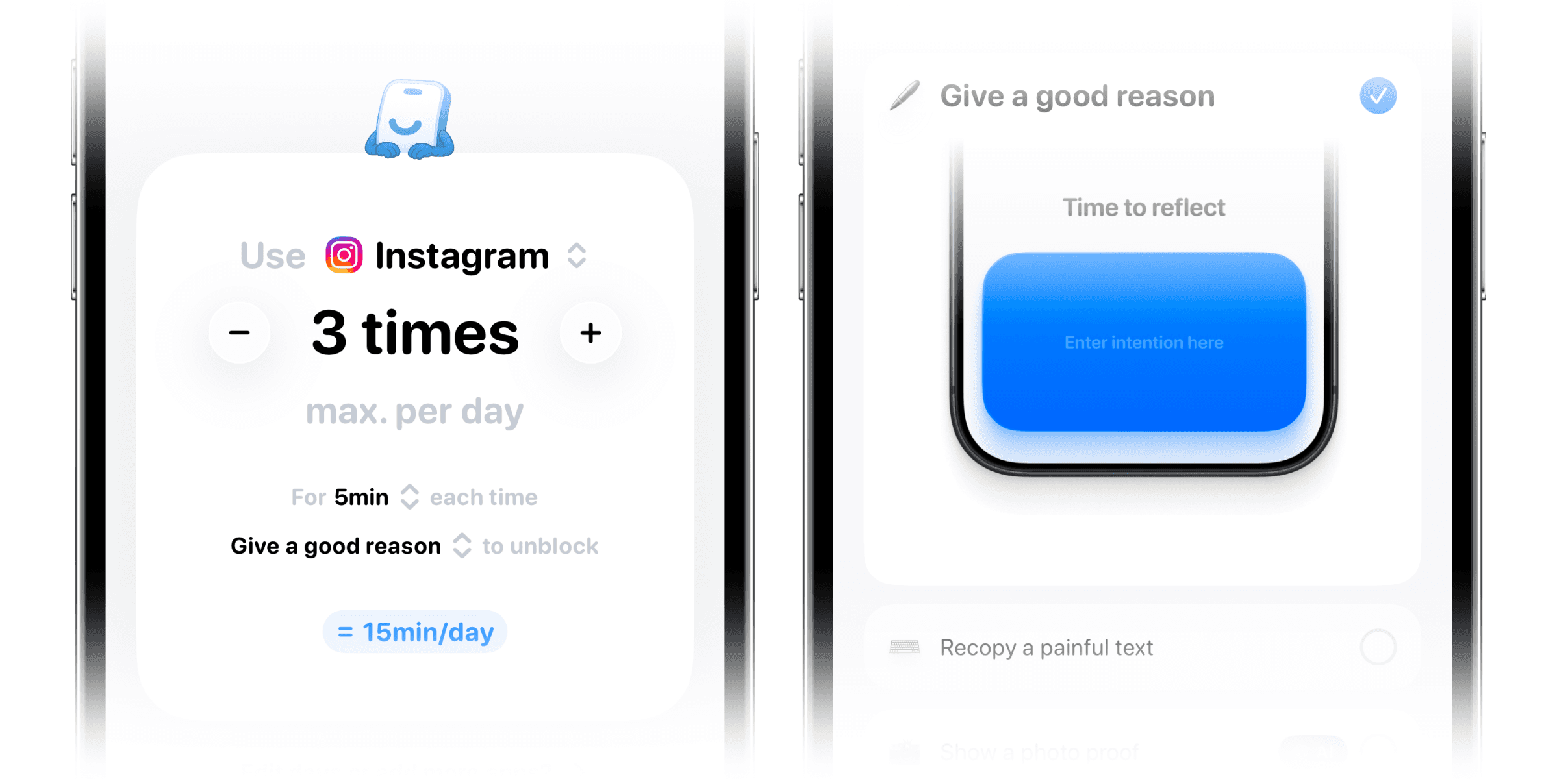
The "Lock" rule is an excellent way to become aware of each app opening. Blocked by default, you will need to ask Jomo for permission to use them, give a good reason for using them, and set a maximum duration. Once the time is up, it's blocked again.
To add the rule, go to Rules > + Start blocking > Set a lock.
Add your apps, a limited number of breaks, for example (or even a max duration).
Tap "Before each unlock" and select "Give a good reason".
And that's it, you're done!
To sum up, it's really not good to make your phone an emotional refuge. Yes, it may provide immediate relief, but remember that it will NOT solve your problems. So, next time everything goes wrong, why not try something else?