Understand
5 min
What Is Nomophobia? The Fear of Being Without Your Phone
When we talk about problematic phone use, it’s important to know that there are “levels.”

Meaning that for some people, using their phone too much is simply annoying in their life, while for others it becomes a huge blocking point that can seriously affect their quality of life.
And today, we’re going to talk about the ultimate level: nomophobia, aka the fear of having to live without your phone. On the menu 🥘, we’re going to unpack together what it is and how to detect it if you feel concerned, but above all, how to avoid this worst-case scenario.
But before going any further, let me introduce myself. The little voice talking to you is Laureline, designer and co-founder of Jomo. Since 2022, my days have been entirely dedicated to you, and my mission is simple: helping you take back control of your phone (and your time!). So if you need a little boost: download Jomo for free.
Nomophobia: What Are We Talking About?
Before going any further, we need to define the terms together, especially what is hiding behind this slightly medical-sounding word. Nomophobia, “no mobile phone phobia,” refers to the anxiety or fear felt when you lose access to your phone. Because it has no battery left, no signal, you forgot it at home, lost it, broke it, or it’s simply out of reach.
The first occurrences of this term date back to 2008, especially after the publication of a study showing that around 53% of respondents felt stressed when they lost access to their phone.
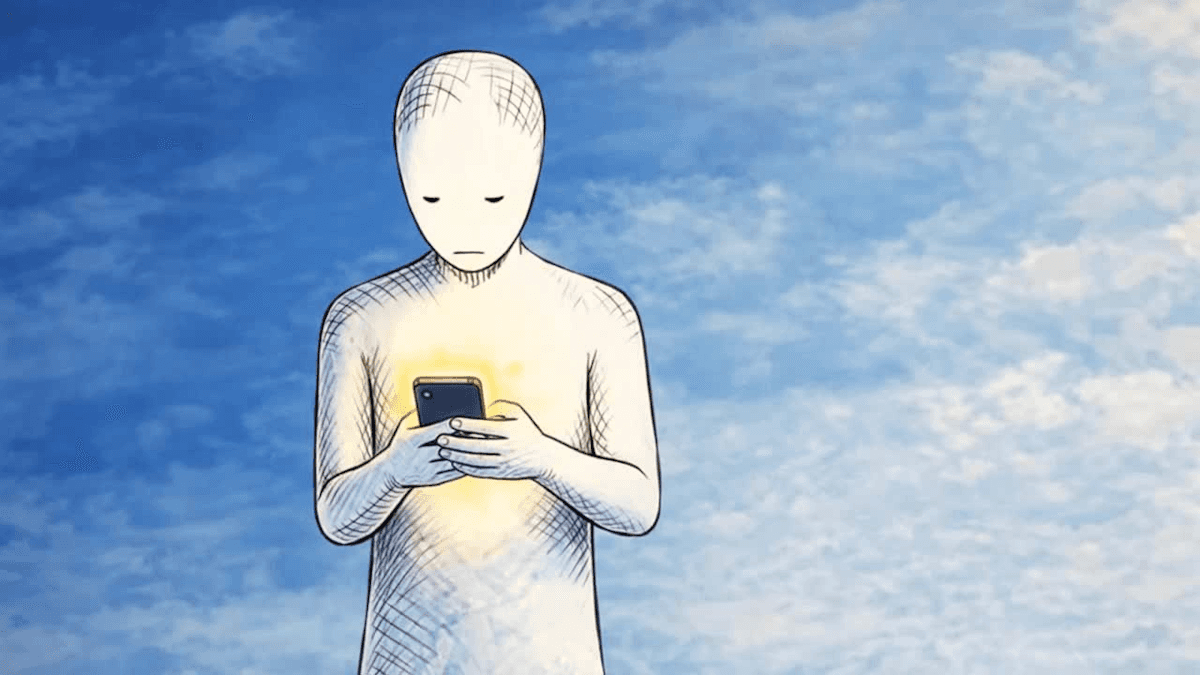
What you need to remember is that nomophobia isn’t “just being afraid” of not having your phone anymore, or “loving” your phone too much. It’s making its presence such a necessity that it almost becomes your only source of emotional security.
Art by Marti Cicardini
Nomophobia vs. Addiction: What’s the Difference?
First, nomophobia and addiction are two completely different things. You can be affected by one, the other, or both.
Addiction (even though smartphone addiction is not officially recognized by the WHO) can be summarized as an irresistible need to consume. People lose control, feel a compulsive need to check their phone, and have a lot of trouble stopping once they start using it. Concrete example: “I just want to scroll on Instagram for 2 minutes,” and 45 minutes later I’m still there.
Nomophobia is the fear of losing access. People are afraid of being separated from the object, of its absence, of feeling disconnected, and they quickly experience a strong feeling of insecurity when they no longer have their smartphone. Concrete example: my phone is at 2% battery, I immediately feel the stress rising, how am I going to manage? A panic attack may start.
Even though they are different, as we said earlier, they are not opposites. Quite the opposite, they often overlap. In science, researchers have identified two related, but not identical, phenomena.
You can be:
Very addicted to an app without panicking if your phone disappears;
Not very addicted, but very anxious if your phone disappears.
At What Point Can We Say We Are Affected by Nomophobia?
It’s important to note that nomophobia, just like addiction, is not officially recognized. However, the science is mature enough to outline a list of similar patterns between individuals.
Here Are the Main Patterns Observed:
Checking your phone “just in case.” Meaning looking at your phone for no specific reason: no notification, no real need, fully automatically, between two tasks.
Immediate stress when your lifeline is “compromised.” Meaning feeling stressed if the battery drops below 10%, when the signal gets weak, or if you no longer have online access. Some people may constantly carry several portable batteries with them.
Sleeping glued to your phone. It is very common for people to keep their phone under their ear (or next to them), on the bed, or directly in their hand. Most people keep it there so they can check it during the night.
Major difficulty doing activities without a phone. Being unable to go for a walk, exercise, go to the bathroom, cook, or even watch another screen (TV, for example) without your phone.
Feeling phantom vibrations. Many people say they feel their phone vibrate when it hasn’t. This phenomenon is called
phantom vibration syndrome. Through this symptom, we can clearly see that it affects our brain in a significant way.
Inability to tolerate emptiness. People can’t stand boredom, waiting, a floating moment, or an uncomfortable emotion. So they jump on their phone as an escape or as a tool for emotional avoidance.
How Do We Get There?
It’s a legitimate question to ask ourselves. It’s true: at what point can our relationship with this small portable device turn into such a problematic internal conflict?
The first answer is simple. This object has become much more than an object, and today it takes up a very important place in our daily lives: our GPS, our memory, our camera, calendar, social link, music, work, distraction, reassurance… It’s there for everything. So the brain ends up making a pretty simple association: phone = safety.
The second answer may be less obvious: apps. The apps we use today are over-optimized to capture every fraction of our attention, and for that, they need to push us to come back as much as possible. And for that, they have a pretty solid arsenal: notifications, variable rewards, messages, likes, infinite feeds, FOMO…

What Should You Do if You Think You Have Nomophobia?
Let’s start on a positive note: you don’t necessarily have to delete your phone. Unlike an addiction or a more “classic” phobia, wanting to completely remove the smartphone from your life is unrealistic. Sooner or later, it will come back.
The goal will mainly be to recreate distance, reduce automatic reflexes, and above all, relearn how to tolerate offline moments (without stimulation).
For that, we’ve prepared 5 solutions to put in place to help you take back control and avoid creating an unhealthy and stressful dependency on your smartphone.
Solution 1: Introduce More Friction
Actually, one of the major issues we have today is that the services we use have removed as much friction as possible from their experience. Everything is super smooth: in one tap, you access a continuous stream of ultra-stimulating videos and content. Not good at all.
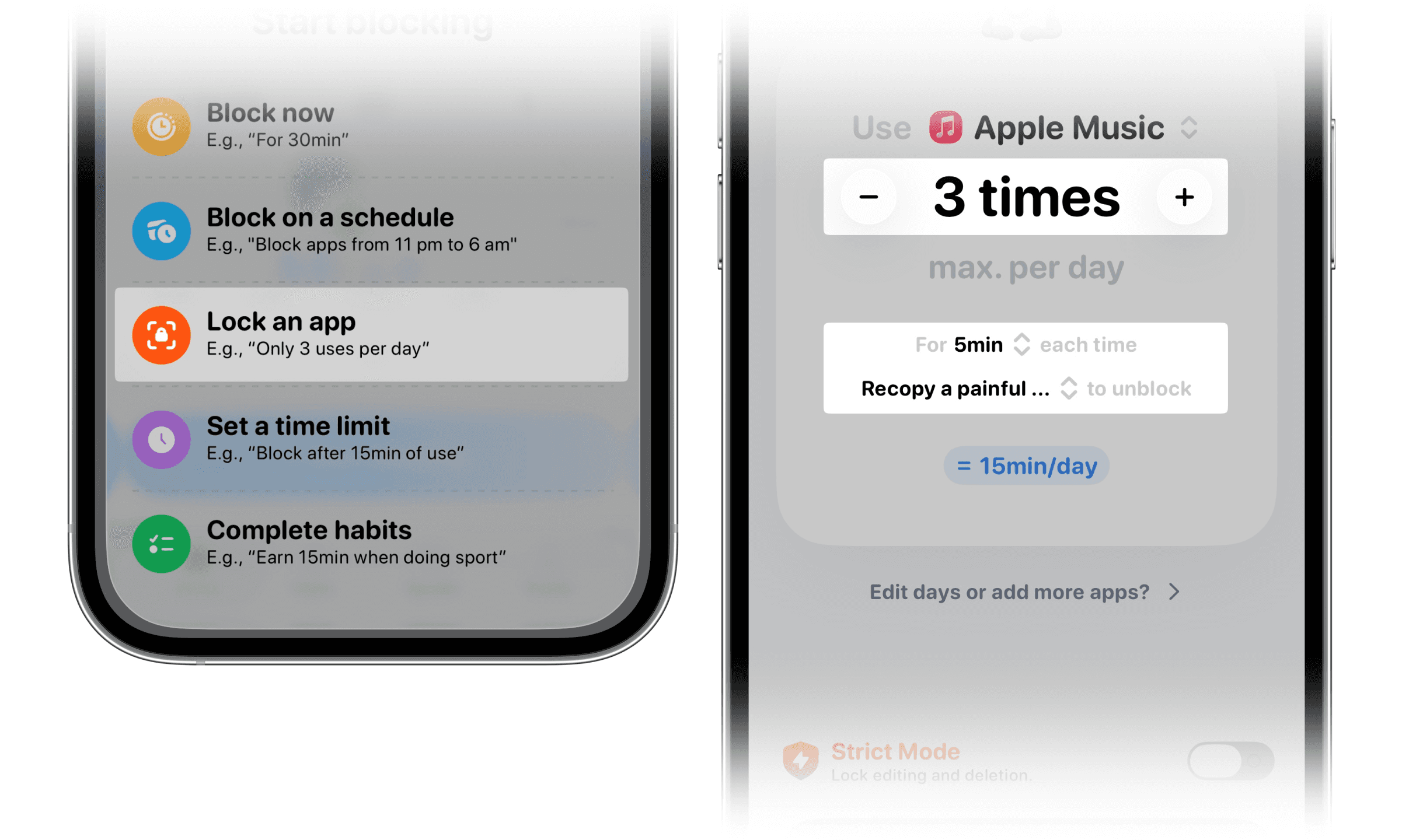
That’s why our first solution is to artificially add friction through an app called Jomo, available for free on iPhone, iPad, and Mac. What we’re going to do is block the most addictive apps by default. You’ll still be able to use them, but before that, you’ll have to unlock them through Jomo by completing an exercise and entering how long you want access for. Two important things: we short-circuit the brain in its action to break the reflex, and then we regulate the length of use.
Tap Start blocking ▸ Lock an app.
Choose an app.
For 5min: choose the desired duration (tip: 5 min).
Wait to unblock: choose the exercise you want (tip: Recopy a painful text).
Finish by tapping + Add.
Solution 2: Relearn Boredom
Yes, it sounds absurd when you put it like that, and yet it’s super important. It is possible to wait without a phone, walk without a podcast, stand in line at the supermarket without scrolling, take the bus without watching TikTok…
To everyone who tells me, “I’m going to look so weird, I can’t,” I answer: “who cares.” Truly. If someone judges you because you’re not scrolling, think about it: who is weirder, the person who gives 23 years of their life to looking at a screen, or the person who takes the time to live their life?
Solution 3: Create Phone-Free Zones
If you feel anxious at the idea of being separated from your phone, don’t start by going on a 5-hour hike without it. The work to do is more about creating repeated rituals in your daily life, easy ones at first, during which you force yourself to leave your phone away from you. And as you get used to it, you expand the time slots and increase the phone-free zones.
For this, you can:
Define phone-free zones. In this specific place, it’s forbidden, period. To help yourself, you can print small notes and stick them near the areas where you used to scroll (in bed, on the couch, in an armchair, in the bathroom…).
Block apps via Jomo based on your location. For example, at the café near your place, the phone is forbidden. Well, you can choose that when you arrive there, everything gets blocked, and when you leave, everything gets unblocked. You still have your phone, but it will be temporarily unavailable, in a way. We explain everything in this tutorial!

Art by Sofia
Solution 4: Replace Instead of Simply Deleting
The second-to-last step, and one of the most important, is to properly replace scrolling with something else, so you don’t give up at the slightest frustration. Because yes, the brain hates emptiness.
For that, you can create an “analog bag,” basically a bag where you keep plenty of simple, portable, anti-scroll activities that don’t depend on your smartphone:
An easy-to-read book
A small notebook and pencil
A camera (even better if it’s film)
An old-school iPod or MP3 player
A knitting kit
Solution 5: Observe and Analyze Yourself
We can’t change if we stay in denial. That’s why it’s super important to take a step back from our habits and identify what pushes us to use our smartphone so much. At first, it feels a little strange, but little by little, it can transform us.
Here’s how to do it in practice:
I pick up my phone, and I ask myself: why did I pick it up? Then comes the feeling: how did it make me feel? stressed, uncomfortable, bad, neutral, pretty good, really good, guilty. And to finish: if I had to do it again, I would… do it again with my eyes closed, not do it again, maybe do it but I should avoid it.
I used my phone, and I ask myself: was this activity really worth it? Was this time productive (useful and led to something tangible) or distracting (I got nothing out of it, nothing changed before vs. after)? And what did I get from this precious time?
For part 2, you can use the Jomo app, which has a journaling system built directly into the screen time report. A good way to keep an eye on your activities.
The Takeaway 🍔
The goal isn’t to become anti-technology and see the smartphone as the plague. Besides, science isn’t that black and white. Most researchers say smartphones aren’t bad. What’s problematic is automatic use, emotional and affective dependence, the inability to disconnect, and above all, the loss of control.
You can love tech without needing to be connected 24/7. That’s our case at Jomo! We have an iPhone, but its presence is very controlled so that it keeps its status as a simple “tool.”
Thank you for reading this far, it really means a lot to me. I wrote this article with my own little hands, my little brain, and my big heart. If you want to try the Premium version of Jomo, you can use my referral code FG2HA9 (it will give you a 14-day free trial).
See you next Monday 🫡